Comparison
Semaglutide, tirzepatide, retatrutide, mazdutide: the GLP-1 agonists compared
One, two or three receptors: what separates the latest generation of GLP-1 agonists, and what their trials do — and do not — allow anyone to compare.
Translated from the French original, which remains the reference version: lire en français →
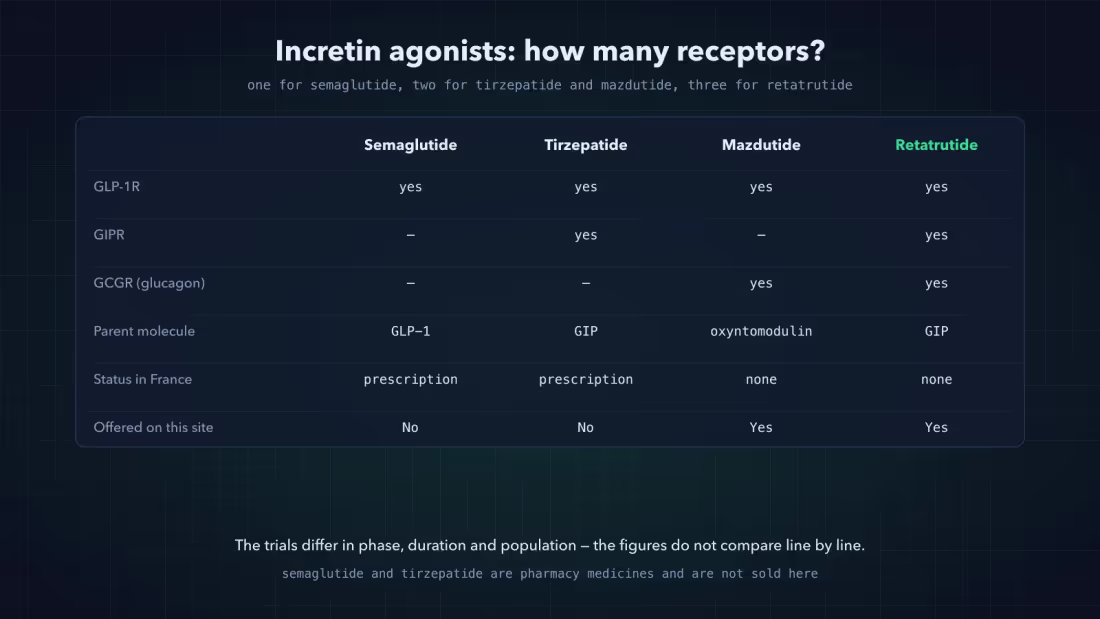
Over the past ten years or so, GLP-1 receptor agonists have gone from a single molecule to an entire class, organised by the number of receptors engaged. This comparison places the four most-cited compounds — semaglutide, tirzepatide, mazdutide and retatrutide — alongside cagrilintide, which follows a parallel route.
This dossier is informational. It contains no information on use.
Status on this site. Semaglutide and tirzepatide are authorised medicines, supplied exclusively by pharmacies on medical prescription. They are not offered on this site. Only retatrutide, mazdutide and cagrilintide, which hold no marketing authorisation in the European Union, appear here as reference materials for in-vitro research. See our article on the legal framework: pharmacy, prescription and research materials.
The overall picture
| Critère | Semaglutide | Tirzepatide | Mazdutide | Retatrutide |
|---|---|---|---|---|
| GLP-1R | Yes | Yes | Yes | Yes |
| GIPR | — | Yes | — | Yes |
| GCGR (glucagon) | — | — | Yes | Yes |
| Parent molecule | GLP-1 | GIP | Oxyntomodulin | GIP |
| Developer | Novo Nordisk | Eli Lilly | Eli Lilly / Innovent | Eli Lilly |
| Status in France | Prescription medicine | Prescription medicine | No authorisation | No authorisation |
| Offered on this site | No | No | Yes (research) | Yes (research) |
Semaglutide: the reference mono-agonist
Semaglutide is an analogue of human GLP-1. Two modifications make it durable: a substitution that protects it from DPP-4, and a fatty acid chain that binds it to albumin. It is the active substance of medicines marketed under the names Ozempic, Wegovy and Rybelsus.
Its pivotal trial in obesity, STEP 1, reports a mean weight reduction of about 15% at 68 weeks. The workings of the receptor it targets are detailed in the dossier on the GLP-1 receptor.
Tirzepatide: the GLP-1 / GIP dual agonist
Tirzepatide is built on the sequence of GIP, the other incretin, with added activity at the GLP-1 receptor. The two incretins act in physiological synergy. It is the active substance of the medicine marketed under the name Mounjaro.
Its pivotal trial in obesity, SURMOUNT-1, reports a mean weight reduction of about 20.9% at 72 weeks at the highest dose.
Mazdutide: the GLP-1 / glucagon dual agonist
Mazdutide takes another route. It draws on oxyntomodulin, an intestinal hormone that activates the GLP-1 and glucagon receptors. Glucagon agonism is associated with an increase in energy expenditure.
Its phase 3 trial GLORY-1, conducted in China, reports a mean weight reduction of 14.84% at 48 weeks at 6 mg. It has been authorised in China since June 2025. See the mazdutide dossier.
Retatrutide: the triple agonist
Retatrutide (LY3437943) brings together all three targets: GLP-1, GIP and glucagon. Its phase 2 trial in obesity, published in 2023, reports a mean weight reduction of about 24.2% at 48 weeks at the highest dose. It is in phase 3 and is not authorised in any country.
See the mechanistic dossier and the review of its clinical literature.
Cagrilintide: a parallel route, amylin
Cagrilintide is not a GLP-1 agonist. It is a long-acting analogue of amylin, a hormone co-secreted with insulin. It is studied alone and in combination with semaglutide, under the development name CagriSema. See the cagrilintide dossier.
Why the figures do not compare line by line
| Composé | Essai | Phase | Durée | Réduction moyenne rapportée |
|---|---|---|---|---|
| Sémaglutide | STEP 1 | 3 | 68 semaines | environ −15 % |
| Tirzépatide | SURMOUNT-1 | 3 | 72 semaines | environ −20,9 % |
| Mazdutide | GLORY-1 | 3 | 48 semaines | −14,84 % (6 mg) |
| Rétatrutide | Phase 2 obésité | 2 | 48 semaines | environ −24,2 % (12 mg) |
This table gathers published results. It is not a ranking:
- The phases differ. A phase 2 result in a few hundred participants does not carry the weight of a phase 3 trial.
- The durations differ. 48, 68 or 72 weeks: the same compound does not show the same figure depending on when it is measured.
- The populations differ. GLORY-1 was conducted in China, the other trials in predominantly Western populations.
- No trial directly compares these four compounds with one another.
What this page does not cover
This page compares neither individual clinical efficacy, nor tolerability, nor the choice of a treatment. Those questions are a matter for a doctor. Medicines of this class are obtainable only from a pharmacy, on prescription.
Analytical parameters
For a laboratory, these peptides share the same difficulties: masses of 4 to 5 kDa, a hydrophobic fatty acid chain, a tendency to adsorb. Their masses remain distinct: retatrutide 4731.4 g/mol, mazdutide 4476.0 g/mol, cagrilintide 4409.0 g/mol. Mass spectrometry is the decisive identity check. See our guide to reading an analysis report.
Frequently asked questions
What is the difference between semaglutide and tirzepatide?
Semaglutide engages a single receptor, that of GLP-1. Tirzepatide engages that of GIP as well.
What is the difference between tirzepatide and retatrutide?
Retatrutide adds the glucagon receptor to the two targets of tirzepatide. It is in phase 3 and is not authorised anywhere.
Can semaglutide or tirzepatide be bought on this site?
No. These are medicines supplied only by pharmacies on medical prescription. This site does not offer them.
Is mazdutide a triple agonist?
No. It engages the GLP-1 and glucagon receptors, but not that of GIP.
Which is the “most potent” GLP-1 agonist?
No trial directly compares these compounds. The published figures come from trials of different phases, durations and populations.
Further reading: Mazdutide: the dossier · GLP-1: receptor and agonists · Retatrutide: the clinical literature
Dossiers in the same category
- Rétatrutide — CAS 2381089-83-2
- Mazdutide — CAS 2259884-03-0
- Cagrilintide — CAS 1415456-99-3
References
- Wilding JPH, et al. Once-Weekly Semaglutide in Adults with Overweight or Obesity. N Engl J Med. 2021. PubMed
- Jastreboff AM, et al. Tirzepatide Once Weekly for the Treatment of Obesity. N Engl J Med. 2022. PubMed
- Ji L, et al. Once-Weekly Mazdutide in Chinese Adults with Obesity or Overweight. N Engl J Med. 2025. PubMed
- Jastreboff AM, et al. Triple-Hormone-Receptor Agonist Retatrutide for Obesity — A Phase 2 Trial. N Engl J Med. 2023. PubMed