Comparison
The "Wolverine stack": what BPC-157 + TB-500 actually is
A nickname from forums, not from the literature — and two peptides with nothing structural in common.
Translated from the French original, which remains the reference version: lire en français →
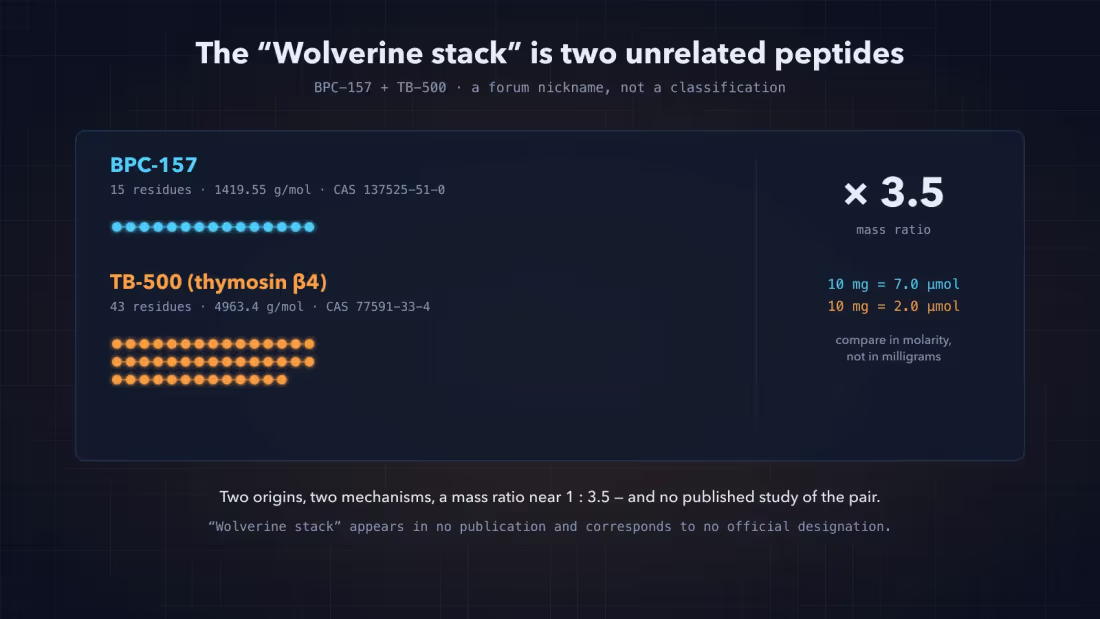
Search volume for “Wolverine stack” and “Wolverine peptide” runs into the tens of thousands a month, and almost none of it leads anywhere precise. The term is a nickname — a reference to a comic-book character’s healing — attached to the pairing of two research peptides, BPC-157 and TB-500.
This article explains what the two compounds actually are, where the name came from, and what can and cannot be said about the pair. It contains no information on use.
Where the name comes from
The term did not originate in the scientific literature. It appears in no publication, no pharmacopoeia and no regulatory text. It emerged in online discussion, and like most nicknames of that kind it describes an expectation rather than an observation.
That matters practically, not just pedantically. A name that exists only in forums cannot be looked up. Searching a database for “Wolverine stack” returns nothing, because the entity it names is not a chemical entity — it is two separate compounds that someone has decided to mention together.
The names that can be looked up are the two underlying ones: BPC-157 (CAS 137525-51-0) and thymosin β4 (CAS 77591-33-4), of which TB-500 is a derivative.
Two compounds with nothing in common
The pairing is usually presented as though the two were siblings. They are not. Our full BPC-157 and TB-500 comparison sets out the detail; the essentials are these.
| Critère | BPC-157 | TB-500 |
|---|---|---|
| Origin | Fragment of a protein from human gastric juice | Synthetic derivative of thymosin β4 |
| Length | 15 amino acids | 43 amino acids (complete Tβ4 sequence) |
| CAS number | 137525-51-0 | 77591-33-4 |
| Molecular mass | 1419.55 g/mol | 4963.4 g/mol |
| Studied mechanisms | Nitric oxide system, angiogenesis, cell migration | Actin binding, cell migration, angiogenesis |
| WADA list | Section S0 | Section S2 |
They differ in origin, in size by a factor of three and a half, and in the mechanisms the literature attributes to them. What they share is that both have been studied in models of tissue repair — which is the entire basis for the pairing.
The question nobody asks about a stack
Here is the problem with combination research generally, and it applies to this pair exactly as it applies to any other.
If an effect is observed after exposure to two compounds at once, that effect cannot be attributed to either one, or to their interaction, without control arms exposing the system to each compound alone. This is not a technicality — it is the difference between a result and an anecdote.
No published study examines BPC-157 and TB-500 together. The literature on each is separate, overwhelmingly preclinical, and in the case of BPC-157 heavily concentrated in a single research group in Zagreb. Pairing two bodies of work does not produce a third.
A rigorous experimental design therefore tests each compound separately before testing them together. Without those conditions, a blend produces an observation that cannot be assigned to anything.
What “stack” means analytically
For a laboratory, a blend raises three concrete issues that a single compound does not.
No single mass to confirm. A mixture has no molecular mass of its own. Identity is established per component, which means a report on a blend should show each constituent, not one figure.
Purity reads differently. The purity of a mixture is the purity of each constituent and the ratio between them. A single “≥99%” on a blend says less than the same figure on a defined peptide, and a report that does not break it down has not measured what it appears to claim. See our guide to reading an analysis report.
Molarity, not mass. With a mass ratio near 1 to 3.5, equal masses of the two contain very different numbers of molecules: 10 mg of BPC-157 is about 7.0 µmol, 10 mg of TB-500 about 2.0 µmol. Any comparison between them has to be made in molarity.
The blends in our catalogue
We supply the pairing as BPC-157 + TB-500, and two wider blends that contain both: GLOW (GHK-Cu, BPC-157, TB-500) and KLOW (KPV, GHK-Cu, BPC-157, TB-500). Our KLOW article covers the four-component blend.
These are supplied as analytical reference materials for in-vitro research. The separate components are available individually, which is what a design with per-component control arms requires.
Sport
Both compounds are prohibited for athletes subject to testing, and under different sections: BPC-157 under S0 (non-approved substances), thymosin β4 and its derivatives including TB-500 under S2. See our article on the WADA 2026 Prohibited List.
Is the Wolverine stack a real thing?
The pairing is real — the name is not. “Wolverine stack” is an informal term for BPC-157 combined with TB-500. It appears in no scientific publication and corresponds to no official designation.
What is in the Wolverine stack?
BPC-157, a 15-amino-acid fragment, and TB-500, derived from the 43-amino-acid protein thymosin β4.
Is there research on the two together?
No. The published work addresses each separately. Combining two separate literatures does not produce evidence about the pair.
Why are they studied together at all?
Because they are associated with the same biological process by two different described mechanisms, which is what makes a complementarity hypothesis worth testing — with per-component controls.
Further reading: BPC-157 vs TB-500: compared · KLOW: what is in the blend · How to read a peptide COA