Comparison
Copper peptides and cosmetic peptides: GHK-Cu, AHK-Cu and Snap-8 compared
Two copper peptides that carry a copper ion, and an octapeptide that carries none: what brings them together, and what separates them.
Translated from the French original, which remains the reference version: lire en français →
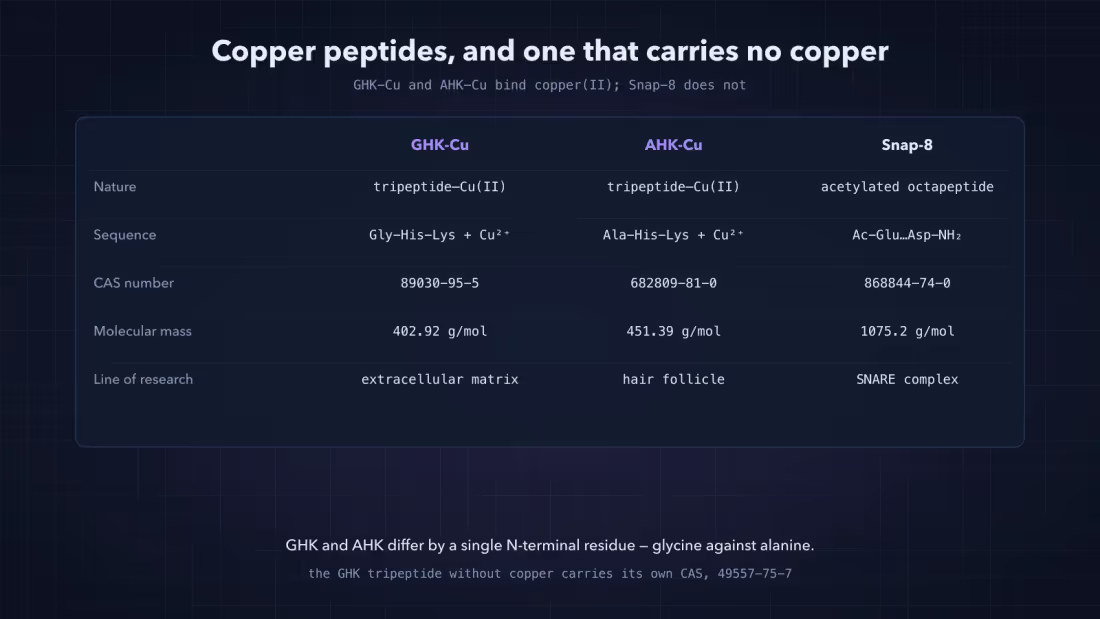
The term “copper peptide” has established itself in cosmetics and dermatological research. Strictly, it designates a small peptide able to bind a copper(II) ion and form a stable complex with it. In catalogues it often sits next to other skin-directed peptides that have nothing to do with copper.
This comparison sets two genuine copper peptides, GHK-Cu and AHK-Cu, against a cosmetic peptide of different structure, Snap-8. It contains no information on use.
In brief
| Critère | GHK-Cu | AHK-Cu | Snap-8 |
|---|---|---|---|
| Nature | Tripeptide–copper(II) complex | Tripeptide–copper(II) complex | Acetylated octapeptide, no copper |
| Sequence | Gly-His-Lys + Cu²⁺ | Ala-His-Lys + Cu²⁺ | Ac-Glu-Glu-Met-Gln-Arg-Arg-Ala-Asp-NH₂ |
| CAS number | 89030-95-5 (complex) | 682809-81-0 | 868844-74-0 |
| Formula | C₁₄H₂₃CuN₆O₄ | C₁₅H₂₄ClCuN₆O₄ (hydrochloride) | C₄₁H₇₀N₁₆O₁₆S |
| Molecular mass | 402.92 g/mol | 451.39 g/mol | 1075.2 g/mol |
| Line of research | Extracellular matrix, wound healing | Hair follicle, dermal papilla | Expression lines, SNARE complex |
Identifiers and masses: PubChem — GHK-Cu, GHK alone, AHK-Cu, Snap-8. The GHK tripeptide without copper carries a distinct number, 49557-75-7; it is the copper complex that carries 89030-95-5.
What “copper peptide” means
GHK and AHK share an architecture: three amino acids, including a central histidine, which form a complex of defined geometry with the copper(II) ion. They differ only in their first amino acid — glycine for one, alanine for the other.
That detail is enough to steer different lines of research. Copper itself is a cofactor of enzymes involved in tissue structure, such as lysyl oxidase, which takes part in the cross-linking of collagen and elastin: a peptide able to carry it and release it therefore attracted particular interest in skin biology.
GHK-Cu: the reference copper peptide
GHK was isolated in human plasma in the early 1970s, where it was identified as a factor favouring cell growth. Its copper form became the most studied and most used copper peptide in cosmetics, under the INCI name copper tripeptide-1.
The in-vitro work covers the synthesis of collagen and glycosaminoglycans by fibroblasts and the remodelling of the extracellular matrix. Our GHK-Cu dossier details those data and their limits.
AHK-Cu : l’orientation folliculaire
AHK-Cu has been studied mainly on dermal papilla cells, which regulate the growth of the hair follicle. In-vitro work has described a stimulation of their proliferation and a reduction of their apoptosis. Its literature is distinctly less abundant than that of GHK-Cu. See our AHK-Cu dossier.
Snap-8: an entirely different mechanism
Snap-8 — INCI name acetyl octapeptide-3 — contains no copper. It is an extension of Argireline (acetyl hexapeptide-3), to which it adds two amino acids, alanine and aspartate.
Its sequence mimics the end of the SNAP-25 protein, a component of the SNARE complex that allows the release of neurotransmitters at the neuromuscular junction. The hypothesis studied is an interference with the assembly of that complex, and therefore a lesser contraction of the muscles responsible for expression lines. It follows a “neuromodulatory” logic, unrelated to copper transport.
What the data does not establish
The literature on these three peptides is dominated by in-vitro work and by cosmetically oriented studies, often conducted or funded by ingredient manufacturers. Moving from an effect on isolated cells to an effect on a whole tissue also assumes that the molecule reaches its target, which depends on formulation and penetration — parameters that in-vitro studies do not test.
Mélanges
GHK-Cu is part of the composition of the research blends GLOW (GHK-Cu, BPC-157, TB-500) and KLOW (KPV, GHK-Cu, BPC-157, TB-500). All the references on this axis are gathered on the skin & beauty page.
Frequently asked questions
What is a copper peptide?
A small peptide able to bind a copper(II) ion and form a stable complex with it. GHK-Cu and AHK-Cu are the two most studied examples.
What is the difference between GHK-Cu and AHK-Cu?
A single amino acid: glycine for GHK, alanine for AHK. GHK-Cu is studied mainly on the extracellular matrix, AHK-Cu on the hair follicle.
Is Snap-8 a copper peptide?
No. Snap-8 is an acetylated octapeptide, without copper, whose sequence mimics part of the SNAP-25 protein. It is studied for its interference with the SNARE complex.
Why do GHK and GHK-Cu have two CAS numbers?
Because they are two chemical entities: the tripeptide alone (49557-75-7) and its complex with copper (89030-95-5).