Comparison
KLOW peptide: what is actually in the blend
Four compounds under one name — KPV, GHK-Cu, BPC-157 and TB-500 — and what a four-component mixture can and cannot establish.
Translated from the French original, which remains the reference version: lire en français →
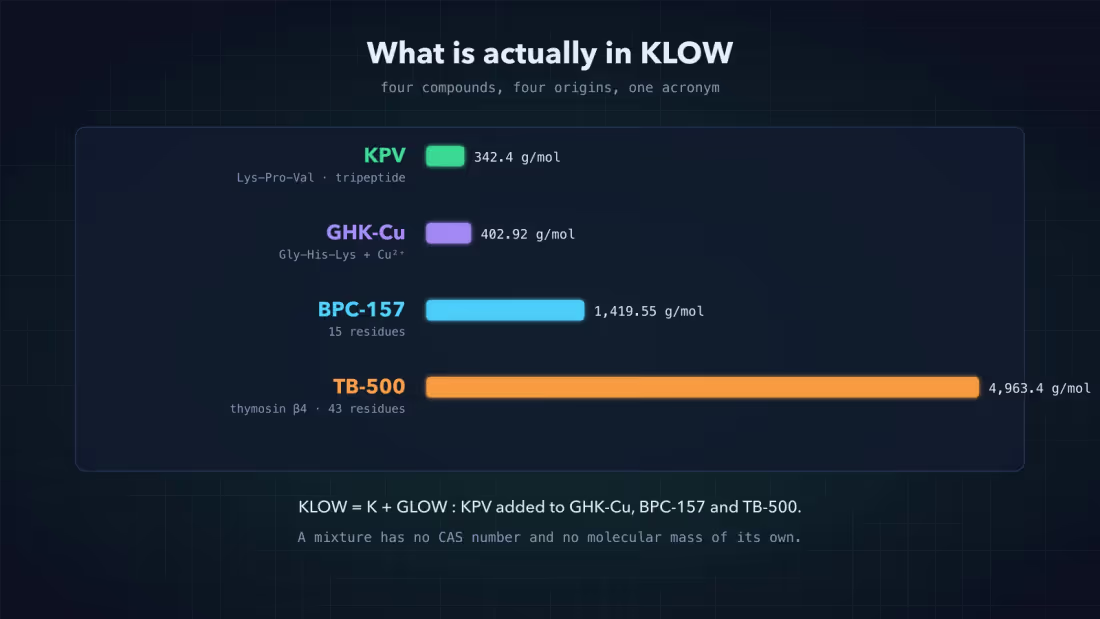
“KLOW peptide” is searched tens of thousands of times a month, and the first thing worth saying is that KLOW is not a peptide. It is a blend of four of them, sold under an acronym that describes its contents.
This article sets out what each component is, what the acronym means, and what follows analytically from buying four compounds in one vial. It contains no information on use.
What the letters mean
KLOW is built on an earlier blend, GLOW, with one component added:
| Letter | Component | What it is |
|---|---|---|
| K | KPV | Lys-Pro-Val, the C-terminal tripeptide of α-MSH |
| G | GHK-Cu | Gly-His-Lys complexed to copper(II) |
| L, O, W | — | From “GLOW”; the letters carry no component of their own |
| plus | BPC-157 | A 15-amino-acid fragment from gastric juice |
| plus | TB-500 | Derived from thymosin β4, 43 amino acids |
So GLOW is GHK-Cu + BPC-157 + TB-500, and KLOW is the same three with KPV added. Our GLOW vs KLOW comparison covers the choice between them.
The four components
These are not variations on a theme. They come from four unrelated places.
KPV is the final three residues of α-melanocyte-stimulating hormone. It is studied on the NF-κB pathway and is transported by PepT1, the intestinal di- and tripeptide transporter — a rare property that makes it one of the few peptides with a plausible oral route. See the KPV dossier.
GHK-Cu is a copper-carrying tripeptide isolated from human plasma in the 1970s, studied on collagen synthesis and extracellular matrix remodelling. Its copper is not incidental: it is the point. See the GHK-Cu dossier.
BPC-157 is a 15-residue fragment of a gastric juice protein, studied on angiogenesis and cell migration, with a literature concentrated in a single research group.
TB-500 derives from thymosin β4, a protein that binds monomeric actin and thereby regulates cell motility.
Four origins, four described mechanisms, one vial.
What a four-component blend costs you analytically
Every additional component multiplies the verification problem.
No CAS number, no molecular mass. A mixture is not a chemical entity. KLOW has neither a CAS number nor a molar mass of its own, and any source that assigns it one should be treated with caution. Its specification lists it as a composite for exactly that reason.
Purity means something different. For a defined peptide, purity is the main peak’s share of detected area. For a blend it is the purity of each constituent and the ratio between them. A chromatogram of KLOW shows at least four principal peaks; a single purity figure stated without a per-component breakdown has not measured what it appears to claim. See our guide to reading an analysis report.
One component’s constraints apply to the whole vial. GHK-Cu is a copper complex and coloured; the colour reflects complexation, not purity. BPC-157 and TB-500 differ in mass by a factor of 3.5. Storage conditions have to suit the most fragile constituent, not the average.
The attribution problem
This is the structural limit of any blend, and it is worth stating plainly because the commercial framing rarely does.
An effect observed in culture after exposure to four compounds cannot be attributed to any one of them, or to any interaction between them, without control arms exposing the system to each compound alone. With four components, a complete factorial design is fifteen conditions plus a control.
No published study examines this four-component combination as such. The literature addresses the components individually. Transposing it to the blend is hypothesis, not observation.
That is not an argument against blends — it is an argument for knowing what one is. A blend is convenient when the research question is about the combination. It is the wrong material when the question is about a component, and the individual references are available for exactly that reason.
Verifying a blend
Three checks, in order:
- Does the report list every component? Four constituents, four identifications. A report naming one is not a report on the blend.
- Does the lot number match the vial? A blend is synthesised and mixed in lots like anything else.
- Is there a quantitative content per component? The ratio between constituents is part of what you are buying, and it is the figure most often left out.
The reports for our catalogue are collected in the lot report register.
What is KLOW peptide?
A blend of four research compounds: KPV, GHK-Cu, BPC-157 and TB-500. It is not a single peptide and has no CAS number of its own.
What is the difference between KLOW and GLOW?
KPV. GLOW is GHK-Cu + BPC-157 + TB-500; KLOW adds KPV to those three.
Does KLOW have a molecular weight?
No. It is a mixture, so it has neither a single molecular mass nor a molecular formula.
Is there research on KLOW specifically?
No. The published work covers the four components separately. No study examines the combination as such.
Further reading: GLOW vs KLOW: which blend · The Wolverine stack explained · KPV: the dossier