Comparison
BPC-157 or TB-500: comparing two peptides studied in tissue repair
Two peptides often cited together, but with two origins, two sizes and two different studied mechanisms.
Translated from the French original, which remains the reference version: lire en français →
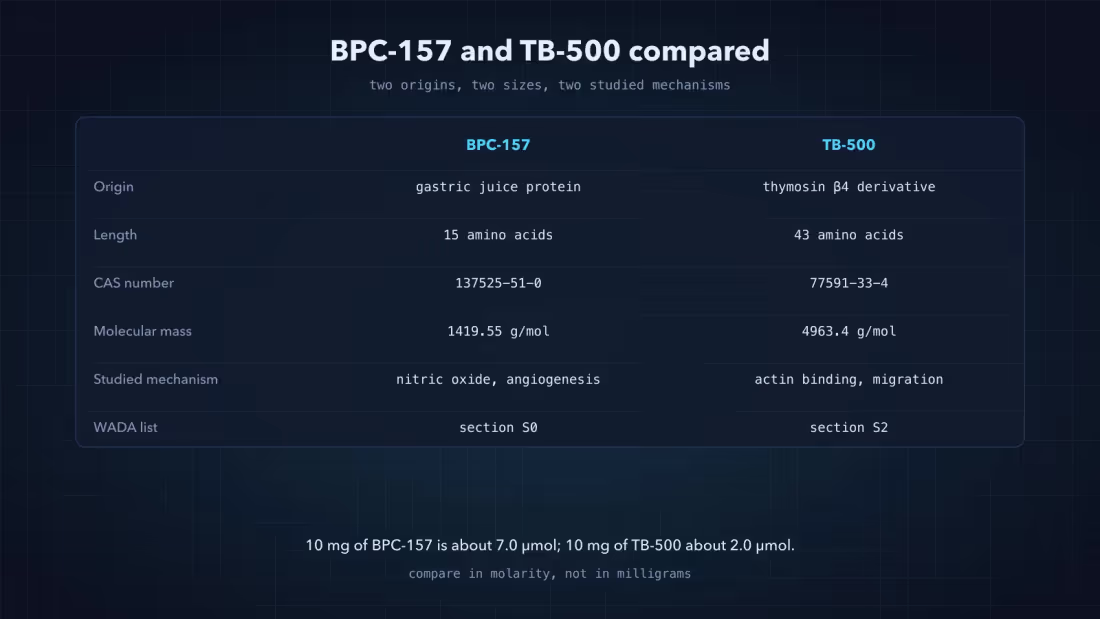
BPC-157 and TB-500 appear side by side so often — including in ready-made blends — that one ends up believing them related. They are not. Their origin, their size and the mechanisms the literature attributes to them differ profoundly.
This comparison summarises what is known about each, what is not known, and why researchers so often study them together. It contains no information on use in humans or animals.
In brief
| Critère | BPC-157 | TB-500 |
|---|---|---|
| Origin | Fragment of a protein from human gastric juice | Synthetic derivative of thymosin β4 |
| Length | 15 amino acids | Complete thymosin β4 sequence: 43 amino acids |
| CAS number | 137525-51-0 | 77591-33-4 (thymosin β4) |
| Molecular formula | C₆₂H₉₈N₁₆O₂₂ | C₂₁₂H₃₅₀N₅₆O₇₈S |
| Molecular mass | 1419.55 g/mol | 4963.4 g/mol |
| Studied mechanisms | Nitric oxide system, angiogenesis, cell migration | Actin binding, cell migration, angiogenesis |
| Principal models | Tendon, ligament, digestive mucosa, skin (rodents) | Cutaneous wound healing, cornea, cardiac tissue (preclinical) |
| WADA list | Section S0 | Section S2 |
The CAS, formula and mass values are those of the BPC-157 and TB-500 pages in our catalogue.
Two unrelated origins
BPC-157 — for Body Protection Compound — is a sequence of 15 amino acids, Gly-Glu-Pro-Pro-Pro-Gly-Lys-Pro-Ala-Asp-Asp-Ala-Gly-Leu-Val, derived from a protein isolated in human gastric juice. Most of its literature comes from a single research group, in Zagreb, which has been studying it since the 1990s.
TB-500 is a trade name, not a scientific one. It designates a synthetic peptide derived from thymosin β4 (Tβ4), a small protein present in most cells. Depending on the supplier, that name covers either the complete Tβ4 sequence or only its active fragment. The formula and mass of our reference (C₂₁₂H₃₅₀N₅₆O₇₈S, 4963.4 g/mol) correspond to the complete sequence.
This ambiguity in the name “TB-500” is the first thing to check with a supplier: the stated mass should make it possible to know which of the two materials is being bought.
What the literature attributes to them
BPC-157 : monoxyde d’azote, angiogenèse, migration
The published work describes interactions of BPC-157 with the nitric oxide system, a stimulation of angiogenesis associated with the VEGFR2 receptor, and an activation of the FAK–paxillin pathway involved in cell migration. These observations come from cell cultures and animal models. Our BPC-157 dossier details these pathways.
TB-500: actin sequestration
Thymosin β4 is known first as a protein that binds monomeric actin (G-actin). By regulating the availability of actin, it is involved in cell motility — a property at the heart of the wound-healing work. Research has also addressed angiogenesis and the repair of cardiac tissue in animal models. See our TB-500 dossier.
What the data does not establish
The two compounds share one limit: their literature is overwhelmingly preclinical.
- For BPC-157, published trials in humans are rare, and the concentration of the work within a single group makes the question of independent replication central.
- For TB-500, a substantial part of the data concerns complete thymosin β4. Transposing those results to a fragment assumes that the fragment retains the activity studied, which has to be demonstrated rather than presumed.
Neither of the two holds a marketing authorisation in France.
Why they are studied together
The interest in pairing them in research lies precisely in their differences: two distinct mechanisms, applied to the same biological process, make it possible to test hypotheses of complementarity. That is the idea behind the BPC-157 + TB-500 blend, and behind the wider GLOW (GHK-Cu, BPC-157, TB-500) and KLOW (KPV, GHK-Cu, BPC-157, TB-500) blends.
A rigorous experimental design nevertheless tests each compound separately before pairing them. Without those control conditions, an effect observed on the blend can be attributed neither to one, nor to the other, nor to their interaction.
Analytical considerations
The difference in size has practical consequences. With a mass ratio of nearly 1 to 3.5, the same mass of powder does not contain anything like the same number of molecules: 10 mg of BPC-157 represents about 7.0 µmol, against about 2.0 µmol for 10 mg of TB-500. Any comparison of concentrations must therefore be made in molarity, not in milligrams.
Identity is verified by mass spectrometry: the measured mass must correspond to 1419.55 g/mol for one and 4963.4 g/mol for the other. Both are reconstituted by the same method, described in our reconstitution guide.
Frequently asked questions
What is the difference between BPC-157 and TB-500?
BPC-157 is a 15-amino-acid fragment from a gastric juice protein; TB-500 derives from thymosin β4, a 43-amino-acid protein that binds actin. Their studied mechanisms are distinct.
Which is the more studied?
Thymosin β4 has an older and more diversified literature, including clinical trials on the complete protein. BPC-157 has numerous publications, but mostly preclinical and from a single group.
Can the two be reconstituted in the same vial?
The stability of a blend in solution depends on both compounds and is not documented in a general way. For a controlled experiment, separate vials allow each concentration to be mastered; the BPC-157 + TB-500 blend exists for the protocols that require it.
Are these peptides prohibited for athletes?
Yes. BPC-157 appears in section S0 and thymosin β4, including TB-500, in section S2 of the World Anti-Doping Agency prohibited list.