Laboratory guide
Reconstituting a research peptide: calculation, solvent and storage
The complete method for going from a lyophilised vial to a solution of known concentration, in the laboratory.
Translated from the French original, which remains the reference version: lire en français →
A peptide reference material arrives as a lyophilisate: a white powder, sometimes a barely visible film at the bottom of the vial. In that form it is stable for months. It is not usable, however: any in-vitro analytical work requires a solution of known concentration.
The operation that takes you from one to the other is called reconstitution. It calls for no particular equipment and no rare skill, but it rests on a calculation that is got wrong surprisingly often — and an arithmetic error at this stage propagates into absolutely everything that follows.
This guide describes the method. It contains no administration protocol, no dosage and no recommendation for use: the materials in question are intended exclusively for in-vitro laboratory research.
What “reconstitute” means exactly
Lyophilisation removes the water from a solution by sublimation, at low temperature and under vacuum. The peptide stays, the water leaves. What remains at the bottom of the vial is the peptide itself, plus any lyophilisation excipients (often mannitol or an acetate buffer).
Reconstituting consists of reintroducing a measured volume of solvent to redissolve that powder. Two things are worth noting straight away, because they govern the whole calculation:
The mass of peptide does not change. A 10 mg vial contains 10 mg of peptide, whether you add 1 mL or 5 mL of solvent. You are not diluting a substance already in solution — you are putting a fixed mass into solution.
The volume is yours to decide. There is no “right” volume imposed by the product. The volume determines the concentration obtained, and therefore how finely you will be able to draw from it afterwards.
From these two facts follows the whole arithmetic of reconstitution.
The calculation: mass ÷ volume
The formula fits on one line:
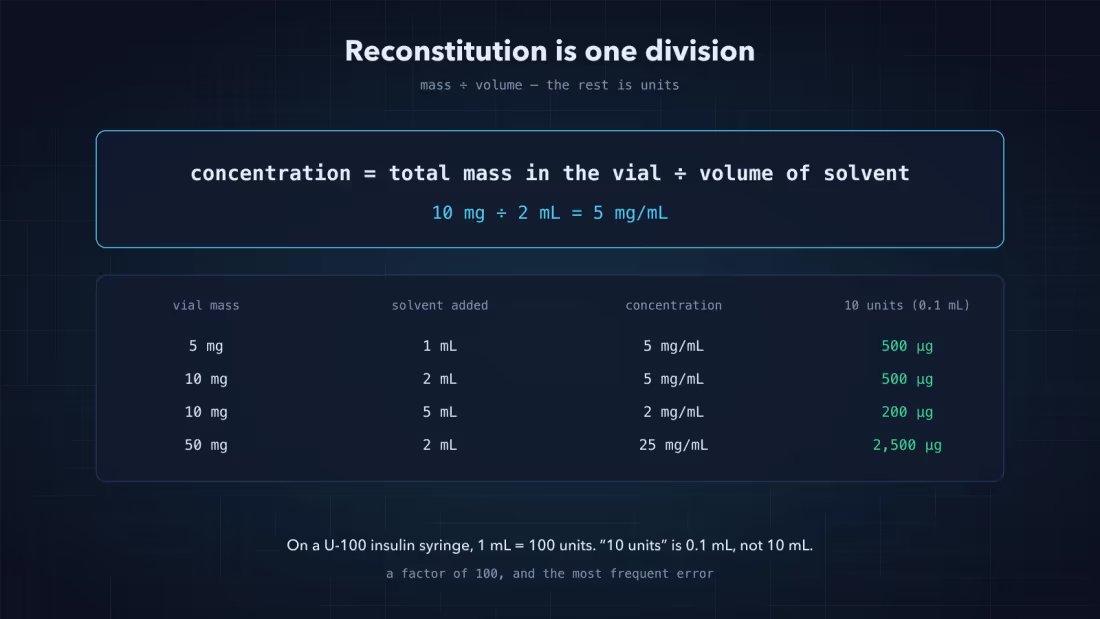
Concentration = total mass in the vial ÷ volume of solvent added
If you add 2 mL of bacteriostatic water to a 10 mg vial, you get 10 ÷ 2 = 5 mg/mL. That is all. There is no second step, no correction factor, no hidden constant.
The difficulty is not the formula, it is the units. Vials are labelled in milligrams, syringes are graduated in units or millilitres, and the literature often speaks in micrograms. Three scales for a single calculation, which leaves ample room for a misplaced factor of 1,000.
Units, recalled
| Unit | Equivalent | Common use |
|---|---|---|
| 1 g | 1,000 mg | Rare on vials |
| 1 mg | 1,000 µg (mcg) | Vial labelling |
| 1 mL | 100 units (U-100 insulin syringe) | Syringe graduation |
| 1 mL | 1 cc | Older notation, identical to the mL |
The line to remember is the third: on a standard U-100 insulin syringe, 1 mL = 100 units. A 0.5 mL syringe is therefore graduated from 0 to 50 units. It is the conversion that causes trouble most often, because it is implicit: nothing is printed on the syringe to recall it.
Exemples chiffrés
The results below can be checked by hand. Each row applies the same division.
| Vial mass | Solvent added | Concentration | Content of 10 units (0.1 mL) |
|---|---|---|---|
| 5 mg | 1 mL | 5 mg/mL | 500 µg |
| 5 mg | 2 mL | 2.5 mg/mL | 250 µg |
| 10 mg | 1 mL | 10 mg/mL | 1,000 µg |
| 10 mg | 2 mL | 5 mg/mL | 500 µg |
| 10 mg | 5 mL | 2 mg/mL | 200 µg |
| 50 mg | 2 mL | 25 mg/mL | 2,500 µg |
| 1,000 mg | 10 mL | 100 mg/mL | 10,000 µg |
The last column follows from the third: 10 units are 0.1 mL, hence one tenth of the concentration per millilitre. At 5 mg/mL, 0.1 mL contains 0.5 mg, that is 500 µg.
Our reconstitution calculator performs this division and this conversion automatically. It does nothing else — deliberately: this is arithmetic, and arithmetic should stay checkable.
Choosing the volume rather than inheriting it
Since the volume is free, it may as well be chosen according to the drawing precision wanted.
A small volume gives a concentrated solution: little solvent to store, but each unit drawn contains a great deal of material, and the relative error on a small withdrawal becomes significant. A large volume gives a dilute solution: withdrawals are larger and therefore more precise, but the vial may not physically hold the volume wanted.
In practice, a 2 mL vial cannot take 5 mL. Check the capacity of the vial before fixing the volume — it is a material constraint, not a parameter.
Choosing the solvent
The choice of solvent is not neutral: it determines how long the solution remains usable.
Eau bactériostatique
Bacteriostatic water is water for injections with about 0.9% benzyl alcohol added. That bacteriostatic agent inhibits microbial proliferation, which allows multiple withdrawals from the same vial over an extended period.
It is the reference solvent for the majority of lyophilised peptides, precisely because most vials are meant to be opened several times. A multi-withdrawal vial reconstituted in sterile water has no protection at all once the septum has first been broken.
Benzyl alcohol has a counterpart: it is slightly acidic and can, for a small number of sensitive sequences, accelerate degradation. The product page states the appropriate solvent where this applies.
Sterile water for injections
Sterile water contains no preservative. It suits vials intended for single and immediate use, or peptides explicitly incompatible with benzyl alcohol.
Its limit is obvious: once the septum is pierced, nothing inhibits microbial growth any longer. A solution prepared in sterile water should be treated as usable over a short window.
Acide acétique dilué
A few peptides that are very poorly soluble in neutral media — certain hydrophobic fragments in particular — dissolve properly only in slightly acidic conditions. A 0.6% acetic acid solution is the classical vehicle in that case.
This is not a default choice. It applies only where the compound’s technical sheet mentions it.
Tableau comparatif
| Solvent | Preservative | Multiple withdrawals | Use case |
|---|---|---|---|
| Bacteriostatic water | Benzyl alcohol 0.9% | Yes | Default solvent for most lyophilisates |
| Sterile water for injections | None | No | Single use, incompatibility with benzyl alcohol |
| Acetic acid 0.6% | None | No | Peptides poorly soluble in neutral media |
The equipment
The list is short:
- A graduated syringe suited to the volume to be transferred. A 0.5 mL / 30G insulin syringe offers graduation to the unit, that is 0.01 mL.
- The solvent, in its original vial.
- Alcohol swabs, to disinfect both septa before each puncture.
- A storage support at controlled temperature.
For repeated handling, a refillable precision pen combined with borosilicate vials allows finer withdrawal than a conventional syringe. These are ordinary laboratory consumables.
Méthode
- Let both vials come back to room temperature. A lyophilisate taken out of the freezer and opened immediately condenses ambient moisture onto its surface.
- Disinfect both septa with an alcohol swab and let them dry.
- Draw the volume of solvent decided in the calculation, purging the air from the syringe.
- Insert the needle into the lyophilisate vial at an angle, so that the solvent runs down the inner wall. Never direct the jet straight onto the powder: peptides are fragile molecules and a direct jet can shear the chain.
- Let it dissolve without agitation. Dissolution is generally complete within a few minutes. If particles persist, roll the vial gently between the fingers.
- Never shake. Vigorous agitation denatures peptides and makes the solution foam.
- Inspect. The solution should be clear and colourless. Persistent cloudiness, a precipitate or a colour signals a problem of dissolution or of solvent compatibility.
- Label with the compound, the concentration obtained and the date of reconstitution. This step is systematically neglected and systematically regretted.
Erreurs fréquentes
Confusing units with millilitres. The dominant error. “10 units” is not “10 mL” but 0.1 mL — a factor of 100.
Losing a factor of 1,000 between mg and µg. A 5 mg vial contains 5,000 µg. A concentration of 2 mg/mL is 2,000 µg/mL.
Believing that more solvent means more product. Adding solvent only dilutes a constant mass. The 10 mg vial contains 10 mg, whatever volume is added.
Trying to put 3 mL into a 2 mL vial. The calculation is correct, the operation is impossible. Check the capacity.
Not labelling. Three clear, colourless vials on the same shelf are indistinguishable after a week.
Storage after reconstitution
The lyophilisate and the solution do not have anything like the same stability.
| State | Temperature | Order of magnitude |
|---|---|---|
| Lyophilised, unopened | −20 °C, away from light | Up to 24 months |
| Lyophilised, unopened | 2–8 °C | Several weeks |
| Reconstituted | 2–8 °C | A few weeks |
| Reconstituted | Room temperature | To be avoided |
These orders of magnitude are indicative and depend on the compound: each reference’s page states its own stability parameters, and that is what governs.
Three rules apply whatever the compound. Protect from light, since several peptides are photosensitive. Avoid repeated freeze-thaw cycles, each of which degrades a fraction of the material — hence the value of aliquoting if spaced-out withdrawals are planned. Do not refreeze a solution that has already been thawed.
Checking the vial before reconstituting it
A step that logically comes before everything above: knowing what the vial contains.
A concentration calculation starts from the mass printed on the label and implicitly assumes two things — that the vial does contain that mass, and that the material is indeed the compound stated. Neither assumption can be verified by eye. A lyophilisate is a white powder, and all white powders look alike.
That is what a lot analysis report documents. On this site, Janoshik Analytical reports are shown on the product pages, for the strength they analyse, and can be consulted before purchase. These reports cover the identity and the purity of the peptide, determined by HPLC and mass spectrometry. They do not cover sterility or endotoxins, which are not part of the analysis — and we do not claim otherwise.
The lot report register lists all the Janoshik reports on file.
Frequently asked questions
How much solvent should be added? The volume you choose. It is not imposed by the product: it determines the concentration obtained. The only constraint — it must fit in the vial.
Can tap water or distilled water be used? No. Neither is sterile. The solvent must be bacteriostatic water or sterile water for injections.
What should be done if the powder does not dissolve? Let it stand and roll the vial gently. If a precipitate persists, the solvent is probably not suited to the compound: check the technical sheet.
Why not shake? Mechanical agitation denatures peptides and makes the solution foam. Dissolution happens on its own.
Does the concentration change over time? The nominal concentration does not, the intact material does. Degradation progressively reduces the fraction of undegraded peptide, without changing the volume.
Further reading: Storing lyophilised peptides