Laboratory guide
EC50, half-life, bioavailability, proteolysis: a peptide's parameters explained
The four concepts found throughout the peptide literature, defined simply: potency, duration, available fraction and enzymatic degradation.
Translated from the French original, which remains the reference version: lire en français →
These terms recur in every publication cited by our dossiers. This guide defines them once, so that a research paper can be read without a glossary open alongside.
EC50 : définition
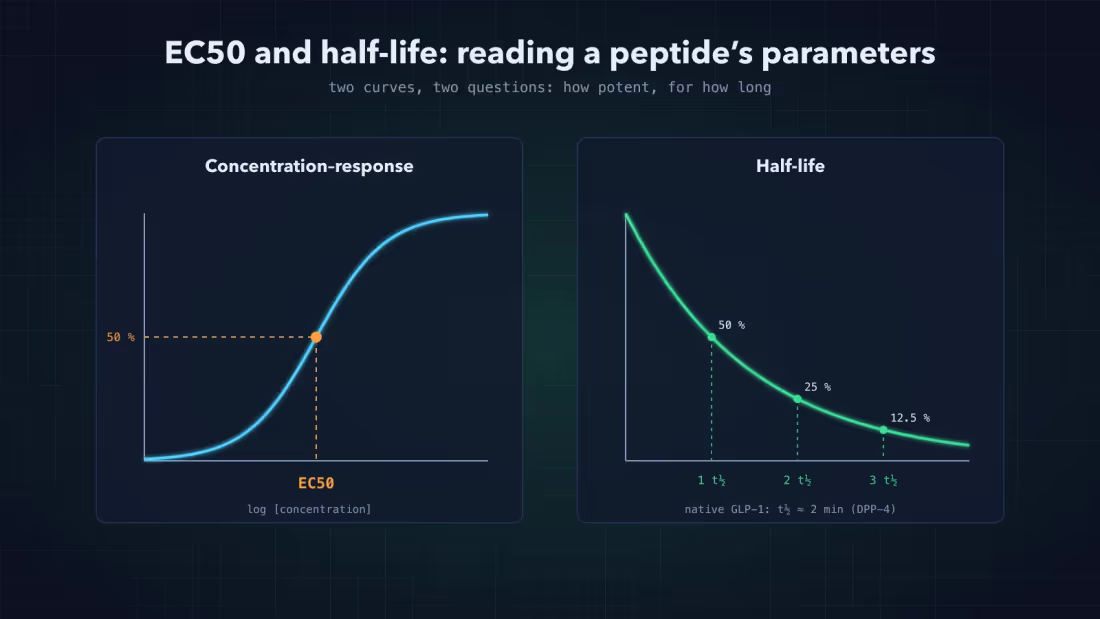
EC50 (half maximal effective concentration) is the concentration of a molecule that produces 50% of its maximal effect in a given assay.
It is obtained from a concentration-response curve: the effect is measured at increasing concentrations, plotted on a logarithmic scale. The curve takes an S shape (sigmoidal). Its inflection point, at half height, gives the EC50.
- The lower the EC50, the more potent the molecule in that assay: less of it is needed to obtain half the effect.
- An EC50 depends on the assay: cell type, receptor, readout measured. Two EC50 values are comparable only within the same system.
Notions voisines :
- IC50: the concentration that inhibits 50% of an activity. It is the equivalent for an inhibitor.
- Kd: the dissociation constant, which measures binding affinity for the receptor. A molecule can bind strongly (low Kd) without strongly activating the receptor.
- Emax: the maximal effect reached, the plateau of the curve.
Demi-vie : définition
The half-life (t½) is the time needed for the concentration of a molecule to fall by half. After one half-life 50% remains, after two 25%, after three 12.5%.
For a peptide, the half-life depends above all on its degradation by enzymes and on its elimination. It is also measured in vitro: stability in plasma, in a culture medium or in a reconstituted solution.
The most cited example is native GLP-1: its half-life is on the order of two minutes, because an enzyme, DPP-4, cuts off its first two amino acids. See the GLP-1 dossier.
Protéolyse : définition
Proteolysis is the cutting of peptide bonds by enzymes called proteases or peptidases. It is the principal cause of the short half-life of natural peptides.
A few enzymes recur often in the literature:
- DPP-4 (dipeptidyl peptidase-4): cuts off the first two amino acids when the second is an alanine or a proline. It is what inactivates GLP-1 and GIP.
- Endopeptidases: cut within the chain.
- Exopeptidases: nibble at the chain from its ends.
Recent research peptides incorporate modifications to resist proteolysis: non-natural amino acids such as Aib at position 2, D-amino acids, cyclisation, or a fatty acid chain that favours binding to albumin. Retatrutide combines several of them.
Biodisponibilité : définition
Bioavailability is the fraction of an administered quantity that reaches the circulation in intact form. It is 100% by definition for the intravenous route, which serves as the reference for comparing the others.
Peptides have a very low oral bioavailability: they are degraded by digestive proteases and cross the intestinal wall poorly. That is the whole subject of the dossier on oral peptides.
Récapitulatif
| Parameter | Question | Typical unit |
|---|---|---|
| EC50 | at what concentration? | nM, µM |
| Emax | up to what effect? | % of the maximal response |
| Kd | with what affinity? | nM |
| Half-life | for how long? | minutes, hours |
| Bioavailability | what fraction available? | % |
Frequently asked questions
Does a low EC50 mean a more effective molecule?
More potent, not necessarily more effective. Potency (EC50) says at what concentration the effect appears; efficacy (Emax) says how far it goes.
Is the half-life of a reconstituted peptide the same as in the body?
No. The stability of a solution in the laboratory depends on temperature, pH and solvent. It is given on each product page and detailed in storing lyophilised peptides.