Laboratory guide
Oral peptides: why bioavailability is the real challenge
Acidity, enzymes, the intestinal barrier: what stops a swallowed peptide, the strategies that get a fraction through, and what that means for capsule and tablet forms.
Translated from the French original, which remains the reference version: lire en français →
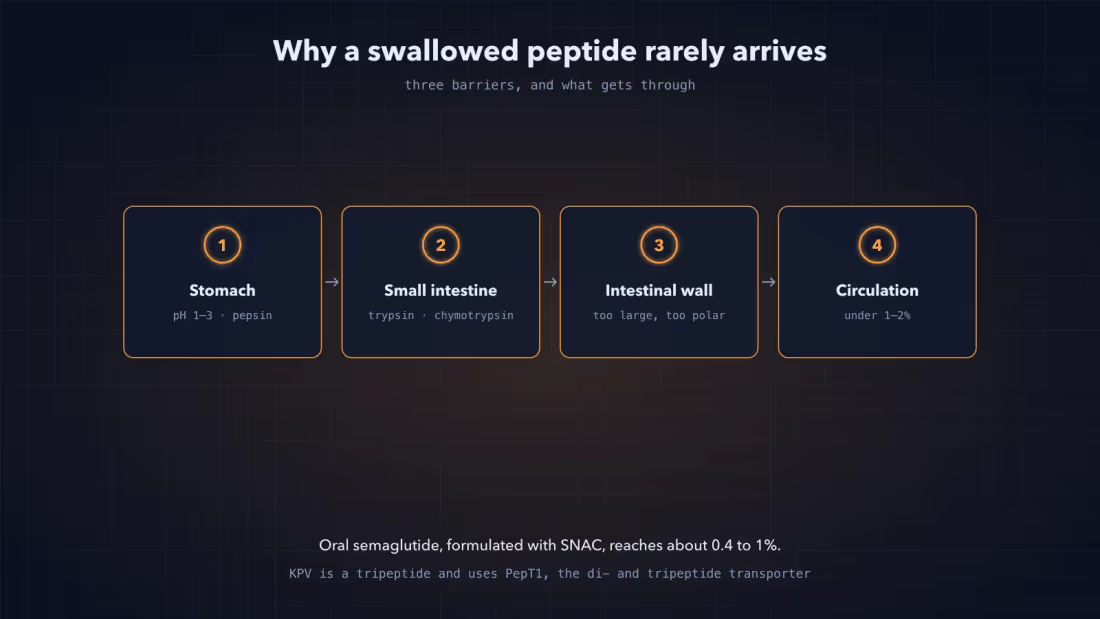
Peptides are, in the overwhelming majority of cases, studied in injectable form or in solution. The reason is simple: taken by mouth, the body digests them. Yet oral forms are multiplying, in research as in the pharmacy. This guide explains the obstacles, the strategies that partly get round them, and what to take from this for capsule and tablet forms.
Three successive barriers
The stomach. Gastric pH, between 1 and 3, denatures many peptides. Pepsin, active in acid conditions, begins to cut them.
The small intestine. The pancreatic enzymes — trypsin, chymotrypsin, elastase, carboxypeptidases — and then the brush border peptidases break the chains down to amino acids, dipeptides and tripeptides.
The intestinal wall. An intact molecule still has to cross the epithelium. Peptides are generally too large and too polar to pass through cell membranes, and too large to pass between the cells, where the tight junctions let only very small molecules filter through.
The result is an oral bioavailability — the fraction of the dose that reaches the circulation intact — generally below 1 to 2% for unformulated peptides.
The strategies that work, in part
| Strategy | Principle | Example |
|---|---|---|
| Absorption enhancer | An associated molecule eases passage across the epithelium | SNAC with oral semaglutide |
| Cyclisation | A chain closed on itself resists enzymes better | Ciclosporin |
| D-amino acids and modified bonds | Enzymes recognise non-natural forms poorly | Many synthetic analogues |
| Intestinal transporters | Very small peptides use physiological transporters | PepT1 transporter (di- and tripeptides) |
| Local action | The peptide acts in the intestine, without needing to be absorbed | Linaclotide |
The case of oral semaglutide
Oral semaglutide is the most studied example. It is formulated with SNAC, an absorption enhancer that locally raises the pH around the tablet, protects the peptide from gastric enzymes and eases its passage across the stomach lining. Even so, its bioavailability is about 0.4 to 1%, which requires doses far higher than those of the injectable form. Semaglutide is a prescription medicine; it is not offered on this site.
Cyclic peptides
Ciclosporin, a cyclic peptide of eleven amino acids of fungal origin, is absorbed by the oral route. Its closed structure, several N-methylated bonds and its strong lipophilicity explain that exception. It has inspired a great deal of work on oral cyclic peptides.
Very small peptides and PepT1
The intestine naturally absorbs the dipeptides and tripeptides produced by digestion, thanks to the PepT1 transporter. Work published in 2008 in Gastroenterology described the transport of the tripeptide KPV by PepT1 in intestinal models, which makes it a logical candidate for oral forms. See the KPV dossier and the KPV tablets reference.
The case of BPC-157
BPC-157 occupies a particular place. Its discovery group describes it as stable in human gastric juice for more than 24 hours, a rare property for a fifteen-amino-acid peptide, consistent with its presumed origin in a gastric protein. A great deal of preclinical work by that group has studied it by the oral route, in the animals’ drinking water.
Two reservations apply. These observations come mainly from a single research group. And stability in gastric juice does not, on its own, tell you what fraction is absorbed. See the BPC-157 dossier.
What this means for an oral form
For a laboratory, a capsule or a tablet is not the equivalent of a lyophilised vial at equal dose:
- the exposed dose differs: only a fraction, often unknown, reaches the circulation intact;
- the excipients matter: the formulation can alter the stability and the release of the peptide;
- the analysis is more complex: assaying a peptide in a matrix containing excipients calls for adapted sample preparation.
An in-vitro model of digestion — simulated gastric and intestinal fluids — allows the stability of an oral form to be measured before any other step.
Frequently asked questions
Why are most peptides not active by the oral route?
Because the stomach and the intestine digest them, and the intact fragments cross the intestinal wall very poorly. Bioavailability is often below 1 to 2%.
How does oral semaglutide work?
It is combined with SNAC, which protects it in the stomach and eases its passage across the lining. Its bioavailability remains about 1%.
Is BPC-157 stable by the oral route?
Its discovery group describes it as stable in human gastric juice. That observation, coming mainly from a single group, does not on its own measure the fraction absorbed.
Why does KPV lend itself to the oral route?
It is a tripeptide. Work has described its transport by PepT1, the intestinal transporter for di- and tripeptides.
Further reading: SPPS peptide synthesis · Storing lyophilised peptides · GLP-1: receptor and agonists
References
- Drucker DJ. Advances in oral peptide therapeutics. Nat Rev Drug Discov. 2020. PubMed
- Buckley ST, et al. Transcellular stomach absorption of a derivatized glucagon-like peptide-1 receptor agonist. Sci Transl Med. 2018. PubMed
- Dalmasso G, et al. PepT1-mediated tripeptide KPV uptake reduces intestinal inflammation. Gastroenterology. 2008. PubMed