Laboratory guide
Bacteriostatic water: composition, pharmacy or laboratory, storage
What bacteriostatic water is, what separates it from the water for injections sold in pharmacies, and how to store it in the laboratory.
Translated from the French original, which remains the reference version: lire en français →
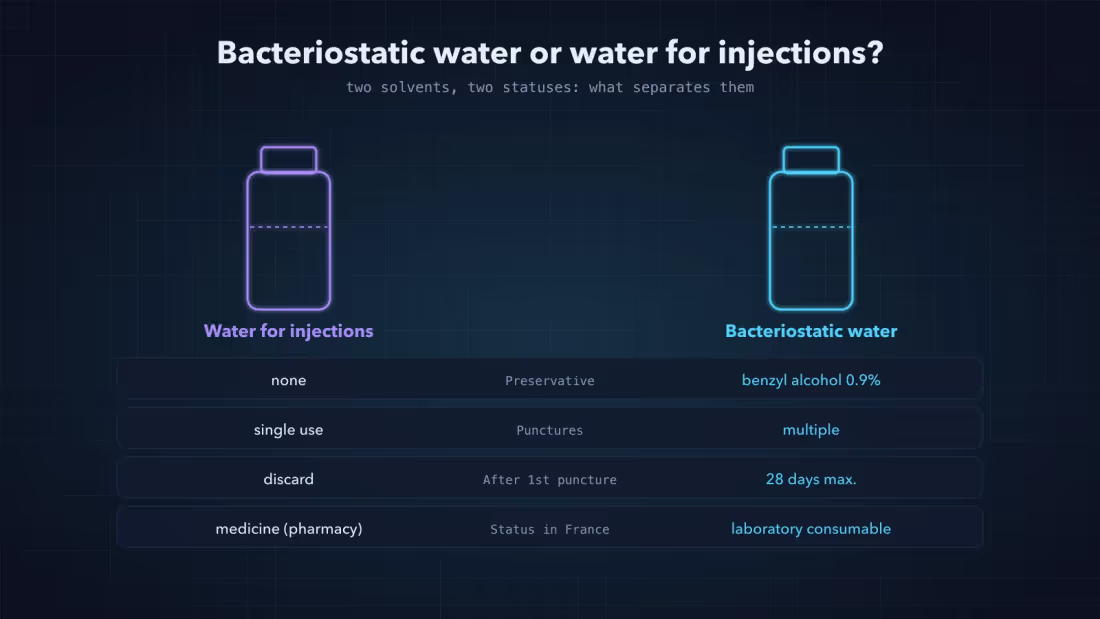
Bacteriostatic water is the most widely used reconstitution solvent for lyophilised peptides in the laboratory. It is also a poorly understood product: people look for it in pharmacies, confuse it with water for injections, and often do not know why it is discarded after 28 days. This guide sets out the position.
Definition: what does “bacteriostatic” mean?
A bacteriostatic agent inhibits the multiplication of bacteria without killing them. A bactericidal agent kills them. The difference is essential: bacteriostatic water limits the growth of any contaminants introduced during successive punctures, but it does not make a contaminated vial sterile.
Composition
Bacteriostatic water is purified water containing 0.9% benzyl alcohol as a preservative. It is that preservative which allows several withdrawals from the same vial, where water without a preservative is single-use.
Our bacteriostatic water is offered in 10 ml and 3 ml vials, in a multi-dose format.
Bacteriostatic water or water for injections: what is the difference?
In France, pharmacies dispense water for injections (EPPI): a medicine, without preservative, in a single-use ampoule or vial. Bacteriostatic water with benzyl alcohol is generally absent from their shelves.
| Critère | Water for injections | Bacteriostatic water |
|---|---|---|
| Preservative | none | benzyl alcohol 0.9% |
| Punctures | single use | multiple |
| After first puncture | discard | 28 days maximum |
| Status in France | medicine, dispensed by pharmacies | laboratory consumable |
For a reconstitution protocol that involves several withdrawals from the same solvent vial, it is the preservative that makes the difference.
Pharmacie, ordonnance, prix
- In pharmacies: searches for bacteriostatic water in a pharmacy rarely succeed. Pharmacies dispense medicines; laboratory bacteriostatic water comes from consumables suppliers.
- Without a prescription: bacteriostatic water sold as a laboratory consumable requires no prescription.
- Price: €4.99 for the 3 ml vial and €6.99 for the 10 ml vial in our catalogue, shipped from France.
Conservation
- Before opening: between 15 and 30 °C, away from light, without freezing. Observe the lot’s expiry date.
- After the first puncture: 28 days at most, then discard the vial, even if some remains.
- Asepsis: disinfect the septum before each puncture, and use new equipment.
Do all peptides reconstitute in bacteriostatic water?
No. It is the usual solvent, but some technical sheets specify another, for example a dilute acid solution for compounds poorly soluble at neutral pH. Solubility appears in the specifications table of each product page. For volumes and the resulting concentration, use the reconstitution calculator and the reconstitution guide.
Frequently asked questions
Is bacteriostatic water sterile?
The vial is packaged for multi-dose use with a preservative. Sterility and the absence of endotoxins are a matter for the manufacturer’s certificate, not for a purity analysis: see endotoxins and sterility.
Why 28 days?
It is the conventional in-use period for a multi-dose vial after its first puncture: beyond that, the risk of cumulative contamination is no longer covered by the preservative.
Can it be frozen?
No. Freezing is not intended for this product and does not extend its life after opening.