Laboratory guide
Endotoxins and sterility: what a LAL test measures, and what an HPLC report does not
Purity, identity, content, endotoxins, sterility: five different measurements, often confused. What each one establishes, and which document carries it.
Translated from the French original, which remains the reference version: lire en français →
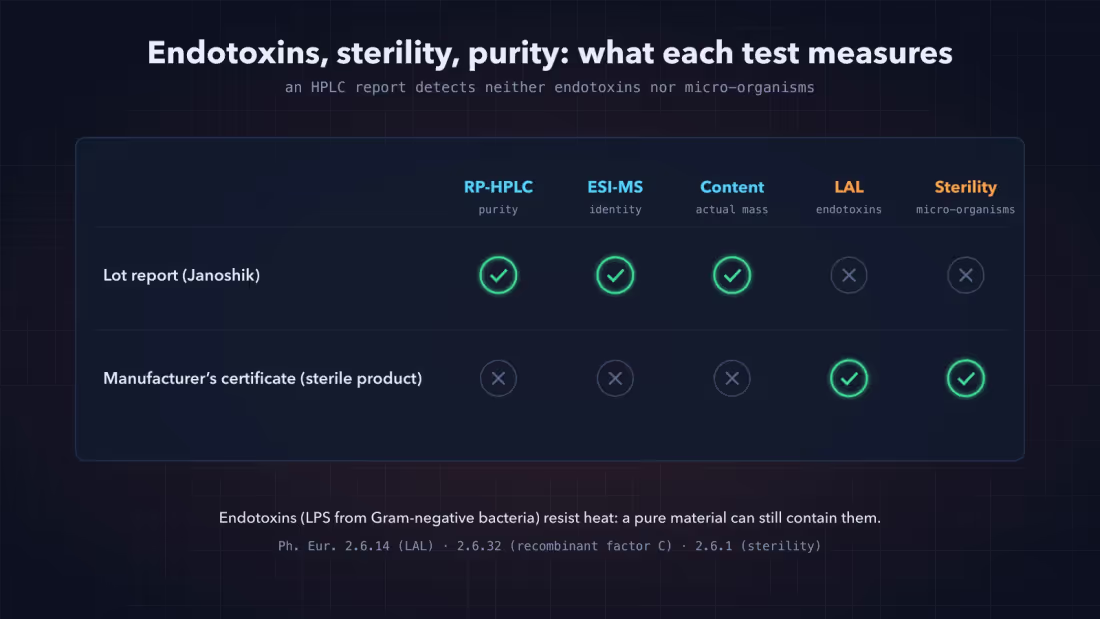
The analysis reports published for research peptides cover purity, identity and content. They are often credited with more. This guide explains what endotoxins are, how they are measured, and why no HPLC report covers them.
Endotoxins: a definition
Endotoxins are lipopolysaccharides (LPS) from the outer membrane of Gram-negative bacteria. They are released when those bacteria multiply or die.
Two properties make them distinctive:
- They resist heat. The autoclaving that sterilises equipment does not destroy them. Removing them calls for depyrogenation, for example dry heat at high temperature.
- A sterile product can contain them. Sterility (the absence of living micro-organisms) and the absence of endotoxins are two different things.
The LAL test
The reference test for assaying endotoxins uses Limulus amebocyte lysate (LAL), an extract of horseshoe crab blood cells that coagulates on contact with endotoxins. The European Pharmacopoeia describes it in chapter 2.6.14, by three methods:
- gel-clot: whether or not a clot forms, read qualitatively or semi-quantitatively;
- turbidimetric: measurement of the turbidity that develops;
- chromogenic: measurement of a colour released by the reaction.
Results are expressed in endotoxin units (EU), per millilitre or per milligram.
An alternative that requires no animal sampling, recombinant factor C (rFC), is described in chapter 2.6.32 of the European Pharmacopoeia.
L’essai de stérilité
The sterility test (European Pharmacopoeia, chapter 2.6.1) looks for the presence of viable micro-organisms, by incubating the sample in culture media for at least fourteen days. It says nothing about endotoxins, and the LAL test says nothing about sterility.
What each document measures
| Measurement | Method | Lot report (Janoshik) | Manufacturer’s certificate for a sterile product |
|---|---|---|---|
| Purity | RP-HPLC | yes | — |
| Identity | ESI-TOF MS | yes | — |
| Content (actual mass) | quantitative assay | yes | — |
| Endotoxins | LAL or rFC | no | yes |
| Sterility | Ph. Eur. 2.6.1 | no | yes |
This is the distinction our catalogue draws between two levels of certification, never conflated: the Janoshik lot report for the identity, purity and content of peptides, and the manufacturer’s certificate for products whose sterility is a characteristic, such as bacteriostatic water. Until a manufacturer’s certificate is published for a lot, no claim of sterility or of freedom from endotoxins is made. The full protocol is on the laboratory verification page.
Why this matters for a laboratory
In cell culture, endotoxins can trigger an inflammatory response in sensitive cells, such as macrophages, and distort a result attributed to the peptide under study. A protocol that depends on this must provide for its own verification, or rely on a material accompanied by an endotoxin certificate.
Frequently asked questions
Does a 99% HPLC report guarantee the absence of endotoxins?
No. Chromatography and mass spectrometry do not detect endotoxins. See how to read an analysis report.
Does lyophilisation remove endotoxins?
No. Lyophilisation removes water; the endotoxins remain in the lyophilisate.
What does a result in EU/mg mean?
The number of endotoxin units per milligram of material. The acceptable threshold depends on the application; it is set by the protocol.