Laboratory guide
How to read a peptide lot analysis report (COA)
What an HPLC and mass spectrometry report actually demonstrates — and the three things it does not.
Translated from the French original, which remains the reference version: lire en français →
A certificate of analysis — a COA — is the only thing linking an anonymous white powder to a chemical identity. Without it, the label on the vial is an unverifiable assertion.
You still have to know what it says. A report is a dense technical document, and it is perfectly possible to look at one and draw no information from it at all. It is also possible to make it say far more than it does — which is the dominant failing of the sector.
This guide describes the structure of a report, how to interpret each section, and above all the exact boundary of what it establishes.
What a COA is, and what it is not
A lot analysis report is the record of measurements made on a sample taken from a given production lot. Every one of those words counts.
A sample. The laboratory does not analyse your vial. It analyses a sample from the same lot. That is normal practice — the analysis is destructive — but it means the report documents a population, not an individual.
A given lot. A report is attached to a lot number. It says nothing about the next lot, produced on another date, possibly from another synthesis. A report without a legible lot number proves nothing verifiable.
Defined measurements. The report covers the parameters actually measured, listed in the document. What does not appear in it was not measured.
That last point is the one systematically lost in commercial communication. A report of identity and purity does not become, by accumulation of adjectives, a guarantee of general quality.
Anatomy of a Janoshik report
Janoshik Analytical is an independent laboratory based in Slovakia, widely used as a reference in the sector. Its reports follow a constant structure.
The header
It carries the name of the compound analysed, the lot number, the date of analysis, a report identifier and how the sample was submitted.
That last detail deserves attention. When a sample is submitted anonymously, the laboratory does not know which supplier it came from. That removes an obvious source of bias: the laboratory cannot adjust a result in favour of a client it cannot identify.
Purity by HPLC
High-performance liquid chromatography separates the components of a mixture by making them travel through a column. Each compound advances at its own speed according to its affinity for the stationary phase, and emerges at a characteristic moment — its retention time.
A UV detector measures absorbance at the column outlet. The result is a chromatogram: a baseline from which peaks emerge.
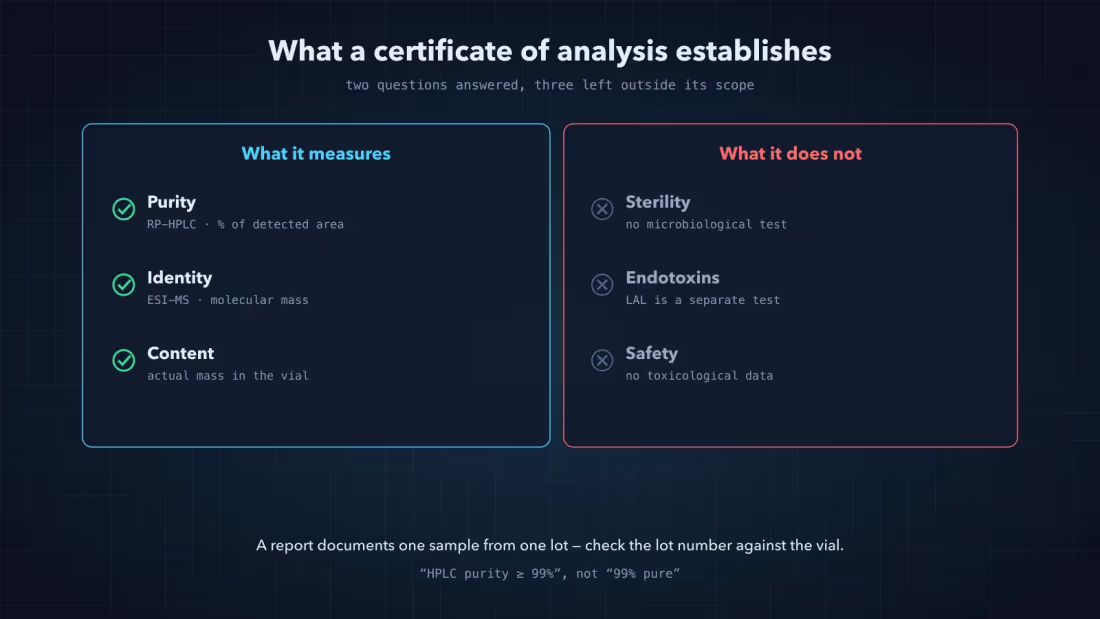
Purity is expressed as a percentage of area: the area of the main peak relative to the total area of all detected peaks. A purity of 99.1% means the main peak represents 99.1% of the total area — not that the product is “99.1% pure” in an absolute sense.
The distinction is real. The area percentage measures only what the detector sees, at the wavelength used. Peptides are generally detected around 214 nm, the wavelength at which the peptide bond absorbs. An impurity with no chromophore at that wavelength — a residual salt, for example — does not appear on the chromatogram. It is not counted in the remaining 0.9%: it is invisible.
That is why the correct wording is “HPLC purity ≥ 99%” and not “99% pure”.
Identity by mass spectrometry
HPLC says that one component dominates. It does not say which component: a retention time is not an identity document.
That is the role of mass spectrometry. The sample is ionised, then the ions are separated according to their mass-to-charge ratio. The result gives the molecular mass of the compound.
That mass is compared with the theoretical mass calculated from the sequence. A close match confirms that the molecule analysed does have the expected composition.
A concrete example: Retatrutide has a molecular mass of 4,731.4 g/mol, GHK-Cu one of 402.92 g/mol. These two molecules cannot be confused on a mass spectrum — the gap is an order of magnitude.
That remark has an important practical consequence. Two different compounds cannot share the same HPLC retention time either. An “analysis report” showing identical values for different molecules is not an analysis report.
Net content
A third parameter, often neglected, is the quantity actually present in the vial.
Purity and content are independent. A vial can contain material that is 99% pure — and hold only 7 mg of it where the label states 10 mg. Purity describes the material present; quantity says how much of it there is.
A report that measures net content states a mass in milligrams, to be compared directly with the label on the vial. It is the most directly verifiable parameter, and the one a supplier has most interest in leaving out.
Reading a chromatogram
The horizontal axis is time, in minutes. The vertical axis is absorbance.
The main peak is the largest. Its retention time is characteristic of the compound under the conditions of the method.
The secondary peaks are the detectable impurities: products of incomplete synthesis, truncated sequences, degradation products.
The baseline should be flat and stable. A drifting baseline signals a problem with the method.
What to look at, in order: the shape of the main peak — symmetrical and narrow, rather than spread out or split; the number and size of the secondary peaks; the presence of visible integration, that is, boundaries drawn around the peaks with the corresponding areas tabulated.
A chromatogram without an integration table is a picture, not a measurement.
What the report does not cover
Three absences have to be stated explicitly, because the market is happy to fill them by implication.
Sterility. An analysis of identity and purity contains no microbiological test. A report stating 99% purity says strictly nothing about the presence of micro-organisms.
Endotoxins. Testing for bacterial endotoxins is a separate test, which is not part of a standard HPLC/MS report.
Safety. No toxicological data appears in a report of identity and purity. A COA qualifies no use whatsoever.
Our product pages state these limits instead of leaving them in the shade: the reports we publish cover the identity and purity of the peptide, excluding sterility and endotoxins.
Quelle méthode prouve quoi
Analytical terms are often used interchangeably in commercial communication, when they answer different questions. The table below separates them.
| Method | The question it answers | What it does not say |
|---|---|---|
| HPLC (RP-HPLC) | What proportion of the detected area does the main component represent? | Which molecule it is; anything that does not absorb at the wavelength used |
| Mass spectrometry (MS) | What is the molecular mass of the component? | In what proportion it is present |
| NMR | What is the detailed structure of the compound? | The quantity present in the vial |
| Karl Fischer titration | What is the residual water content? | Identity and purity |
| LAL test | Are bacterial endotoxins present? | Identity, purity, sterility |
| Sterility test | Are viable micro-organisms present? | Identity, purity, endotoxins |
Two readings follow. First, HPLC and MS are complementary, not redundant: one quantifies without identifying, the other identifies without quantifying. A serious report carries both, and it is their combination that establishes that a majority component really is the molecule stated.
Second, the last three rows of the table are separate analyses, not included in a report of identity and purity. They are not omitted through negligence: they are simply not part of that scope.
Verifying that a report is genuine
A PDF is trivially editable. A percentage can be replaced in seconds in an image editor, and the layout of a well-known laboratory can be reproduced without particular difficulty.
Three elementary checks greatly reduce that risk.
Compare the lot number printed on the vial with the one on the report. A discrepancy makes the document irrelevant, however genuine it may be.
Check internal consistency. The measured mass must correspond to the theoretical mass of the stated sequence. A report giving a mass incompatible with the compound’s formula is self-contradictory, and this is visible without any particular expertise: the molecular mass appears on all our product pages.
Cross-check with the source. Janoshik assigns an identifier to each analysis, and the corresponding report can be consulted from its own domain. A report hosted only on the seller’s site, with no traceable identifier, rests entirely on that seller’s word.
That is why our report links point to the laboratory’s document, strength by strength, and not to a local copy.
Warning signs
A few things disqualify a report within seconds.
No lot number. The report cannot be attached to anything.
A lot that does not match the one on the vial. A genuine report covering another lot does not document what you have.
An image with no chromatogram. A table of values copied into a PDF is not a report: the raw data is missing.
Identical values from one product to another. The clearest signal of all. The same retention time shown for molecules of different masses indicates a template, not an analysis.
A badge with no document. A “lab tested” claim that links to no consultable file is not proof. That is why every report in our lot report register opens directly, attached to the strength and the lot it analyses: a consultable document is verifiable, a badge is not.
A note on the vocabulary of the market
These compounds are frequently discussed in bodybuilding or performance contexts, and a share of online searches associates them with those uses — “peptides for bodybuilding” and “best peptides for muscle growth” are among the common queries.
That association belongs to commercial talk, not to documentation. No analysis report bears on a use: a COA establishes the identity and purity of a material, and nothing else. A supplier who presents an analysis report as a warrant for use is making it say what it does not say.
Our position on this point is constant and can be checked across the whole site: the materials offered are analytical standards for in-vitro research, no human use is proposed, and the only assertions we make concern what the reports actually measure.
Why the lot matters
A peptide synthesis is not perfectly reproducible. Two lots of the same compound, produced by the same manufacturer six months apart, can differ in their impurity profile and their net content.
A report therefore documents one lot, and one only. That is why the report linked on our pages corresponds to the strength selected, and not to a generic document attached to the product name.
Frequently asked questions
Does a COA guarantee that the product is safe? No. It documents identity and purity on one lot. It contains no safety data and qualifies no use.
What does “≥ 99%” mean? That the main peak represents at least 99% of the total area detected at the method’s wavelength. It is a relative measurement, not an absolute purity.
Purity and quantity, what is the difference? Purity describes the material present; quantity says how much of it there is. A vial can be very pure and underfilled.
Why submit the sample anonymously? Because a laboratory that does not know the origin of a sample has no way of steering the result.
Is a 2023 report valid for a vial bought today? Only if the lot number is the same. Otherwise it documents a different lot.
Further reading: How to choose a peptide supplier in France