Buying guide
How to choose a peptide supplier in France: 8 checkable criteria
Analysis report, seller identity, delivery, price per milligram: what a laboratory can check before buying research peptides online.
Translated from the French original, which remains the reference version: lire en français →
Buying research peptides in France is today done almost exclusively online. The shops resemble one another: the same references, the same promises of “purity ≥ 99%”, the same vials photographed against a dark background. What distinguishes them is not visible on a home page — it is read in the documents.
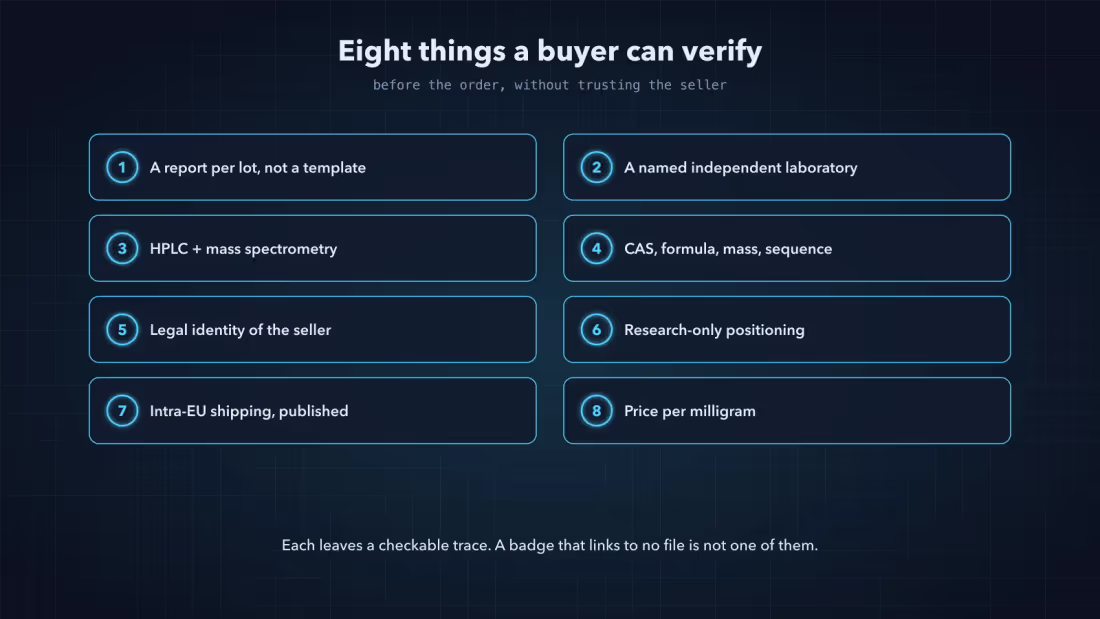
This guide offers eight objective criteria, all verifiable by the buyer without taking the seller’s word for anything. It is addressed to laboratories and researchers buying reference materials for in-vitro research; it contains no information on use.
1. A certificate of analysis per lot, not a “standard” certificate
The first sort is simple. Some sellers publish a single certificate of analysis, valid for all orders and all years. Others attach a report to each manufacturing lot.
Only the second says anything about your vial. A peptide is synthesised in lots; two lots of the same compound can differ in purity, in content and in impurities. The question to ask is therefore: is the lot number on the report the one printed on the label? If the seller cannot answer, the report describes a different material from the one you will receive.
Our guide to reading an analysis report details every section of a certificate.
2. An independent, identifiable laboratory
A report written by the seller itself does not have the standing of one issued by a third party. The laboratory should be named, contactable, and independent of the shop. Most independent analytical laboratories also allow the authenticity of a report to be checked on their own site, which closes the door to retouched documents.
A document with no laboratory name, no date and no sample reference is not a certificate: it is an illustration.
3. The right methods: purity, identity, content
Three different measurements hide behind the word “quality”, and they do not substitute for one another.
| Method | What it measures | What it does not say |
|---|---|---|
| HPLC (chromatography) | Purity: the share of signal corresponding to the main peptide | The identity of the peptide |
| Mass spectrometry (ESI-MS) | Identity: does the molecular mass match the compound stated? | The quantity present |
| Quantitative content | The actual mass of peptide in the vial | The nature of the impurities |
The most frequent confusion concerns the last two rows. A vial labelled “10 mg” and 99% pure by HPLC can contain distinctly less than 10 mg of peptide: residual water and counter-ions (acetate, TFA) weigh too. A serious supplier clearly distinguishes purity from quantitative content.
4. Full identification of the compound
A product page should allow the compound to be identified without ambiguity: CAS number, molecular formula, molecular mass and, ideally, sequence. BPC-157, for instance, is defined by CAS 137525-51-0, the formula C₆₂H₉₈N₁₆O₂₂ and a mass of 1,419.55 g/mol.
These data are also what allows the report to be cross-checked: the mass measured by spectrometry must match the mass stated on the page.
5. A legally identified seller
In France, every operator of a commercial website must identify itself: company name, registration number, address, publication director. The general terms of sale must state the right of withdrawal and the competent consumer mediator.
This information is not a formality. It tells you who you are buying from, which law applies and who to turn to in a dispute. A site that publishes neither full legal notice nor general terms leaves you no recourse.
6. A consistent “research only” positioning
This is a counter-intuitive criterion, but a decisive one. A seller who promises health effects, offers “courses of treatment” or states dosages is presenting its products as medicines within the meaning of article L.5111-1 of the French Public Health Code. Without a marketing authorisation, that presentation is illegal.
It is also revealing: a supplier prepared to ignore that framework has little reason to be rigorous elsewhere. Our article on peptides, pharmacies and prescriptions details the distinction.
7. Transparent intra-European logistics
Where the parcel is sent from matters. A parcel shipped from another European Union member state travels to France with no customs formality. A shipment from outside the EU can be held, taxed or delayed, and the transport conditions escape any control.
The stated lead times, parcel tracking, packaging and storage instructions on arrival should all appear before you order. Lyophilised peptides withstand short transport at room temperature, but not a prolonged stay in a customs warehouse — see our guide to storing lyophilised peptides.
8. Prices that can be compared… per milligram
Comparing two shops on the price of a vial makes no sense if the strengths differ. The right indicator is the price per milligram. In our own catalogue, retatrutide works out at €9.80/mg in a 5 mg vial (€48.99) and at €7.57/mg in a 30 mg vial (€226.99).
Two further rules apply. The total — delivery included — must be displayed before payment. And a price well below the market should arouse suspicion rather than enthusiasm: peptide synthesis has a cost, and the saving is rarely made without a trade-off on purity or content.
Grille récapitulative
| Criterion | What to look for | Warning sign |
|---|---|---|
| Analysis report | One report per lot, number matching the label | A single certificate for all lots |
| Laboratory | Named third party, report verifiable | Report with no laboratory and no date |
| Methods | HPLC + mass spectrometry | Purity alone, without identity |
| Identification | CAS, formula, mass, sequence | Trade name only |
| Seller | Legal notice, terms of sale, mediator | No legal identity |
| Positioning | In-vitro research only | Health promises, dosages |
| Logistics | Intra-EU shipping, lead times and tracking published | Vague origin, customs possible |
| Price | Coherent price per mg, total before payment | Abnormally low price |
How Purpeptide answers these criteria
We apply this grid to our own catalogue, including where it tells against us.
- Analysis reports: 58 distinct Janoshik reports, each attached to the strength and the lot it analyses. All are consultable in the lot report register.
- Methods: purity by chromatography and identity by mass spectrometry, detailed on the laboratory verification page.
- Seller: a French company, identified in our legal notice.
- Logistics: dispatch within 24 to 48 h from our logistics site in France, delivery in mainland France in 2 to 4 working days, with no customs formality. Details on the shipping page.
- Prices: displayed by strength on each page; delivery in France at €6.49, free from €250; minimum order €200.
The full catalogue brings together the 47 references.
Frequently asked questions
Where can research peptides be bought in France?
Online, from a supplier that publishes a per-lot analysis report, identifies itself legally and ships from the European Union. The eight criteria above allow this to be verified before any order.
Are research peptides sold in pharmacies?
No. A pharmacy dispenses medicines holding a marketing authorisation; reference materials intended for research have none. See our article on the legal framework.
Does an analysis report guarantee the quality of my vial?
Only if it covers the same lot. A report attached to another lot, or a generic one, says nothing about the material you receive.
What is the difference between purity and content?
Purity measures the share of the main peptide among what chromatography detects. Content measures the actual mass of peptide in the vial. A material can be very pure and contain less than the labelled mass.