Buying guide
Research peptide prices: how to compare per milligram
Retatrutide, BPC-157, GHK-Cu, TB-500, NAD+: why the price of a vial cannot be compared, and how to work out what a research peptide really costs.
Translated from the French original, which remains the reference version: lire en français →
“Retatrutide price”, “BPC-157 price”, “GHK-Cu price”: these are among the most frequent searches about research peptides. The answer displayed in a shop is almost always a price per vial. But a vial is not a unit of measurement. This guide explains how to compare properly, what makes up the price of a research peptide, and publishes the price per milligram of our own catalogue so that the comparison can be checked.
The calculation: vial price ÷ mass of peptide
The price per milligram is calculated by dividing the price of the vial by the mass of lyophilised peptide it contains, the mass given on the label.
An example with the retatrutide in our catalogue:
| Format | Vial price | Price per milligram |
|---|---|---|
| 5 mg | €48.99 | €9.80/mg |
| 10 mg | €94.99 | €9.50/mg |
| 15 mg | €135.99 | €9.07/mg |
| 30 mg | €226.99 | €7.57/mg |
The 30 mg vial costs more than four times the 5 mg one, but the milligram in it is 23% cheaper. That is the general rule: the larger the format, the lower the price per milligram, because the fixed costs (vial, filling, lyophilisation, testing) are spread over more material.
The price per milligram in our catalogue
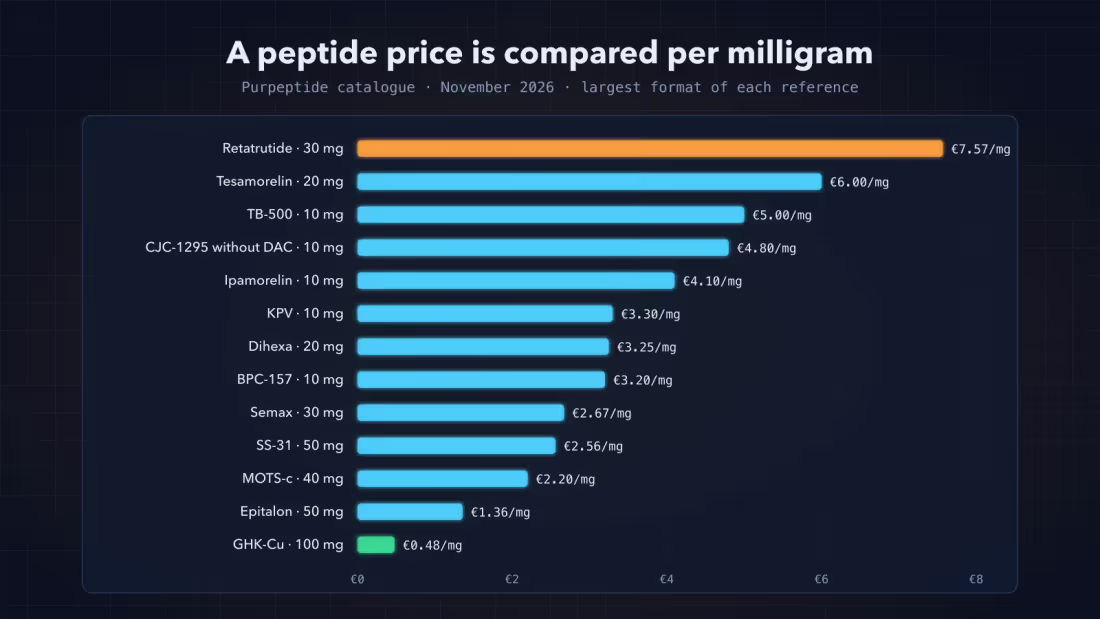
List prices as at 19 November 2026, largest format of each reference, before discount:
| Reference | Format | Price per mg |
|---|---|---|
| Retatrutide | 30 mg | €7.57 |
| Tesamorelin | 20 mg | €6.00 |
| TB-500 | 10 mg | €5.00 |
| CJC-1295 without DAC | 10 mg | €4.80 |
| Ipamorelin | 10 mg | €4.10 |
| KPV | 10 mg | €3.30 |
| Dihexa | 20 mg | €3.25 |
| BPC-157 | 10 mg | €3.20 |
| Semax | 30 mg | €2.67 |
| SS-31 | 50 mg | €2.56 |
| MOTS-c | 40 mg | €2.20 |
| Epitalon | 50 mg | €1.36 |
| GHK-Cu | 100 mg | €0.48 |
The differences between references reflect above all the length and complexity of the sequence. GHK-Cu is a tripeptide: three amino acids and a copper ion, synthesised in a few steps. Retatrutide has 39 amino acids and non-natural ones among them. Each amino acid added is a further synthesis cycle, with its own yield and its own possible impurities (see solid-phase peptide synthesis).
What makes up the price of a research peptide
- Synthesis. The cost rises with the length of the sequence, the presence of modified amino acids and difficult coupling steps.
- Purification. Reaching a high purity by chromatography loses material: it is the main price factor at equal length.
- Lyophilisation and packaging in a sealed vial.
- Lot analysis. An independent report (RP-HPLC, mass spectrometry, quantitative content) costs money per lot. A very low price is often explained by its absence.
- Logistics. Cold storage, packaging, tracked shipping.
Three traps in price comparisons
1. The “kit” price. Some shops sell in lots of 10 vials. Always bring the price back to the vial, then to the milligram.
2. Purity is not content. A report can show 99% purity for a vial that contains 8 mg instead of 10 mg. The real price per milligram is calculated on the measured mass, not on the label. That is why quantitative content appears in our reports: see how to read an analysis report.
3. The report that does not cover your lot. A low price with a generic certificate says nothing about the vial delivered. Check that the lot number on the report is the one on the product page: our lot report register lists them all.
Discounts: how they change the price per milligram
In our catalogue, the volume discount applies to the total number of units in the basket: −5% from 5 units, −10% from 10, −15% from 15. Payment in cryptocurrency (BTC, ETH) takes a further 10% off the remaining amount. A BPC-157 10 mg thus goes from €3.20/mg to €2.72/mg from 15 units. For laboratory volumes, see bulk ordering.
A price in pharmacies?
Research peptides have no pharmacy price: they are not medicines and are not dispensed there. Searches for a “pharmacy price” in fact concern authorised medicines, which are something else entirely. The detail is in our article on the legal framework.
Frequently asked questions
Why does the same peptide cost twice as much elsewhere?
Compare the price per milligram first, then what comes with it: the lot analysis report, the measured content, the identity of the seller, the delivery time. A price difference is often explained by one of these points.
Does the price include delivery?
No. Delivery to France is €6.49 and free from €250 of purchases; the rates by zone are on the shipping page. Displayed prices are tax inclusive; for UK orders the 20% UK VAT included is shown separately at checkout.
Is the price per milligram the same for every size?
No: it falls as the vial gets larger. Choosing the large format only makes sense if the quantity matches your protocol and the stability of the product after reconstitution.