Laboratory guide
Solid-phase peptide synthesis (SPPS): how a research peptide is made
From Merrifield's method to Fmoc chemistry: the synthesis cycle, where impurities come from, and why a long peptide costs more than a short one.
Translated from the French original, which remains the reference version: lire en français →
Almost every research peptide — from three-amino-acid KPV to forty-four-amino-acid tesamorelin — is made by the same method: solid-phase peptide synthesis, or SPPS. Understanding how it works lets you read an analysis report with a surer eye, and shows where the impurities come from.
L’invention de Merrifield
In the early 1960s, at Rockefeller University in New York, Bruce Merrifield had the idea of attaching the first amino acid of a peptide to an insoluble resin bead, then adding the following ones one by one. The growing peptide stays fixed to the bead throughout the synthesis. Between two steps it is enough to wash the resin to remove reagents and by-products, with no intermediate purification at all.
Published in 1963, the method made peptide synthesis fast and automatable. It earned Merrifield the Nobel Prize in Chemistry in 1984.
The synthesis cycle
The chain is built from the C-terminal end towards the N-terminal end. Each amino acid added carries a protecting group on its amine function, so that it reacts only once. Each cycle has four steps:
- Deprotection: the protecting group is removed from the last amino acid attached;
- Wash;
- Coupling: the next amino acid is added, activated by a coupling reagent (DIC/Oxyma, HBTU or HATU, for example);
- Wash.
The cycle repeats as many times as there are amino acids. Reactive side chains — those of lysine, aspartic acid, cysteine and so on — stay protected throughout the synthesis. At the end, a cleavage step detaches the peptide from the resin and removes all the protecting groups at once.
Two strategies: Boc and Fmoc
| Critère | Boc / Bzl | Fmoc / tBu |
|---|---|---|
| Amine protection | Boc (tert-butyloxycarbonyl) | Fmoc (fluorenylmethoxycarbonyl) |
| Deprotection at each cycle | Acid (TFA) | Base (piperidine) |
| Final cleavage | Hydrofluoric acid (HF) | Trifluoroacetic acid (TFA) |
| Current use | Particular cases | Industry standard |
Merrifield’s historical strategy, Boc/Bzl, requires a final cleavage with hydrofluoric acid, which is very dangerous to handle. The Fmoc/tBu strategy, developed in the 1970s, uses only milder conditions. It has established itself as the standard, particularly for large-scale production.
The problem of cumulative yield
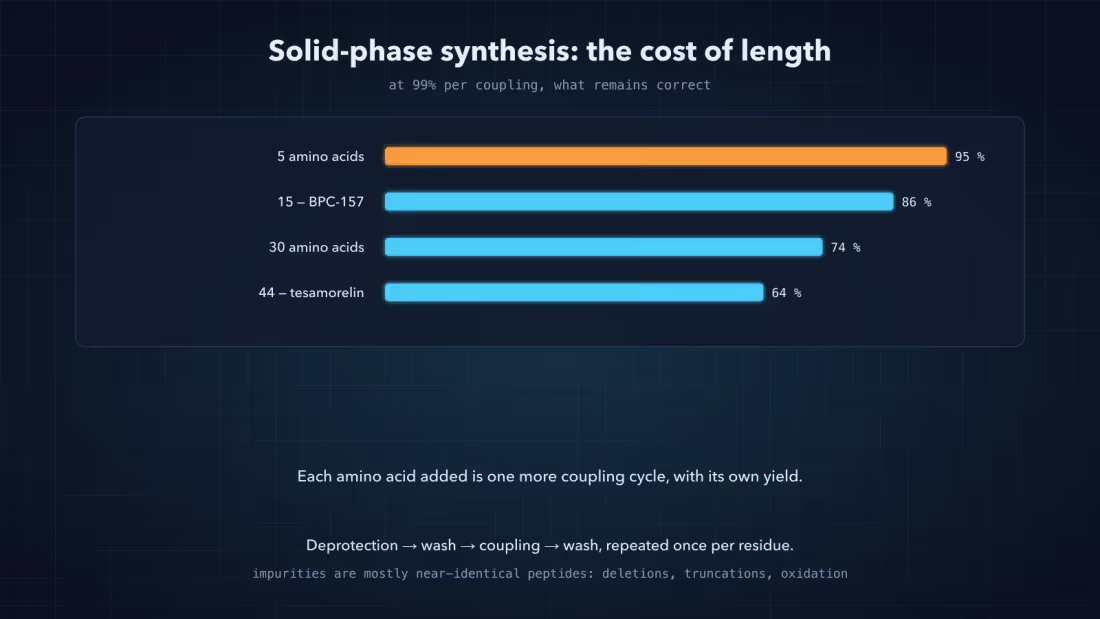
No coupling is perfect. If each step succeeds 99% of the time, the proportion of complete and correct chains falls with every cycle:
| Length | Per-step yield 98% | 99% | 99.5% |
|---|---|---|---|
| 5 amino acids | 90% | 95% | 98% |
| 15 amino acids (BPC-157) | 74% | 86% | 93% |
| 30 amino acids | 55% | 74% | 86% |
| 44 amino acids (tesamorelin) | 41% | 64% | 80% |
This is the principal reason a long peptide costs more. The crude synthesis product contains more incorrect chains, purification is harder, and the final quantity is smaller. For very long peptides, several separately synthesised fragments are sometimes assembled, by condensation or by native chemical ligation.
Where the impurities come from
The impurities in a synthetic peptide are not outside contaminants. Most of them are peptides almost identical to the expected product:
- deletion sequences: one amino acid is missing, because a coupling failed;
- truncated sequences: the chain stopped before the end;
- racemisation: an amino acid has gone from the L form to the D form, especially histidine and cysteine;
- aspartimide formation: a frequent side reaction at Asp-Gly motifs;
- oxidation: methionine and tryptophan oxidise readily (+16 Da);
- residual protection: a protecting group was not entirely removed.
A deletion sequence differs from the product by the mass of a single amino acid. It is detectable by mass spectrometry, but it can be difficult to separate chromatographically.
Purification and lyophilisation
The crude peptide is purified by preparative reverse-phase HPLC. The fractions containing the product at the target purity are combined, then lyophilised: the water is removed by sublimation under vacuum, giving the white powder that a vial contains. See our guide to storing lyophilised peptides.
Purity, counter-ions and net peptide content
The TFA used during cleavage and purification remains bound to the basic functions of the peptide, as a trifluoroacetate salt. An exchange can replace it with an acetate, better tolerated in certain cell models.
From this follows an essential distinction:
- purity (≥99%, for example) measures the share of the expected product among the peptide species detected by HPLC;
- net peptide content measures the share of peptide in the total mass of powder, counter-ions and residual water included. It often sits between 60 and 90%.
A peptide that is 99% pure can therefore contain distinctly less peptide than the mass stated on the vial, if that mass refers to the crude powder. See our guide to reading an analysis report.
Frequently asked questions
What does SPPS mean?
Solid-phase peptide synthesis. The peptide is built amino acid by amino acid on a resin bead.
What is the difference between Fmoc and Boc?
They are two protecting groups for the amine. Fmoc chemistry, being milder, is the current standard. Boc chemistry requires a final cleavage with hydrofluoric acid.
Why does a long peptide cost more?
Because the yield falls at every step: at 99% per coupling, only about 64% of chains are still correct after 44 steps, and purification is harder.
What is the difference between purity and net peptide content?
Purity compares the product with the other peptides present. Net peptide content compares the peptide with the total mass of powder, counter-ions and water included.
Further reading: Reading a lot analysis report · Reconstituting a research peptide · Choosing a peptide supplier in France
References
- Merrifield RB. Solid Phase Peptide Synthesis. I. The Synthesis of a Tetrapeptide. J Am Chem Soc. 1963;85. DOI
- Behrendt R, White P, Offer J. Advances in Fmoc solid-phase peptide synthesis. J Pept Sci. 2016. PubMed
- Behrendt R, et al. Preventing aspartimide formation in Fmoc SPPS of Asp-Gly containing peptides. J Pept Sci. 2016. PubMed