Laboratory guide
Storing lyophilised peptides: temperature, humidity, light
From the arrival of the parcel to the freezer: what degrades a lyophilisate, and the habits that preserve its stability before reconstitution.
Translated from the French original, which remains the reference version: lire en français →
A lyophilised peptide is a remarkably robust material: deprived of its water, it escapes most of the reactions that would degrade it in solution. That robustness has conditions, however, and most losses of quality occur before reconstitution even begins — on arrival, in storage, or at the moment the vial is opened.
This guide covers the life of the material in dry form. Storage after it has been put back into solution is dealt with in our reconstitution guide. It contains no information on use.
Why a lyophilisate keeps
Lyophilisation removes the water from a peptide by freezing and then sublimation under vacuum. Water is the medium of most degradation reactions: hydrolysis of peptide bonds, deamidation of certain amino acids, microbial growth. Without water, those reactions slow to the point of becoming negligible at low temperature.
That is what explains the considerable difference in stability between a powder and a solution of the same peptide.
The four degradation factors
| Factor | What it causes | Most exposed residues |
|---|---|---|
| Humidity | Hydrolysis, deamidation, caking of the powder | Asparagine, glutamine |
| Oxygen | Oxidation of side chains | Methionine, cysteine, tryptophan |
| Light | Photodegradation | Tryptophan, tyrosine |
| Temperature | Accelerates all of the above | All |
The sequence of a peptide therefore indicates its sensitivity. A compound rich in methionine or tryptophan calls for particular attention to oxygen and light — this is the case, for example, with Semax, whose sequence begins with a methionine.
When the parcel arrives
A lyophilised peptide withstands short transport at room temperature: a few days in transit do not compromise a properly sealed vial. It should not stay there, however.
- Check the vial: cap intact, stopper in place, no cracks.
- Look at the lyophilisate: a white powder or film, dry and not stuck to the walls.
- Note the lot number and match it to the corresponding analysis report.
- Put the vial in the freezer without delay, in its original packaging.
The right cold
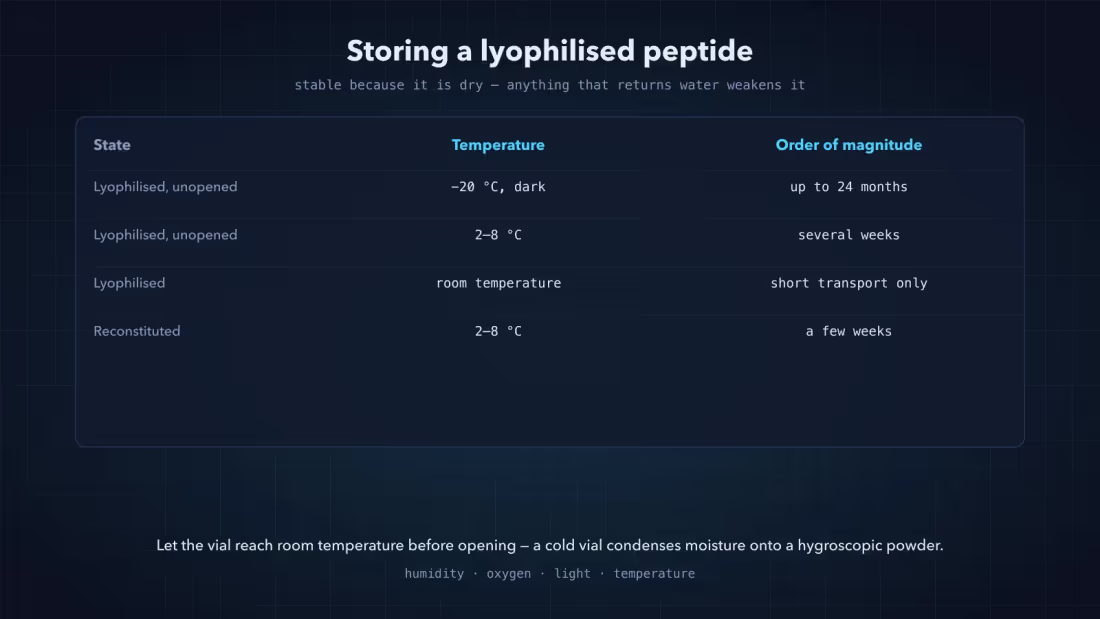
| State | Temperature | Order of magnitude |
|---|---|---|
| Lyophilised, unopened | −20 °C, away from light | Up to 24 months |
| Lyophilised, unopened | 2–8 °C | Several weeks |
| Lyophilised | Room temperature | Short transport only |
| Reconstituted | 2–8 °C | A few weeks — see the reconstitution guide |
These orders of magnitude are indicative; each reference’s page gives its own parameters, and that is what governs.
Two points matter as much as the temperature itself. A frost-free freezer runs defrost cycles that raise the temperature several times a day: it is ill-suited to long-term storage. And the door of a refrigerator or freezer undergoes the sharpest variations every time it is opened.
The condensation trap
This is the most frequent error, and the least visible. A vial taken out of the freezer and opened immediately is colder than the surrounding air: the moisture in the air condenses at once onto the powder, which is hygroscopic.
The rule is simple: let the vial come back to room temperature before opening it, ideally in a desiccator, for about twenty minutes. The same step applies to every withdrawal.
Aliquot rather than multiply openings
Every freezing and opening cycle exposes the material to humidity and to temperature variation. Where spaced-out withdrawals are planned, dividing the material into aliquots — each used once only — avoids subjecting the whole lot to repeated cycles. See aliquoting in our glossary.
What you can see, and what you cannot
Certain signs should raise concern: a caked or sticky powder, a yellowish appearance, a lyophilisate that has melted into a damp film. They indicate exposure to humidity or heat.
The converse is not true. A powder of perfect appearance may have lost part of its integrity to oxidation, invisible to the eye. Only an analysis — chromatography and mass spectrometry — can establish it. That is why observing the storage conditions is worth more than a visual check.
Frequently asked questions
Should a lyophilised peptide be frozen?
For storage of several months, yes: −20 °C away from light is the reference. Storage of a few weeks at 2–8 °C is possible depending on the compound.
Is a peptide received at room temperature damaged?
No, if the vial is intact and transport lasted a few days. A sealed lyophilisate withstands short carriage; it should then be placed in the cold.
How long does a lyophilised peptide keep?
Up to 24 months at −20 °C for most compounds, as an indication. Each reference’s page states its own stability window.
Can a vial be refrozen?
A well-resealed lyophilisate can go back into the freezer, provided it was opened at room temperature to avoid condensation. A solution that has already been thawed, on the other hand, must not be refrozen.