Research dossier
KPV — C-terminal α-MSH motif dossier
The minimal C-terminal motif of α-MSH, studied independently of the melanocortin receptors.
Translated from the French original, which remains the reference version: lire en français →
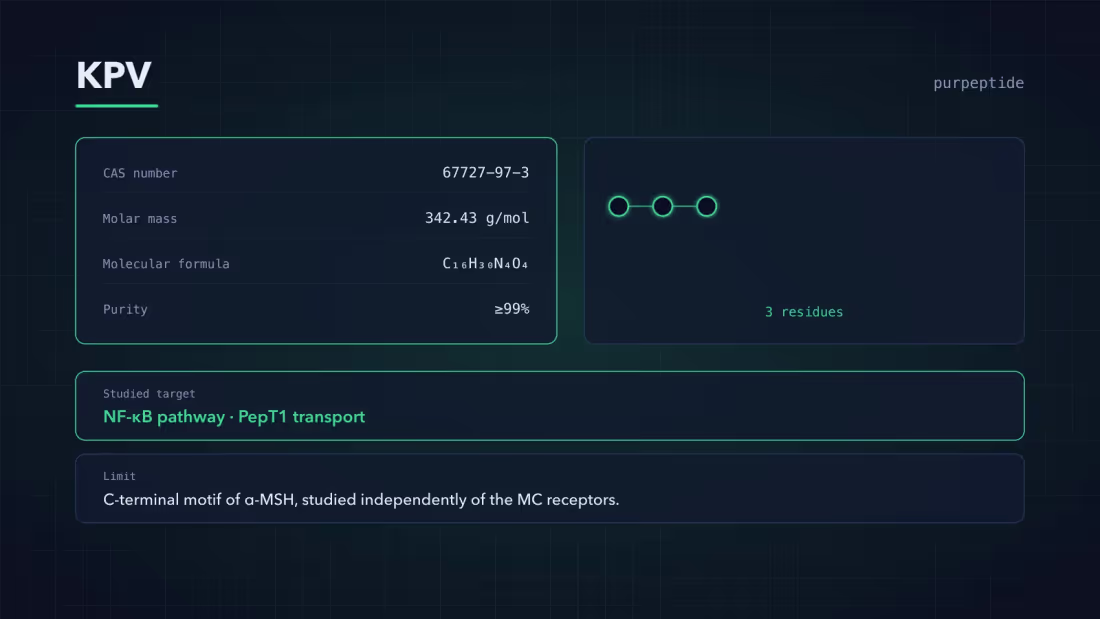
Molecular identity
| Parameter | Value |
|---|---|
| CAS number | 67727-97-3 |
| Molar mass | 342.43 g/mol |
| Molecular formula | C₁₆H₃₀N₄O₄ |
| Sequence / nature | Lys-Pro-Val |
| Purity | ≥99% |
| Appearance | White lyophilised powder |
The values above correspond to the catalogue lot and are reproduced as they stand from the product page. Any discrepancy between this dossier and the product page should be reported before use.
Research context
The separation of anti-inflammatory activity from melanotropic activity within a single hormone is what makes this tripeptide interesting. It is an example of reducing a molecule to its minimal active motif, a classic approach in peptide chemistry.
Mechanism studied
KPV is a tripeptide corresponding to the three C-terminal residues of α-MSH — lysine, proline, valine.
Its scientific interest rests on a clear dissociation: in the published literature this fragment retains part of the anti-inflammatory activity of the whole hormone while lacking the melanotropic activity. It does not significantly activate the melanocortin receptors, which implies a distinct mechanism.
The dominant mechanistic hypothesis is intracellular: work has reported inhibition of the NF-κB pathway, measured by nuclear translocation of the p65 subunit under immunofluorescence, by transcription reporter assays, and by cytokine measurement in the culture supernatant after LPS stimulation.
A second line of research concerns its transport: publications describe internalisation via the PepT1 peptide transporter, expressed notably in intestinal epithelium, which has directed part of the work toward epithelial barrier models in culture.
In-vitro literature
The most frequent models are intestinal epithelial lines (Caco-2, HT-29) and cultured macrophages stimulated with LPS. Cytokine measurement by ELISA is the principal endpoint.
Bibliographic entry points
- PubMed — peer-reviewed literature
- PubChem — chemical profile and assay data
- NCBI — methodology and receptor references
These links are an entry point into the literature, not an edited selection. None of the sources cited relates to a human use of this material, and consulting them directly is recommended for any protocol design.
Distinguishing this compound from its analogues
A C-terminal fragment of α-MSH without melanotropic activity: data relating to whole α-MSH are not transferable.
The CAS number shown on the product page is the identifier to rely on. Trade names, development codes and customary abbreviations vary from one source to another and are not a reliable identification.
Methodological limits
A very short tripeptide: identity verification by mass spectrometry is poorly discriminating, since several amino acid combinations can give neighbouring masses. Sequence confirmation is preferable. Weak chromatographic retention also complicates quantification.
These limits are not formalities: they determine what a protocol using this material can and cannot establish. Making them explicit in the experimental plan avoids attributing to the compound an observation that belongs to the measurement system.
Analytical parameters
A very short and very polar tripeptide, weakly retained in reversed phase. The chromatographic method must be adapted accordingly.
| Parameter | Value |
|---|---|
| Storage | Store at −20 °C, protected from light |
| Solubility | Soluble in bacteriostatic water (BAC) |
| Stability | Stable for 24 months at −20 °C; 30 days after reconstitution at 2–8 °C |
| Control methods | RP-HPLC · MS · NMR |
Reconstitution is a matter for the experimental protocol. The volume of solvent determines the final concentration and is not prescribed here: it depends on the design of the experiment and the conditions of the assay.
Resulting concentrations
The table below is arithmetic: it gives the concentration obtained for a given solvent volume, with no recommendation of use.
| Format | 1 ml | 2 ml | 3 ml |
|---|---|---|---|
| 10mg | 10.00 mg/ml | 5.00 mg/ml | 3.33 mg/ml |
These values assume complete dissolution and a peptide content consistent with the lot report. Where the actual quantitative content differs from the nominal mass — a common discrepancy, caused by counter-ions and residual water — the effective concentration is lower than the theoretical value. That is precisely why quantitative content per vial forms part of the verification protocol.
Protocol design
Three points govern the validity of an assay using this material, whatever the question being asked.
The effective concentration is not the nominal concentration. It depends on the actual peptide content of the lot, on complete dissolution and on adsorption to the walls of the container. A concentration check after reconstitution is preferable to assuming a perfect yield.
The actual exposure time may be shorter than the nominal duration where the compound is degraded by the medium. Verify stability under the exact conditions of the assay — medium, serum, temperature, duration — before interpreting an absence of effect.
The control arm must correspond to the vehicle actually used, at the same final concentration. This requirement is unremarkable and remains the most frequent cause of irreproducible results.
Lot verification
The following formats are covered by a Janoshik Analytical report, readable from the product page:
- 10mg — lot report available
| Format | Lot report | Availability |
|---|---|---|
| 10mg | Covered | In stock |
The verification programme covers exclusively the identity and purity of the material, by reversed-phase chromatography and mass spectrometry. It covers neither sterility, nor endotoxins, nor any microbiological characteristic.
Frequently asked questions
How does this product arrive?
As a lyophilised powder in a sealed vial, shipped in insulated, plain packaging. Return the vial to the storage temperature given in the specifications on receipt.
Which solvent should be used for reconstitution?
Bacteriostatic water is the usual reconstitution solvent for lyophilised peptides in a laboratory setting. The volume is a matter for the experimental protocol and the concentration sought; we provide no dosage recommendation.
How long does the material remain stable?
The stability window appears in the specifications table on this page, before and after reconstitution. Those values correspond to the storage conditions stated; any temperature variation shortens them.
Does the analysis report correspond exactly to my vial?
The report linked on this page corresponds to the format selected. Each report is issued by Janoshik Analytical from an anonymously submitted sample, and covers the identity and purity of the peptide.
Can this product be used on humans or animals?
No. It is an analytical grade reference material intended exclusively for in-vitro laboratory research. Any administration to humans or animals is excluded, and no therapeutic, diagnostic or medical claim is made.