Research dossier
GLP-1: the hormone, the receptor and the generations of agonists
What GLP-1 actually is, why it is degraded within two minutes, and how the agonists work around that.
Translated from the French original, which remains the reference version: lire en français →
Few acronyms have been used so widely and defined so poorly. “GLP-1” refers sometimes to a hormone, sometimes to a receptor, sometimes to a family of marketed molecules — three distinct things that common usage runs together.
This dossier separates them.
GLP-1, what it actually is — definition
Glucagon-like peptide-1 is a peptide hormone of 30 to 31 amino acids, secreted by the L cells of the distal intestine in response to the arrival of nutrients in the intestinal lumen.
Its name comes from its structural kinship with glucagon: both derive from the same precursor gene, proglucagon, cut differently depending on the tissue. In the pancreas, cleavage produces glucagon; in the intestine, it produces GLP-1 and GLP-2. It is a classic example of tissue-specific post-translational processing.
GLP-1 is therefore natural in the strict sense: it is produced continuously by a healthy intestine, and its secretion rises after every meal. Research on “natural GLP-1” concerns this endogenous secretion and the dietary factors that modulate it — a subject distinct from the pharmacology of the agonists.
The incretin effect
One long-standing observation founded this whole field: glucose given by mouth produces a markedly greater insulin response than the same quantity of glucose given intravenously.
The gap is explained by signals of intestinal origin released as nutrients pass through. This is the incretin effect, and it is carried mainly by two hormones: GLP-1 and GIP (glucose-dependent insulinotropic polypeptide).
The glucose-dependent character is essential: GLP-1 potentiates insulin secretion only when blood glucose is elevated. In the fasting state, it does not stimulate it. This is a safety property intrinsic to the class.
The effects described
The literature attributes several documented actions to endogenous GLP-1:
| Site | Effect described |
|---|---|
| Pancreatic β cell | Glucose-dependent potentiation of insulin secretion |
| Pancreatic α cell | Suppression of glucagon secretion |
| Stomach | Slowing of gastric emptying |
| Central nervous system | Satiety signalling, nucleus of the solitary tract and hypothalamus |
The two-minute problem
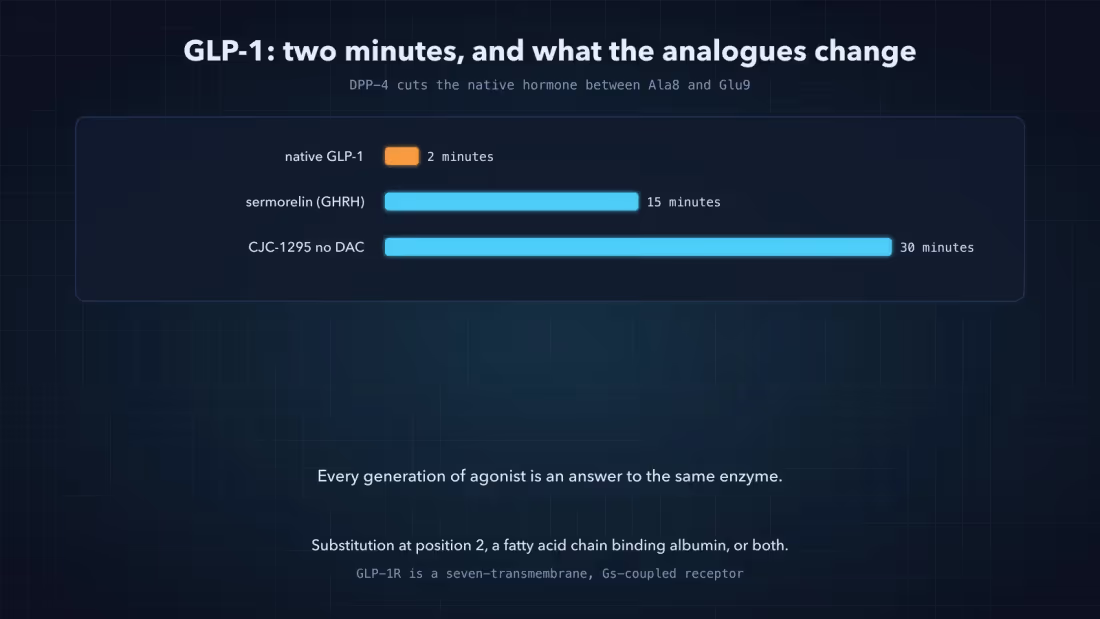
Endogenous GLP-1 has a plasma half-life of about two minutes.
It is inactivated by dipeptidyl peptidase-4 (DPP-4), a ubiquitous enzyme that cleaves the first two N-terminal residues. The resulting fragment can no longer activate the receptor. Renal elimination completes the process.
This fragility is why GLP-1 itself never amounted to a usable agent: infused, it works; injected, it has disappeared before it could act.
Two pharmacological strategies follow, and they are often confused:
Inhibit the enzyme. DPP-4 inhibitors — the gliptins, sometimes written iDPP4 — block the degradation and prolong the action of endogenous GLP-1. The effect remains bounded by physiological secretion.
Make the peptide resistant. Modify the sequence so that DPP-4 can no longer cut it, and slow renal elimination. This is the route taken by the agonists, and it reaches concentrations with no physiological equivalent.
The GLP-1R receptor
The GLP-1 receptor is a class B G protein-coupled receptor, expressed on pancreatic β cells, in several regions of the central nervous system, and at variable levels in other tissues.
Its activation engages mainly the Gs → adenylate cyclase → cAMP → PKA pathway. Class B receptors have a large extracellular domain that captures the C-terminal end of the ligand, while the N-terminal end engages the transmembrane core to trigger activation. This two-stage architecture explains why cleaving the first two residues by DPP-4 is so effective: it removes precisely the part that activates.
In an in-vitro research setting, the activity of an agonist at this receptor is expressed as an EC50 — the concentration producing half of the maximal response. A lower EC50 indicates greater potency. It is a relative measure, dependent on the cell system, the reporter and the conditions; two EC50 values from different protocols are not comparable.
The three generations of agonists
The evolution of this class follows a logic of adding targets.
| Generation | Targets | Principle |
|---|---|---|
| Mono-agonist | GLP-1R | DPP-4 resistance, extended half-life |
| Dual agonist | GLP-1R + GIPR | Addition of the complementary incretin |
| Triple agonist | GLP-1R + GIPR + GCGR | Addition of energy expenditure |
The first generation reproduces the action of GLP-1 while making it durable. Two structural modifications recur systematically: substitution of the residue cleaved by DPP-4 — often with α-aminoisobutyric acid (Aib) — and the addition of a fatty acid chain that binds reversibly to albumin, sequestering the peptide in circulation.
The second generation adds the GIP receptor. The two incretins acting in physiological synergy, engaging them together produces a greater effect than either alone.
The third generation adds the glucagon receptor. The choice is counter-intuitive — glucagon agonism raises blood glucose — but it is associated in the literature with an increase in energy expenditure. Concomitant GLP-1/GIP agonism is what offsets the glycaemic effect. Retatrutide belongs to this generation, and its mechanistic dossier sets out that balance.
“GLP-3” does not exist
The term circulates online, sometimes written GLP-3RT, as a designation for retatrutide. It has no scientific existence.
There is no third member of a GLP series that would be more potent than the second. Proglucagon produces GLP-1 and GLP-2 — the latter acting on the intestinal mucosa, unrelated to glucose metabolism. A triple agonist is not a “GLP-3”: it is a single molecule engaging three distinct receptors, only one of which is a GLP receptor.
Amylin: a parallel route
A neighbouring class deserves to be distinguished, because it is often filed with the incretins when its mechanism is different.
Amylin is co-secreted with insulin by the β cell. Its described effects — slowing of gastric emptying, satiety signalling — act through the amylin receptors, not through GLP-1R. Cagrilintide is a long-acting amylin analogue, studied in combination models with the incretin agonists precisely because the two routes are independent.
What modulates endogenous secretion
Research on “natural GLP-1” concerns the determinants of its secretion by the L cells, distinct from any pharmacological intervention.
L cells are concentrated in the ileum and the colon, that is, downstream of most absorption. They are therefore fully stimulated only by nutrients that reach the distal intestine.
The literature describes several secretory factors. Short-chain fatty acids — produced by microbial fermentation of fibre — activate receptors expressed on L cells. Proteins and amino acids are among the most studied stimuli. Bile acids act through the TGR5 receptor. Transit speed governs the exposure of the distal intestine.
These mechanisms explain why endogenous secretion varies with the composition of a meal and not only with its caloric load. They also explain the difference in scale with pharmacology: physiological secretion is pulsatile, brief and bounded, whereas a DPP-4-resistant agonist maintains continuous receptor occupancy for several days. These are not two intensities of the same phenomenon, but two different regimes.
Analytical considerations
For a laboratory handling these compounds as reference materials, a few properties of the class govern characterisation.
These are long peptides. Thirty residues and more for the lipidated agonists, synthesised over a large number of coupling cycles. The expected impurity profile is dominated by truncated sequences, structurally close to the intended product and often poorly resolved by chromatography.
Lipidation is a control point. A fatty acid chain that is absent, or grafted at an incorrect position, changes the mass distinctly. It is a defect that a high HPLC purity can mask and that mass spectrometry settles unambiguously.
Non-natural residues complicate assignment. Aib and the other substitutions introduced to resist DPP-4 shift the theoretical mass relative to what a naive reading of the sequence would suggest. The reference mass must come from the compound’s data sheet, not from an improvised calculation.
The guide to reading an analysis report sets out the cross-reading of HPLC and mass spectrometry that this profile demands.
What this page does not cover
Searches concerning dosage, or how to take a GLP-1 agonist, relate to prescribed medicines, dispensed by pharmacies and administered under medical supervision. That information is a matter for a healthcare professional and for the product’s own leaflet — it does not appear here, and no administration schedule is proposed.
The materials presented on this site belong to the metabolism and GLP-1 category but are analytical standards intended exclusively for in-vitro research. They are neither medicines nor equivalents of authorised medicines. Each dosage carries the Janoshik analysis report for the corresponding lot, readable before purchase: that is the only register in which we make claims.
Frequently asked questions
GLP-1: what is the definition? A peptide hormone of 30 to 31 amino acids secreted by the L cells of the intestine after a meal. It potentiates insulin secretion in a glucose-dependent manner, restrains glucagon, slows gastric emptying and takes part in satiety signalling.
Is GLP-1 natural? Yes. It is produced continuously by a healthy intestine. The agonists, by contrast, are synthetic molecules designed to resist the degradation that limits the natural hormone to a half-life of about two minutes.
What is the difference between GLP-1 and GLP1? None: they are two spellings of the same acronym. “GLP 1” is also encountered.
What is DPP-4? Dipeptidyl peptidase-4, the enzyme that inactivates GLP-1 by cleaving its first two residues. Inhibitors of this enzyme are sometimes written iDPP4.
What is an EC50? The concentration of a compound producing half of its maximal response in a given system. It measures potency, depends entirely on the experimental conditions, and is not comparable from one protocol to another.
See also: Peptides in pharmacies, without a prescription: the French framework