Comparison
GLOW vs KLOW: the difference is one tripeptide
Three components or four: what separates the two blends, what that costs analytically, and when a blend is the wrong material.
Translated from the French original, which remains the reference version: lire en français →
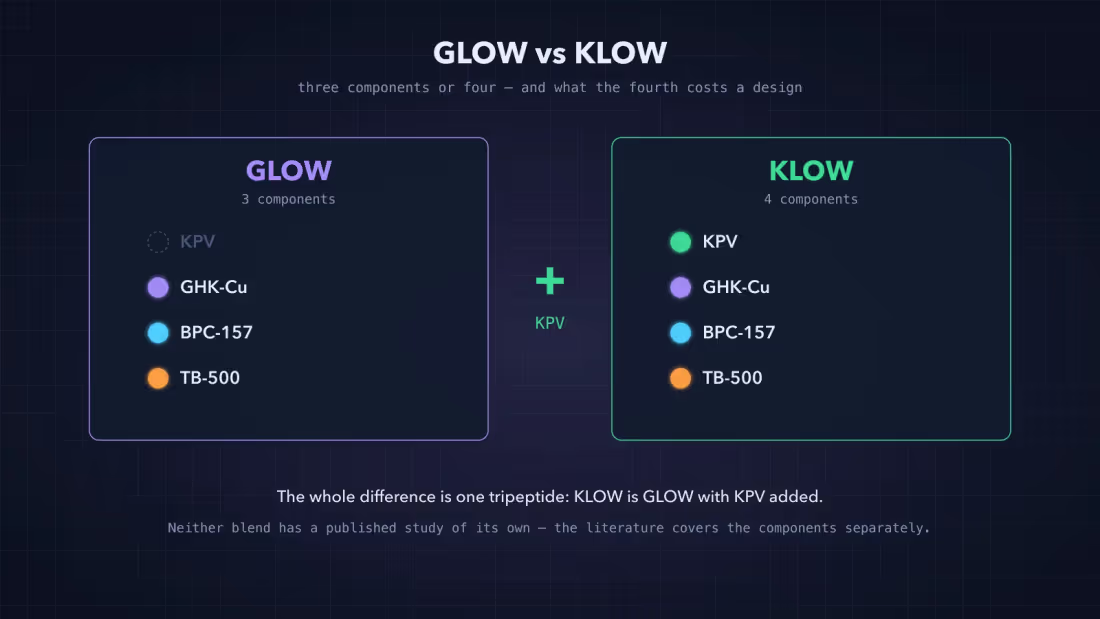
The two blends are sold side by side and the names give almost nothing away. The difference is a single component.
This article sets out what each contains, what the addition changes, and what both share as mixtures. It contains no information on use.
Composition
| Critère | GLOW | KLOW |
|---|---|---|
| KPV | — | Yes |
| GHK-Cu | Yes | Yes |
| BPC-157 | Yes | Yes |
| TB-500 | Yes | Yes |
| Components | 3 | 4 |
| CAS number | None (blend) | None (blend) |
| Molecular mass | Not applicable | Not applicable |
That is the whole difference: KLOW is GLOW with KPV added. The letters G, L, O and W do not each stand for a component — “KLOW” is “K” prefixed to the existing name.
What KPV adds
KPV is Lys-Pro-Val, the final three residues of α-melanocyte-stimulating hormone. Two things distinguish it from the other three components.
It is the smallest by a wide margin — a tripeptide against a copper-complexed tripeptide, a 15-residue fragment and a 43-residue protein derivative. And it is one of the few peptides with a documented intestinal transport route: work published in Gastroenterology described its transport by PepT1, the transporter for di- and tripeptides. See the KPV dossier and our guide to oral peptides.
Its studied mechanism — the NF-κB pathway — is also distinct from the three others, which is the logic of adding it rather than increasing the dose of something already present.
What the fourth component costs
Each component added multiplies what a rigorous design has to control for.
To attribute an observed effect to a component, a design needs an arm exposing the system to that component alone. For three components a complete factorial design is seven conditions plus a control; for four it is fifteen plus a control. The blend does not make that requirement go away — it just makes it more expensive to satisfy.
Neither blend has a study of its own. The literature covers the four compounds individually. No published work examines either three-component or four-component combination as such, so nothing about the pair of blends can be settled by citation.
Analytically, both face the same situation set out in our KLOW article: no CAS number, no molecular mass, purity that must be read per constituent, and storage conditions governed by the most fragile component.
Choosing between them
The honest framing is narrow, because the broad one would be a claim we are not in a position to make.
- If the research question concerns KPV specifically, neither blend is the right material. Use KPV on its own, where a concentration can be set and a control arm run.
- If the question concerns a combination, the blends exist for that, and the choice between three and four components is a choice about how many variables the design carries.
- If the question concerns any single component, the individual references are available and are the correct material.
A blend is a convenience, not an upgrade. It is the right material when the combination is the object of study, and the wrong one whenever a component is.
Verification
Both are supplied with a Janoshik lot report covering the constituents. For a blend, the checks are: every component identified, the lot number matching the vial, and a quantitative content per component — the ratio between constituents being part of what the vial is. Our guide to reading an analysis report sets out how to read one, and the lot report register collects them.
What is the difference between GLOW and KLOW?
KPV. GLOW is GHK-Cu + BPC-157 + TB-500; KLOW is those three plus the KPV tripeptide.
Is KLOW better than GLOW?
Neither blend has a study of its own, so there is no published basis for ranking them. They differ by one component, and which is appropriate depends on what a design is testing.
Do GLOW and KLOW have CAS numbers?
No. Both are mixtures, so neither has a CAS number or a molecular mass of its own.
What does GLOW stand for?
It is a trade name rather than an initialism of its contents. KLOW is formed by prefixing “K”, for KPV, to it.
Further reading: KLOW: what is in the blend · The Wolverine stack explained · Copper peptides compared