Regulatory framework
Peptides and doping: what the WADA 2026 Prohibited List says
BPC-157, TB-500, CJC-1295, GHRPs, MOTS-c: section by section, the peptides covered by the list in force since 1 January 2026, and the French framework that applies it.
Translated from the French original, which remains the reference version: lire en français →
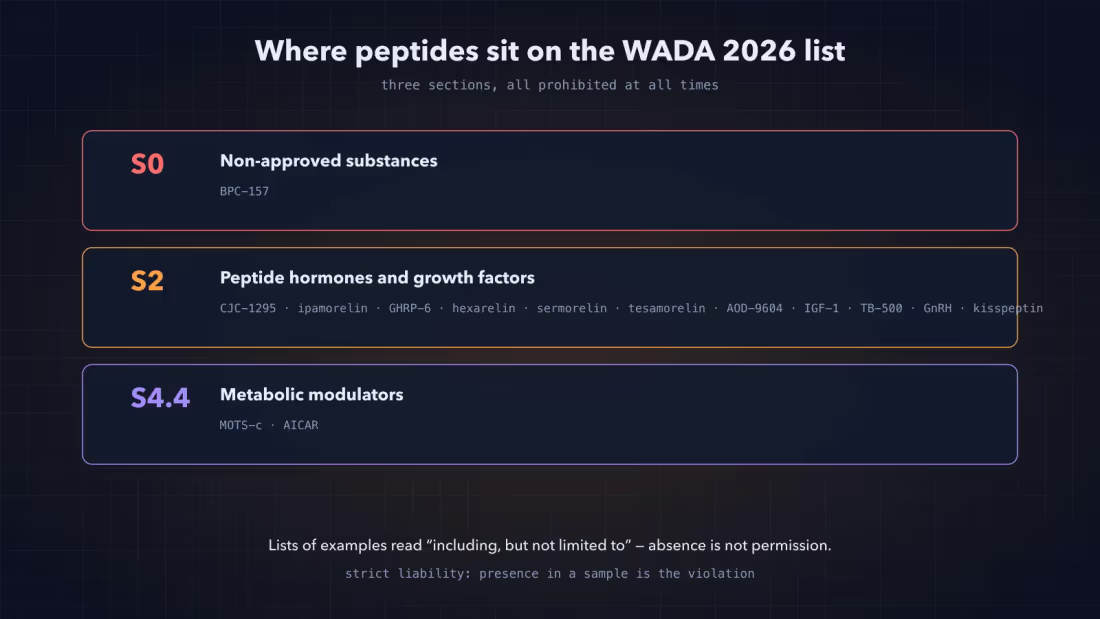
The Prohibited List of the World Anti-Doping Agency (WADA) is revised every year. The 2026 version, adopted by WADA’s executive committee on 11 September 2025, has been in force since 1 January 2026. It applies to every athlete subject to the World Anti-Doping Code, in competition and out of competition.
This guide describes the sections that concern peptides and maps them against the references in our catalogue. The materials we offer are intended exclusively for in-vitro laboratory research. They are not intended for athletes, nor for any administration to humans.
How the list is organised
The list distinguishes substances prohibited at all times (sections S0 to S5) from those prohibited in competition only (S6 to S9). Peptides almost all fall into the first category: they are prohibited at any time, including during training.
Three sections concern them directly:
| Section | Title | What it covers |
|---|---|---|
| S0 | Non-approved substances | Any pharmacological substance with no authorisation for human therapeutic use |
| S2 | Peptide hormones, growth factors, related substances and mimetics | GH, its fragments, its releasing factors, growth factors, peptides of the gonadotropic axis |
| S4.4 | Metabolic modulators | AMPK activators, insulins and mimetics |
The lists of examples are all preceded by the wording “including, but not limited to”: a substance absent from the examples may perfectly well be prohibited.
S0: the non-approved substances clause
Section S0 prohibits at all times any pharmacological substance that is not addressed by any other section and that has no current authorisation from a health authority for human therapeutic use. It explicitly covers medicines in preclinical or clinical development, discontinued medicines and substances reserved for veterinary use.
The 2026 text cites BPC-157 at the head of its examples. It is one of the few peptides named in this section.
By construction, the S0 clause also covers most research peptides that are named nowhere else, as soon as they hold no authorisation in any country. A substance authorised somewhere in the world, even outside Europe, does not fall under S0 — but may fall under another section.
S2: peptide hormones and growth factors
This is the fullest section for peptides. All its substances are non-specified, which exposes an athlete to heavier sanctions.
S2.2.1 — Testosterone-stimulating peptides, in males
The list names chorionic gonadotrophin, LH, GnRH (gonadorelin) and its agonist analogues, together with kisspeptin and its agonist analogues. These substances are prohibited in male athletes. See the gonadorelin and kisspeptin dossiers.
S2.2.3 — Growth hormone, analogues and fragments
Besides GH and its long-acting analogues, the list names GH fragments, with AOD-9604 and hGH 176-191 as examples. See the AOD-9604 dossier.
S2.2.4 — GH releasing factors
The list names three families:
- GHRH and its analogues, with CJC-1293, CJC-1295, sermorelin and tesamorelin as examples;
- GH secretagogues and their mimetics, including ipamorelin, ibutamoren (MK-677), anamorelin and ghrelin;
- the GHRPs, including examorelin (hexarelin), GHRP-2 (pralmorelin) and GHRP-6.
The mention of tesamorelin shows that a marketing authorisation offers no protection: an authorised medicine remains prohibited if it appears in a section. See the GHRH / GHRP comparison.
S2.3 — Facteurs de croissance
The list names IGF-1 and its analogues, mechano growth factors (MGF) and thymosin β4 and its derivatives, for example TB-500. IGF-1 LR3 is an analogue of IGF-1. See the TB-500 and IGF-1 LR3 dossiers.
S2.1.5 — Innate repair receptor agonists
This sub-section, attached to the agents acting on erythropoiesis, names asialo-EPO and carbamylated EPO. ARA-290 is described in the literature as an agonist of that same receptor.
S4.4: metabolic modulators
Section S4.4.1 names AMPK activators, including AICAR and MOTS-c, a peptide of mitochondrial origin. Section S4.4.2 covers insulins and insulin mimetics. See the MOTS-c dossier.
Mapping against the catalogue references
| Reference | Section | Mention in the 2026 list |
|---|---|---|
| BPC-157 | S0 | Named as an example |
| TB-500 | S2.3 | Named (thymosin β4 derivative) |
| CJC-1295, CJC-1295 DAC | S2.2.4 | Named |
| Sermorelin, Tesamorelin | S2.2.4 | Named |
| Ipamorelin | S2.2.4 | Named |
| GHRP-2, GHRP-6, Hexarelin | S2.2.4 | Named |
| Gonadorelin, Kisspeptin | S2.2.1 | Named, in males |
| AOD-9604 | S2.2.3 | Named |
| IGF-1 LR3 | S2.3 | An IGF-1 analogue, named as a class |
| MOTS-c | S4.4.1 | Named |
| Peptides with no authorisation anywhere | S0 | General clause |
This table is informational. Classifying a substance is a matter for WADA and, in France, for the AFLD. In case of doubt, their interpretation prevails.
The French framework
In France, anti-doping comes under the Sports Code. Article L.232-9 prohibits an athlete from holding or using, without a duly justified medical reason, a substance appearing on the list. Article L.232-10 prohibits anyone from prescribing, administering, transferring or offering these substances to an athlete. The WADA list is made applicable in French law by decree.
The Agence française de lutte contre le dopage (AFLD) organises testing, investigates cases and grants therapeutic use exemptions.
Strict liability and TUEs
The World Anti-Doping Code rests on strict liability: the mere presence of a prohibited substance in a sample constitutes a violation, without any need to prove intent. A contamination, a mislabelled food supplement or a product bought without knowing its composition is not an automatic excuse.
An athlete whose state of health requires a medicine appearing on the list may apply for a therapeutic use exemption (TUE). It applies only to medicines prescribed in a medical setting. It cannot cover a research material.
Detection
WADA-accredited laboratories detect most of these peptides by liquid chromatography coupled to mass spectrometry (LC-MS/MS), in urine or blood. The GHRPs and their metabolites, along with several GHRH analogues, have been the subject of published methods since the 2010s. Samples can be stored and reanalysed for ten years.
Frequently asked questions
Is BPC-157 prohibited by WADA?
Yes. It is cited as an example in section S0 of non-approved substances, prohibited at all times.
Is TB-500 prohibited?
Yes. Section S2.3 covers thymosin β4 and its derivatives, citing TB-500.
Are CJC-1295 and ipamorelin prohibited?
Yes. Both are named in section S2.2.4, among the growth hormone releasing factors.
Is a peptide absent from the list permitted?
Not necessarily. The lists of examples are not exhaustive, and the S0 clause prohibits any substance without therapeutic authorisation, whether named or not.
Can the peptides on this site be used by athletes?
No. They are reference materials for in-vitro research. They are intended for no administration to humans.
Further reading: The legal framework: pharmacy, prescription and research materials · Choosing a peptide supplier in France
References
- World Anti-Doping Agency. Prohibited List 2026, in force on 1 January 2026. wada-ama.org
- Agence française de lutte contre le dopage. afld.fr