Comparison
CJC-1295, Ipamorelin, GHRP-6: GHRH analogues and GHRPs compared
Two families of growth hormone secretagogues, two different receptors — and the difference between CJC-1295 with and without DAC.
Translated from the French original, which remains the reference version: lire en français →
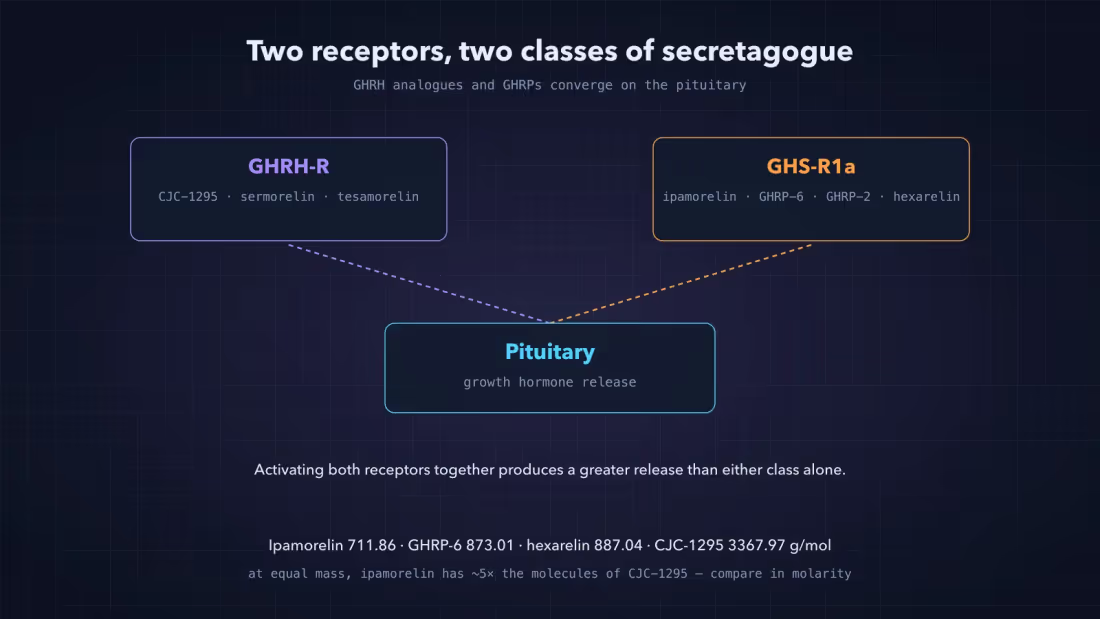
Growth hormone secretagogues form a family of peptides studied for their ability to stimulate the release of GH by the pituitary. They are often presented in a jumble, whereas they divide into two clearly distinct classes according to the receptor they activate.
This comparison places the three references in our catalogue — CJC-1295 without DAC, Ipamorelin and GHRP-6 — within that organisation. It contains no information on use.
Two receptors, two classes
The pituitary releases growth hormone under the effect of two principal signals:
- GHRH (growth hormone-releasing hormone), the hypothalamic hormone that acts at the GHRH-R receptor;
- ghrelin, which acts at the GHS-R1a receptor, also called the growth hormone secretagogue receptor.
The GHRH analogues mimic the first signal; the GHRPs (growth hormone-releasing peptides) activate the second. CJC-1295 belongs to the first class; Ipamorelin and GHRP-6 to the second.
In brief
| Critère | CJC-1295 without DAC | Ipamorelin | GHRP-6 |
|---|---|---|---|
| Class | GHRH analogue | GHRP | GHRP |
| Receptor | GHRH-R | GHS-R1a | GHS-R1a |
| Length | 29 amino acids | 5 amino acids | 6 amino acids |
| CAS number | 863288-34-0 | 170851-70-4 | 87616-84-0 |
| Molecular formula | C₁₅₂H₂₅₂N₄₄O₄₂ | C₃₈H₄₉N₉O₅ | C₄₆H₅₆N₁₂O₆ |
| Molecular mass | 3367.97 g/mol | 711.86 g/mol | 873.01 g/mol |
| Distinguishing feature | Four stabilising substitutions | Selectivity described for GH | Marked orexigenic effect |
The CAS, formula and mass values are those of the pages in our catalogue.
Tesamorelin and hexarelin: the other members of the two families
Two further catalogue references complete these two classes.
| Critère | Tesamorelin | Hexarelin |
|---|---|---|
| Class | GHRH analogue | GHRP |
| Receptor | GHRH-R | GHS-R1a (and CD36) |
| Length | 44 amino acids | 6 amino acids |
| CAS number | 218949-48-5 | 140703-51-1 |
| Molecular mass | 5135.86 g/mol | 887.04 g/mol |
| Distinguishing feature | Complete GHRH, end protected from DPP-4 | Methylated derivative of GHRP-6, poorly selective |
Tesamorelin takes the opposite approach to CJC-1295: instead of shortening GHRH to 29 amino acids, it keeps all 44 and protects only the N-terminal end with a trans-3-hexenoyl group. It is also the only compound of this family to have been authorised as a medicine, in the United States, for a precise indication. See our tesamorelin dossier.
Hexarelin is a GHRP-6 to which a methyl group has been added on a tryptophan. More potent than its precursor in the work that characterised it, it is also the least selective of the family and binds the CD36 receptor. See our hexarelin dossier.
Two further references attach to these families. Sermorelin is the 1-29 fragment of human GHRH, the shortest sequence described as retaining the activity of the hormone: it is the direct ancestor of CJC-1295, which takes up its 29 amino acids and adds four substitutions. GHRP-2 — international name pralmorelin — is a hexapeptide of the GHRP family, close to GHRP-6 and an agonist at the same GHS-R1a receptor.
CJC-1295: with or without DAC, two different compounds
CJC-1295 without DAC, also called Mod GRF (1-29), takes up the first 29 amino acids of GHRH — the portion sufficient for its activity — and introduces four substitutions that protect it from enzymatic degradation. Its reported half-life remains short, on the order of half an hour.
CJC-1295 with DAC adds a group (drug affinity complex) that binds covalently to circulating albumin. That grafting extends the reported half-life to several days. The two compounds are not interchangeable: release profile, studied duration of action and molecular mass all differ. Our catalogue offers both: CJC-1295 without DAC and CJC-1295 with DAC.
Our CJC-1295 dossier details its sequence and its substitutions.
Ipamorelin or GHRP-6: the question of selectivity
Both are agonists at the GHS-R1a receptor, but their profiles differ.
GHRP-6, a hexapeptide, is among the first GHRPs described, in the 1980s. By mimicking ghrelin, it produces an orexigenic effect — a stimulation of appetite — that is marked in the models studied, and it can be accompanied by an elevation of cortisol and prolactin.
Ipamorelin, a more recent pentapeptide, was described at the end of the 1990s as the first selective GHRP: in the animal studies that characterised it, it stimulated GH release without a notable elevation of ACTH or cortisol. See our Ipamorelin and GHRP-6 dossiers.
The GHRH + GHRP synergy
The reason these two classes are so often paired has been documented for a long time. Activating both receptors simultaneously produces, in the published work, a GH release greater than the sum of the effects of each class given alone.
That is the principle of the CJC-1295 + Ipamorelin blend. As with any pairing, a rigorous experimental design tests each compound separately before the blend, failing which the observed effect cannot be attributed.
Analytical considerations
The molecular masses of these three compounds range from 711.86 to 3367.97 g/mol. At equal mass, an Ipamorelin solution therefore contains nearly five times more molecules than a CJC-1295 solution: comparisons must be made in molarity.
Identity is checked by mass spectrometry, and the length of CJC-1295 makes it more exposed to synthesis errors than a pentapeptide: the chromatographic purity of each lot deserves to be verified on the analysis report.
Frequently asked questions
What is the difference between GHRH and GHRP?
GHRH analogues, such as CJC-1295, activate the GHRH-R receptor. The GHRPs, such as Ipamorelin and GHRP-6, activate the GHS-R1a receptor, the ghrelin receptor. These are two distinct routes to GH release.
Ipamorelin or GHRP-6: which is the more selective?
Ipamorelin was characterised as selective for GH, without a notable elevation of cortisol in the initial animal studies. GHRP-6 comes with a marked orexigenic effect.
What is the difference between CJC-1295 with and without DAC?
The DAC is a group that fixes the molecule to albumin and extends its reported half-life from a few tens of minutes to several days. They are two distinct compounds; our catalogue offers both.
Are these peptides prohibited for athletes?
Yes. GHRH analogues and growth hormone secretagogues appear in section S2 of the World Anti-Doping Agency prohibited list.