Research dossier
Tesamorelin — dossier on the stabilised GHRH analogue
The complete 44-amino-acid GHRH, protected from degradation by a single group added at its end.
Translated from the French original, which remains the reference version: lire en français →
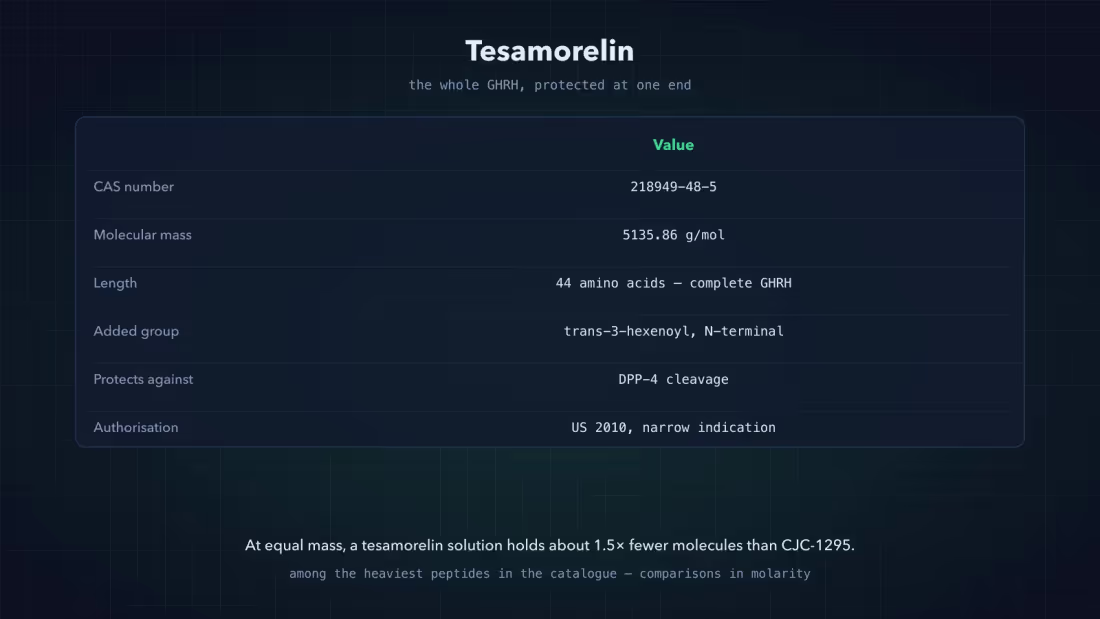
Tesamorelin — developed under the code TH9507 — is a synthetic analogue of GHRH (growth hormone-releasing hormone), the hypothalamic hormone that commands the release of growth hormone by the pituitary. It is distinguished from the other analogues by a simple design choice: keep the complete sequence of the hormone and modify only its end.
This dossier describes its identity, its mechanism, the published literature and its analytical parameters. It contains no information on use.
Molecular identity
| Parameter | Value |
|---|---|
| CAS number | 218949-48-5 |
| Molar mass | 5135.86 g/mol |
| Molecular formula | C₂₂₁H₃₆₆N₇₂O₆₇S |
| Sequence / nature | trans-3-hexénoyl-GHRH (1-44)-NH₂ |
| Purity | ≥99% |
| Appearance | White lyophilised powder |
The values above correspond to the lot in the catalogue and are carried over as they stand from the product page. They agree with the compound’s PubChem record.
The problem the modification solves
Natural GHRH is rapidly inactivated in the body. An enzyme, dipeptidyl peptidase-4 (DPP-4), cuts off its first two amino acids and renders it inactive within minutes — the same mechanism that limits the lifetime of GLP-1, described in our GLP-1 dossier.
Tesamorelin adds a trans-3-hexenoyl group to the N-terminal tyrosine. That addition masks the site recognised by DPP-4 and confers markedly greater enzymatic resistance on the peptide, without modifying the rest of the sequence or its ability to activate the receptor.
Mechanism studied
Like GHRH, tesamorelin binds to the GHRH-R receptor of the somatotroph cells of the pituitary. Its activation triggers the secretion of growth hormone, which in turn stimulates the production of IGF-1, mainly by the liver.
One point distinguishes it from the secretagogues of the GHRP family, such as hexarelin or Ipamorelin: it acts upstream, on the hypothalamic signal itself, and preserves the pulsatile character of secretion described in the literature.
Littérature publiée
Tesamorelin is one of the few peptides of this family to have gone through a complete clinical development. It was authorised in the United States in 2010, for a precise indication: the reduction of excess abdominal adipose tissue in patients living with HIV and presenting with lipodystrophy.
The published trials dealt with visceral adipose tissue and, more recently, with liver fat content in that same population. This work concerns the authorised medicine, within its clinical trial framework; it does not transpose to a research reference material.
Regulatory status
Tesamorelin has no marketing authorisation in France or in the European Union. Like all GHRH analogues, it appears in section S2 of the World Anti-Doping Agency prohibited list. See our article on the legal framework for peptides in France.
Distinguishing this compound from its analogues
| Critère | Tesamorelin | CJC-1295 without DAC |
|---|---|---|
| Length | 44 amino acids | 29 amino acids |
| Stabilisation strategy | N-terminal trans-3-hexenoyl group | Four amino acid substitutions |
| Molecular mass | 5135.86 g/mol | 3367.97 g/mol |
| Receptor | GHRH-R | GHRH-R |
The two compounds target the same receptor by two opposite strategies: keep the whole hormone, or shorten it to its active part. Our comparison of secretagogues places them among the other members of the family.
Methodological limits
The available clinical data concern a precise population and indication. Studies outside that framework are distinctly fewer. The size of the molecule — 44 amino acids — also makes its synthesis more demanding than that of a short peptide, which gives the analytical control of each lot a particular importance.
Analytical parameters
With a mass of 5135.86 g/mol, tesamorelin is among the heaviest peptides in the catalogue. Its identity is verified by mass spectrometry, and its purity by high-performance liquid chromatography. At equal mass, a tesamorelin solution contains about 1.5 times fewer molecules than a CJC-1295 solution: comparisons must be made in molarity.
Lot verification
The 10 mg format has a Janoshik analysis report for lot PSE-2026-TESA-1, readable from the product page and in the lot report register.
Frequently asked questions
Are tesamorelin and TH9507 the same compound?
Yes. Tesamorelin is the international nonproprietary name; TH9507 was its development code.
What is the difference between tesamorelin and CJC-1295?
Both are GHRH analogues. Tesamorelin keeps the 44 amino acids of the hormone and protects its end with a trans-3-hexenoyl group; CJC-1295 without DAC keeps only 29 of them, stabilised by four substitutions.
Is tesamorelin authorised in France?
No. It has been authorised in the United States since 2010 for a precise indication, but holds no marketing authorisation in France or in the European Union.
Why the trans-3-hexenoyl group?
It masks the DPP-4 cleavage site at the end of the molecule, which protects it from the rapid enzymatic inactivation that natural GHRH undergoes.
See also: CJC-1295, Ipamorelin, GHRP-6: GHRH and GHRP compared · Hexarelin: the dossier
Dossiers in the same category
- CJC-1295 (without DAC) — CAS 863288-34-0
- Ipamorelin — CAS 170851-70-4
- Hexarelin — CAS 140703-51-1
References
- Falutz J, et al. Metabolic effects of a growth hormone-releasing factor in patients with HIV. N Engl J Med. 2007. PubMed