Research dossier
Hexarelin — dossier on the GHS-R1a receptor secretagogue
A hexapeptide derived from GHRP-6, among the most potent of its family — and one of the few to also bind the CD36 receptor.
Translated from the French original, which remains the reference version: lire en français →
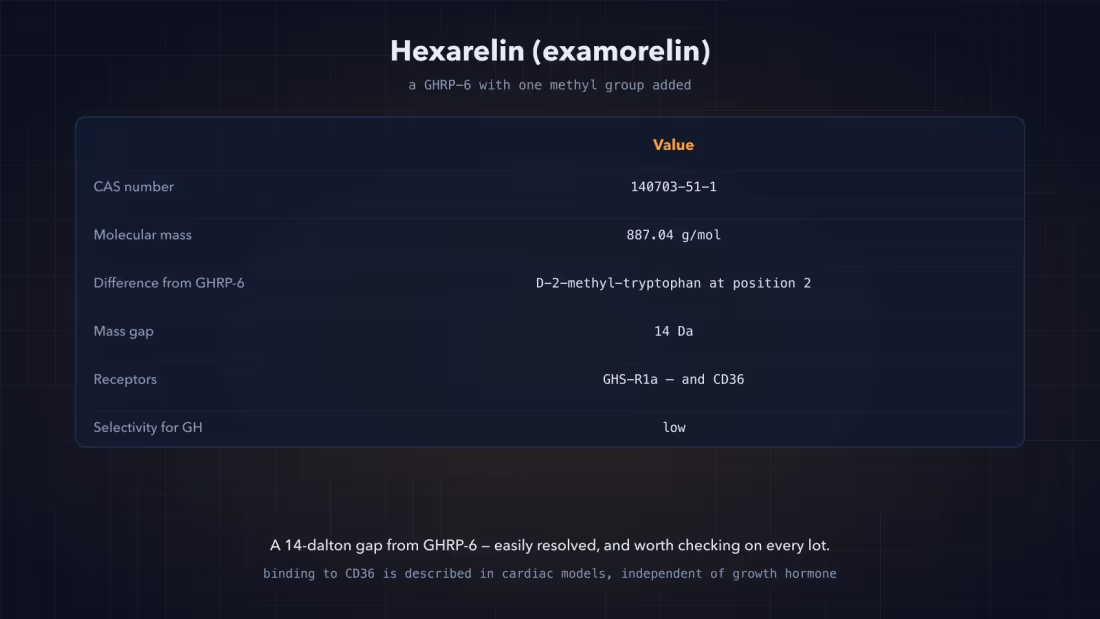
Hexarelin — international nonproprietary name examorelin — is a hexapeptide of the GHRP (growth hormone-releasing peptides) family. It was designed in the early 1990s as a derivative of GHRP-6, with one objective: to obtain a more marked release of growth hormone.
This dossier describes its identity, its studied mechanisms, the limits of its literature and its analytical parameters. It contains no information on use.
Molecular identity
| Parameter | Value |
|---|---|
| CAS number | 140703-51-1 |
| Molar mass | 887.04 g/mol |
| Molecular formula | C₄₇H₅₈N₁₂O₆ |
| Sequence / nature | His-D-2-Me-Trp-Ala-Trp-D-Phe-Lys-NH₂ |
| Purity | ≥99% |
| Appearance | White lyophilised powder |
The values above are those of the product page and agree with the compound’s PubChem record, listed under its international name, examorelin.
Lineage from GHRP-6
The sequence of hexarelin reproduces that of GHRP-6 with one difference: the D-tryptophan in second position is replaced by a D-2-methyl-tryptophan. That additional methyl group — the only difference between the two formulas — was enough, in the work that characterised it, to produce a greater GH release than its precursor.
Mechanism studied: the GHS-R1a receptor
Like the other GHRPs, hexarelin activates the GHS-R1a receptor, the ghrelin receptor, on the cells of the pituitary and hypothalamus. That activation triggers the release of growth hormone by a pathway distinct from that of GHRH and analogues such as tesamorelin or CJC-1295.
It is not selective for GH. The published studies also describe an elevation of ACTH, cortisol and prolactin — the opposite of Ipamorelin, characterised precisely for its selectivity.
A second target: the CD36 receptor
Hexarelin has a feature rare in its family. Work has shown that it binds the CD36 receptor, a scavenger receptor expressed notably in cardiac tissue. In animal models, that binding has been associated with effects on the heart independent of growth hormone. These observations remain preclinical.
The question of desensitisation
Several studies have described an attenuation of the growth hormone response during prolonged exposure to hexarelin. This desensitisation is an important parameter in any experimental design covering extended durations.
Regulatory status
Hexarelin is not authorised as a medicine in any country. Like all growth hormone secretagogues, it appears in section S2 of the World Anti-Doping Agency prohibited list. See our article on the legal framework for peptides in France.
Distinguishing this compound from its analogues
| Critère | Hexarelin | GHRP-6 | Ipamorelin |
|---|---|---|---|
| Length | 6 amino acids | 6 amino acids | 5 amino acids |
| Molecular mass | 887.04 g/mol | 873.01 g/mol | 711.86 g/mol |
| Selectivity for GH | Low | Low | High |
| CD36 binding described | Yes | — | — |
Methodological limits
The literature on hexarelin is mainly old, concentrated in the 1990s and 2000s. The work on the CD36 receptor remains preclinical, and desensitisation complicates the interpretation of prolonged exposure studies.
Analytical parameters
With a mass of 887.04 g/mol, hexarelin differs from GHRP-6 (873.01 g/mol) only by a methyl group, a gap of 14 daltons. That gap is easily resolved by mass spectrometry, but it makes it necessary to verify the identity of each lot: a material sold as hexarelin must show the mass of hexarelin, not that of GHRP-6.
Lot verification
The Janoshik certificates of analysis for the catalogue are collected in the lot report register, where each report is tied to the strength and the lot it analyses.
Frequently asked questions
Do hexarelin and examorelin designate the same compound?
Yes. Hexarelin is the common name and examorelin the international nonproprietary name.
What is the difference between hexarelin and GHRP-6?
A methyl group on the tryptophan in second position. That modification produced a more marked GH release in the work that characterised it.
Is hexarelin selective for growth hormone?
No. The studies also describe an elevation of ACTH, cortisol and prolactin. Ipamorelin is the GHRP characterised for its selectivity.
What is the CD36 receptor?
A receptor expressed notably in cardiac tissue, to which hexarelin binds. The associated effects were observed in animal models, independently of growth hormone.
Further reading: CJC-1295, Ipamorelin, GHRP-6: GHRH and GHRP compared · Tesamorelin: the dossier
Dossiers in the same category
- GHRP-6 — CAS 87616-84-0
- Ipamorelin — CAS 170851-70-4
- Tésamoréline — CAS 218949-48-5
References
- Ghigo E, et al. Growth hormone-releasing activity of hexarelin, a new synthetic hexapeptide, after intravenous, subcutaneous, intranasal, and oral administration in man. J Clin Endocrinol Metab. 1994. PubMed