Research dossier
Gonadorelin — dossier on synthetic GnRH
A decapeptide identical to the natural hypothalamic hormone, whose effect depends entirely on the rhythm of exposure.
Translated from the French original, which remains the reference version: lire en français →
Gonadorelin is the synthetic form of GnRH (gonadotropin-releasing hormone), also called LHRH. It is the hypothalamic hormone that commands the release of luteinising hormone (LH) and follicle-stimulating hormone (FSH). Its structure was established in 1971 by the teams of Andrew Schally and Roger Guillemin, work rewarded by the Nobel Prize in Medicine in 1977.
This dossier describes its identity, its studied mechanism and its analytical parameters. It contains no information on use.
Molecular identity
| Parameter | Value |
|---|---|
| CAS number | 33515-09-2 |
| Molar mass | 1182.3 g/mol |
| Molecular formula | C₅₅H₇₅N₁₇O₁₃ |
| Sequence / nature | pGlu-His-Trp-Ser-Tyr-Gly-Leu-Arg-Pro-Gly-NH₂ |
| Purity | ≥99% |
| Appearance | White lyophilised powder |
The values above are those of the product page. The sequence is identical to that of natural human GnRH. Both of its ends are blocked: a pyroglutamate (pGlu) at the N-terminus, a glycinamide at the C-terminus.
Studied mechanism: the GnRHR receptor
Gonadorelin binds to the GnRH receptor (GnRHR), a G protein-coupled receptor expressed by the gonadotroph cells of the anterior pituitary. Its activation triggers the release of LH and FSH, which act in turn on the gonads.
In the body, GnRH is itself under the control of kisspeptin, which stimulates the GnRH neurons of the hypothalamus. Kisspeptin therefore acts one storey above gonadorelin. See the kisspeptin dossier.
The pulsatile / continuous paradox
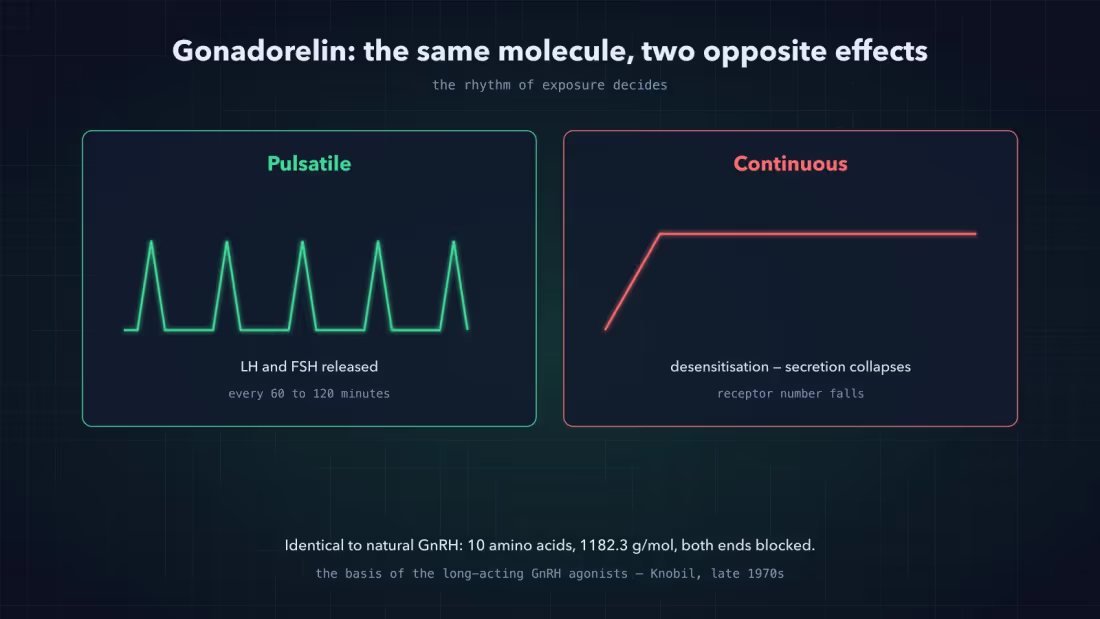
GnRH is naturally secreted in pulses, roughly every 60 to 120 minutes. That rhythm is indispensable to its effect.
- Pulsatile exposure: it stimulates the release of LH and FSH.
- Continuous exposure: after an initial stimulation, it brings about desensitisation and a fall in the number of receptors. LH and FSH secretion collapses.
This phenomenon, described in the work of Ernst Knobil in the late 1970s, is the foundation of the long-acting GnRH agonists such as leuprorelin or triptorelin. Their prolonged exposure puts the gonadotropic axis at rest. It makes the rhythm of exposure the central parameter of any experimental design with gonadorelin.
A half-life of a few minutes
Unmodified, gonadorelin is degraded within minutes, mainly by cleavage between glycine 6 and leucine 7. The synthetic agonists replace precisely that glycine 6 with a D-series amino acid, which slows their degradation and increases their affinity.
Telling gonadorelin apart from the synthetic agonists
| Critère | Gonadorelin | Synthetic agonists (leuprorelin, triptorelin…) |
|---|---|---|
| Sequence | Identical to natural GnRH | Position 6 in the D series, sometimes a modified C-terminus |
| Half-life | A few minutes | Lengthened |
| Effect of prolonged exposure | Desensitisation | Desensitisation, sought |
| Molecular mass | 1182.3 g/mol | Varies with the compound |
Regulatory status
Gonadorelin is an active substance in medicines in several countries, notably for exploring the gonadotropic axis. The reference material offered here is not a medicine and is intended only for in-vitro research. GnRH and its analogues appear in section S2 of the World Anti-Doping Agency prohibited list in humans. See our article on the legal framework for peptides in France.
Methodological limits
The pharmacology of GnRH is very well characterised, but its response depends strongly on the model, the rhythm of exposure and the starting hormonal status. The same concentration can produce stimulation or desensitisation depending on the protocol.
Analytical parameters
At 1182.3 g/mol and ten amino acids, gonadorelin lends itself well to analysis by HPLC and mass spectrometry. Two points deserve attention. The N-terminal pyroglutamate forms by cyclisation: an uncyclised glutamine would give a mass 17 Da higher. The tryptophan at position 3 is sensitive to oxidation, which adds 16 Da.
Gonadorelin is often supplied as the acetate. The counter-ion does not appear in the mass of the peptide but weighs in the vial. See our guide to reading an analysis report.
Lot verification
The Janoshik certificates of analysis for the catalogue are collected in the lot report register, where each report is tied to the strength and the lot it analyses.
Frequently asked questions
Do gonadorelin, GnRH and LHRH designate the same molecule?
Yes. Gonadorelin is the synthetic form of GnRH, also called LHRH. Its sequence is identical to that of the natural hormone.
Why does the effect of gonadorelin depend on rhythm?
The pituitary responds to pulses. Continuous exposure desensitises its receptors, and the release of LH and FSH falls.
What is the difference between gonadorelin and kisspeptin?
Kisspeptin acts on the hypothalamic neurons that secrete GnRH. Gonadorelin acts directly on the pituitary.
What is the difference from leuprorelin or triptorelin?
They are synthetic agonists modified at position 6 to last longer. Gonadorelin is the natural sequence, degraded within minutes.
Further reading: Kisspeptin: the dossier · Oxytocin: the dossier
Dossiers in the same category
- Kisspeptine — CAS 374675-21-5
- Oxytocine
- Sermoréline — CAS 86168-78-7
References
- Schally AV, et al. Hypothalamic follicle-stimulating hormone (FSH) and luteinizing hormone (LH)-regulating hormone: structure, physiology, and clinical studies. Fertil Steril. 1971. PubMed
- Belchetz PE, et al. Hypophysial responses to continuous and intermittent delivery of hypothalamic gonadotropin-releasing hormone. Science. 1978. PubMed