Literature review
Retatrutide and weight loss: what the clinical literature reports
A review of the published phase 2 results — figures, doses studied and adverse events reported.
Translated from the French original, which remains the reference version: lire en français →
Retatrutide (development designation LY3437943) is the first triple agonist to have produced published clinical data. It activates three receptors simultaneously — GLP-1, GIP and glucagon — where semaglutide targets only one and tirzepatide two.
The queries that lead to this compound are often phrased simply — “retatrutide weight loss”, “reta results” — and the published figures about it circulate widely, often distorted and rarely attributed. This document gathers what the published trials actually report, with their conditions and their limits.
The phase 2 trial in obesity
The reference publication is that of Jastreboff et al., in the New England Journal of Medicine in 2023 (Triple–Hormone-Receptor Agonist Retatrutide for Obesity — A Phase 2 Trial, NEJM 2023;389
).Protocole
| Parameter | Value reported |
|---|---|
| Participants | 338 adults with obesity |
| Duration | 48 weeks |
| Design | Randomised, double-blind, placebo-controlled |
| Route | Weekly subcutaneous injection |
| Doses evaluated | 1 mg, 4 mg, 8 mg, 12 mg |
| Escalation | Gradual, over several weeks |
Results on body weight
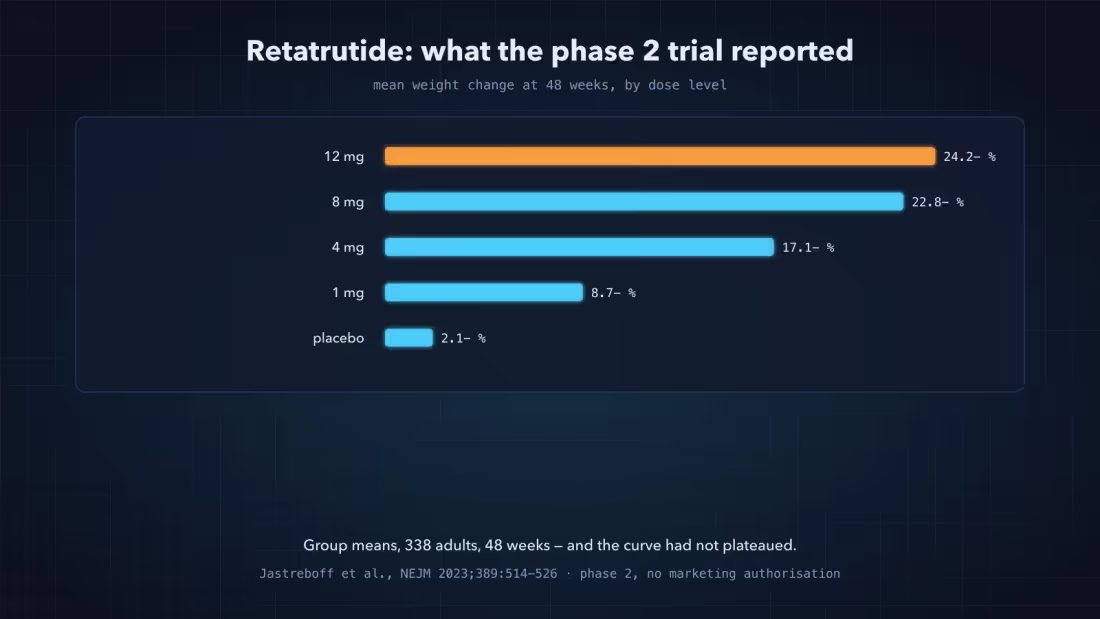
The mean change in body weight reported at 48 weeks varied with dose:
| Group | Mean weight change at 48 weeks |
|---|---|
| Placebo | -2.1% |
| 1 mg | about -8.7% |
| 4 mg | about -17.1% |
| 8 mg | about -22.8% |
| 12 mg | about -24.2% |
The figure of -24.2% at the 12 mg level is the one that drew attention: at publication it was the highest mean weight reduction reported in a phase 2 trial of a pharmacological agent of this class.
Two qualifications are needed to read that figure correctly. It is a group mean: individual dispersion was wide. And the curve had not reached a plateau at 48 weeks, which the authors note explicitly — the trial stopped before the maximal effect had been characterised.
Effets indésirables rapportés
What is commonly called “side effects” appears in the publications under the term adverse events. The most frequently reported adverse events were gastrointestinal: nausea, diarrhoea, vomiting, constipation. They were mostly mild to moderate in intensity, dose-dependent, and concentrated during the dose escalation phase.
That profile is consistent with the GLP-1 receptor agonist class as a whole. The authors also report increases in heart rate, observed mainly at the intermediate levels.
One point deserves emphasis because it is systematically omitted when these figures are repeated: gradual escalation is part of the protocol, and the tolerability profile reported is the one obtained with that escalation, under medical supervision, in a controlled trial.
The trial in type 2 diabetes
A second phase 2 trial, Rosenstock et al., published in The Lancet in 2023, evaluated retatrutide in adults with type 2 diabetes over 36 weeks, with an active comparator (dulaglutide) in addition to placebo.
The results reported covered both glycated haemoglobin and body weight, with reductions greater than those of the comparator at the higher levels. The adverse event profile was again dominated by gastrointestinal manifestations.
Why triple agonism
The mechanistic interest of retatrutide lies in the third target.
GLP-1 — slowing of gastric emptying and central satiety signalling. This is the mechanism of the first-generation agonists.
GIP — potentiation of the insulin response and effects on adipose tissue. Tirzepatide adds this target to GLP-1.
The glucagon receptor — this one differs in nature. Its agonism is associated in the literature with an increase in energy expenditure, whereas the first two targets act mainly on intake. The developers’ working hypothesis is that combined action on both sides of the energy balance explains the magnitude of the effects reported.
It is also what makes the compound pharmacologically delicate: glucagon agonism on its own tends to raise blood glucose, an effect that the concomitant GLP-1/GIP agonism has to offset. The balance between the three activities is a design parameter, not an accident.
The mechanistic dossier details this pharmacology.
Placing the compound among the incretins
Retatrutide belongs to a progression of pharmacological complexity. The table below places the three generations according to the published data of their respective trials — bearing in mind that those trials differ in population, duration and design, and that a direct comparison of the percentages is not rigorous.
| Compound | Targets | Mean weight reduction reported | Regulatory status |
|---|---|---|---|
| Semaglutide | GLP-1 | about -15% at 68 weeks (STEP 1, phase 3) | Authorised |
| Tirzepatide | GLP-1 + GIP | about -20.9% at 72 weeks (SURMOUNT-1, phase 3) | Authorised |
| Retatrutide | GLP-1 + GIP + glucagon | about -24.2% at 48 weeks (phase 2) | No authorisation |
Two reservations apply. The retatrutide row comes from a phase 2 trial in 338 participants; the other two come from phase 3 trials in far larger numbers. A phase 2 result does not carry the same evidential weight as a phase 3 result.
And the duration differs: 48 weeks against 68 and 72. Retatrutide therefore shows its figure over a shorter period, which makes the gap all the more remarkable — but also all the less comparable line by line.
On the names in circulation
This compound appears online under several designations, which sustains a real confusion.
LY3437943 is its development designation at the originating laboratory. It is the term used in the earliest publications.
Retatrutide is its international nonproprietary name, the one used in recent publications and the correct name.
“Reta” is a common informal abbreviation, with no formal standing.
“Peptide R3” or “R3” are names that appeared in online selling, sometimes used to designate this compound. They correspond to no official designation, appear in no scientific publication, and guarantee nothing whatever about the nature of what they label. A material sold under a name that does not exist in the literature cannot be connected to any published data.
This is precisely the case where the lot analysis report stops being a selling point and becomes the only verifiable element: mass spectrometry measures a molecular mass, and that mass does not depend on the name written on the label. Retatrutide has a molecular mass of 4,731.4 g/mol. A material that does not show that mass is not retatrutide, whatever name it is offered under.
What these data do not say
These are phase 2 trials. They establish a signal of efficacy and a preliminary tolerability profile in moderate numbers. The phase 3 trials (the TRIUMPH programme) were under way at the time of writing. The history of pharmaceutical development contains many compounds whose phase 2 results were not confirmed.
Nothing is established beyond the duration studied. 48 weeks tells you nothing about what happens at three years, nor about weight maintenance after stopping.
The product used was of pharmaceutical quality, formulated, dosed and administered within a clinical trial framework, with medical supervision, strict inclusion criteria and a supervised escalation. None of those conditions applies outside that framework.
Retatrutide holds no marketing authorisation. It is approved by no regulatory authority, in France, in the European Union or in the United States. It can be neither prescribed nor dispensed.
On “before / after” comparisons
The comparison images circulating online about this compound are not data. They have no protocol, no control group, no verification of what was actually administered, and no control of concomitant variables.
Four elements are systematically missing from these comparisons, and each one on its own makes them uninterpretable.
The identity of the substance. Nothing establishes what was actually administered. In the absence of a lot analysis, the label is the only source — and that is exactly what an analysis report exists to verify.
The control group. Without a comparator, no change can be attributed to one cause rather than another.
Concomitant variables. Diet, activity, sleep, other substances: none of them is documented in a photographic comparison.
Publication bias. Disappointing results are not posted. What circulates is, by construction, the favourable fraction — with no denominator.
The only interpretable data are those from published, peer-reviewed controlled trials — those reported above.
The reference material
This site supplies retatrutide as an analytical standard for in-vitro research. What we document about it is exclusively analytical: the identity, purity and content of the lot.
Each strength on the product page carries the corresponding Janoshik analysis report, consultable before purchase. The price appears there by strength — it is the price of an analytical standard, not that of a weight-loss treatment, which does not exist since the compound holds no marketing authorisation. These reports establish that the material is indeed the compound stated and in what proportion — they cover identity and purity, excluding sterility and endotoxins. The guide to reading a report explains how to interpret them.
That is the only register in which we make assertions. The clinical data reported above belong to the published literature; they are not properties of the material we sell, and we draw no claim from them.
Frequently asked questions
Does retatrutide cause weight loss? The question can only be answered in terms of what a trial measured. The phase 2 trial reported a mean weight reduction of about 24.2% at 48 weeks at the highest level, in adults with obesity, with a pharmaceutical product administered under medical supervision. That result belongs to that trial and those conditions; it does not transpose, and the material offered here is an in-vitro analytical standard intended for no human use.
What weight loss did the phase 2 trial report? A mean weight reduction of about 24.2% at 48 weeks at the 12 mg level, against -2.1% on placebo (Jastreboff et al., NEJM 2023). This is a group mean in a controlled trial.
What doses were studied? 1, 4, 8 and 12 mg subcutaneously once weekly, with gradual escalation. These are the doses of the trial protocol, reported for documentary purposes — they are not a dosage and they apply to no use outside a trial.
Is retatrutide dangerous? The question of danger cannot be settled from the available data. A phase 2 trial in 338 participants characterises a preliminary tolerability profile, not a benefit-risk balance. No long-term data exist, the compound holds no marketing authorisation, and the material offered on this site is not intended for human use — which makes the question moot for it.
What side effects of retatrutide have been reported? Mainly gastrointestinal — nausea, diarrhoea, vomiting, constipation — mostly mild to moderate in intensity and dose-dependent, together with increases in heart rate.
Is retatrutide available in pharmacies? No. It holds no marketing authorisation and can be neither prescribed nor dispensed.
How does it differ from tirzepatide? Tirzepatide is a GLP-1/GIP dual agonist. Retatrutide adds glucagon receptor agonism, associated in the literature with an increase in energy expenditure.
See also: Peptides in pharmacies, without a prescription: the French framework
References
- Jastreboff AM, Kaplan LM, Frías JP, et al. Triple–Hormone-Receptor Agonist Retatrutide for Obesity — A Phase 2 Trial. N Engl J Med. 2023;389(6). PubMed
- Rosenstock J, Frias J, Jastreboff AM, et al. Retatrutide, a GIP, GLP-1 and glucagon receptor agonist, for people with type 2 diabetes: a randomised, double-blind, placebo and active-controlled, parallel-group, phase 2 trial. Lancet. 2023;402(10401). PubMed