Literature review
Retatrutide dosing: the doses used in the published trials
What the phase 2 protocols actually specified — four dose levels, a gradual escalation, and why the escalation is not a detail.
Translated from the French original, which remains the reference version: lire en français →
“Retatrutide dosing” and “retatrutide dosage” are searched tens of thousands of times a month, and most of what ranks for them is either a shop or a forum. This article does something narrower and more useful: it reports what the published trial protocols actually specified, with the escalation they ran and the limits the authors themselves stated.
The four dose levels
The reference publication is Jastreboff et al., New England Journal of Medicine, 2023 (Triple–Hormone-Receptor Agonist Retatrutide for Obesity — A Phase 2 Trial, NEJM 2023;389
).| Parameter | What the protocol specified |
|---|---|
| Route | Subcutaneous injection |
| Frequency | Once weekly |
| Dose levels | 1 mg, 4 mg, 8 mg, 12 mg |
| Escalation | Gradual, over several weeks |
| Duration | 48 weeks |
| Participants | 338 adults with obesity |
| Design | Randomised, double-blind, placebo-controlled |
The 8 mg and 12 mg arms were reached by stepping up from a lower starting dose rather than beginning there. That is the part most often dropped when these numbers are repeated.
What each level reported
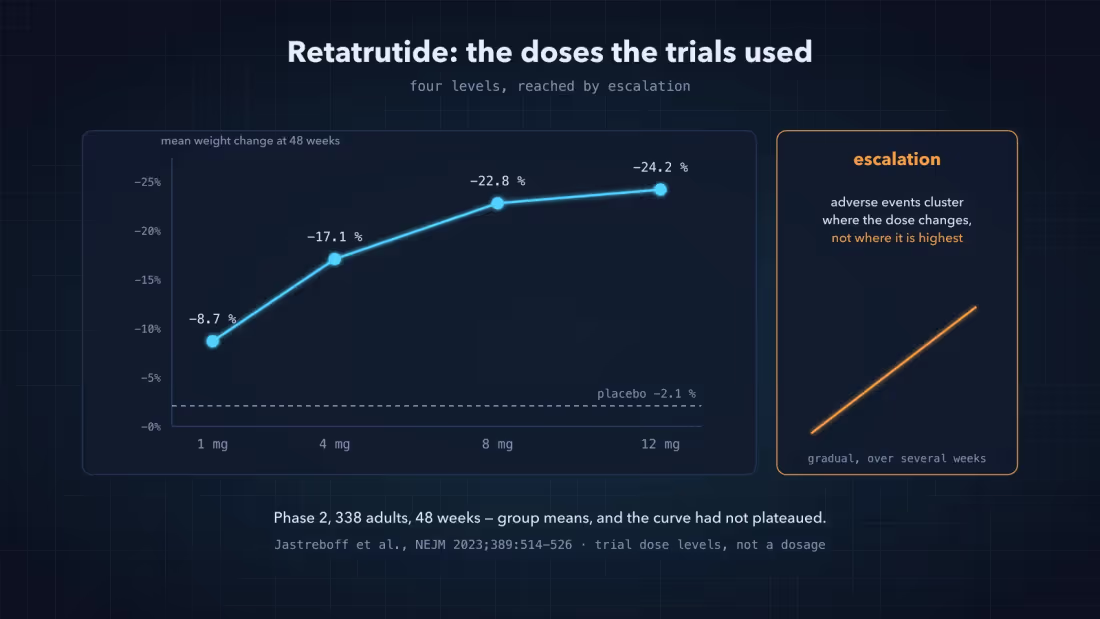
Mean change in body weight at 48 weeks:
| Group | Mean weight change |
|---|---|
| Placebo | -2.1% |
| 1 mg | about -8.7% |
| 4 mg | about -17.1% |
| 8 mg | about -22.8% |
| 12 mg | about -24.2% |
Two qualifications from the authors themselves. These are group means — individual dispersion was wide. And the curve had not plateaued at 48 weeks: the trial ended before the maximal effect had been characterised, so the 12 mg figure is where the study stopped, not where the effect stopped.
Why the escalation is not a detail
The reported tolerability profile is the profile obtained with that escalation. It is not a property of the molecule independent of how it was introduced.
The most frequent adverse events were gastrointestinal — nausea, diarrhoea, vomiting, constipation — mostly mild to moderate, dose-dependent, and concentrated during the escalation phase. The authors also report increases in heart rate, mainly at intermediate levels.
Read that sequence carefully: the events cluster where the dose is changing, not where it is highest. A protocol that arrived at 12 mg by a different route would not be the protocol that produced these numbers, and the published tolerability data would not describe it.
This is the single most important thing the raw figures leave out.
The type 2 diabetes trial
A second phase 2 trial, Rosenstock et al., The Lancet, 2023, evaluated retatrutide in adults with type 2 diabetes over 36 weeks, against both placebo and an active comparator (dulaglutide). It reported results on glycated haemoglobin and body weight, with reductions greater than the comparator at the higher levels, and an adverse event profile again dominated by gastrointestinal manifestations.
Different population, different duration, different endpoints — which is exactly why its dose levels should not be read across from the obesity trial.
What these protocols do not establish
They are phase 2. They establish an efficacy signal and a preliminary tolerability profile in moderate numbers. The phase 3 programme (TRIUMPH) was under way at the time of writing. Pharmaceutical development is full of compounds whose phase 2 results did not hold.
Nothing beyond 48 weeks. No data exist on three years, or on what happens after stopping.
The product was pharmaceutical grade, formulated and administered inside a trial, with medical supervision, strict inclusion criteria and a supervised escalation. None of those conditions exists outside that framework.
Retatrutide holds no marketing authorisation — not in France, the EU or the US. It cannot be prescribed or dispensed. See our article on the legal framework.
Why a trial dose is not a dosage
A dosage is a clinical instruction: this amount, this often, for this person, with this monitoring. It carries an indication, a contraindication list, and an authority that stands behind it.
A trial dose level is none of those. It is an experimental variable — one arm of a study designed to find out what a range does, in a selected population, under observation, with a stopping rule. The fact that an arm reported a number does not convert that arm into an instruction, and no amount of repetition makes it one.
That distinction is why this page reports what was studied and stops there.
The reference material
We supply retatrutide as an analytical standard for in-vitro research. What we document is analytical: the identity, purity and content of the lot, each strength carrying its Janoshik report, readable before purchase.
For the mechanism, see the retatrutide dossier; for the full trial review, the clinical literature; for how it compares with the other incretin agonists, the GLP-1 comparison.
What doses of retatrutide were used in the trials?
1, 4, 8 and 12 mg, subcutaneously once weekly, with gradual escalation, over 48 weeks in the phase 2 obesity trial.
Which dose produced the largest reported weight change?
12 mg, at about -24.2% mean change at 48 weeks, against -2.1% on placebo. It is a group mean, and the curve had not plateaued.
What is the escalation schedule?
The protocol specified a gradual step-up over several weeks rather than starting at the target level. The reported tolerability profile is the one obtained with that escalation.
Is there an approved retatrutide dosage?
No. Retatrutide holds no marketing authorisation anywhere, so no approved dosage exists. The trial figures are experimental dose levels, not a dosage.
Further reading: Retatrutide and weight loss: the clinical literature · Retatrutide: the mechanistic dossier · The legal framework