Research dossier
Mazdutide — dossier on the GLP-1 / glucagon dual agonist
An oxyntomodulin analogue engaging two receptors, GLP-1R and GCGR — the first of its class to be authorised, in China, in 2025.
Translated from the French original, which remains the reference version: lire en français →
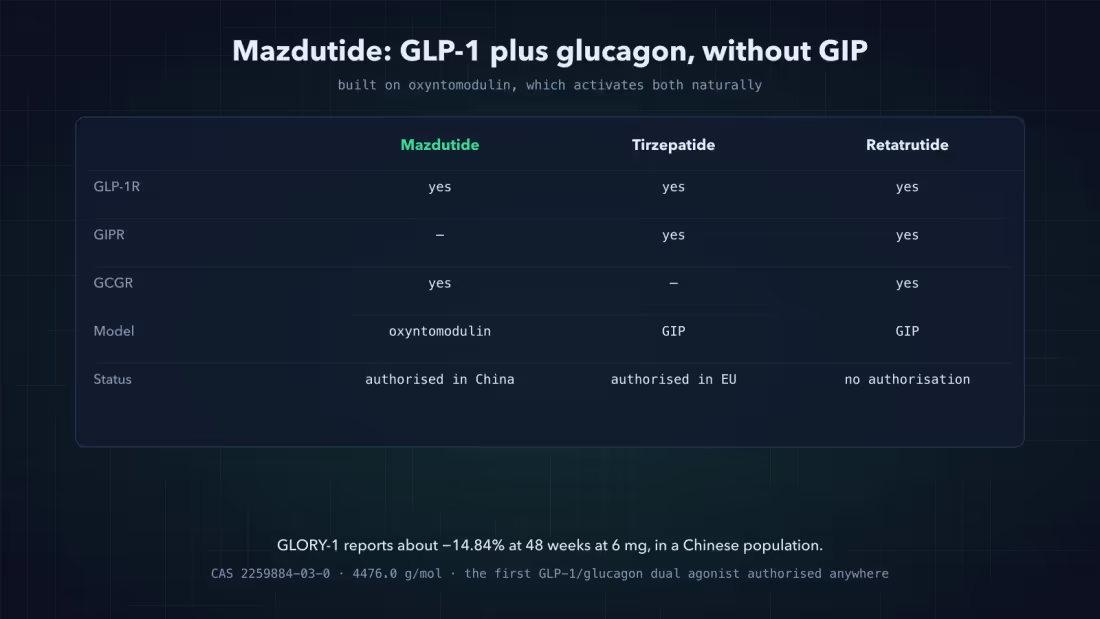
Mazdutide — development codes IBI362 and LY3305677 — is a synthetic peptide designed by Eli Lilly, then licensed in 2020 to the Chinese company Innovent Biologics for China. It is a dual agonist of the GLP-1 (GLP-1R) and glucagon (GCGR) receptors, built on the model of a natural intestinal hormone, oxyntomodulin.
This dossier describes its identity, its mechanism, its clinical literature and its analytical parameters. It contains no information on use.
Molecular identity
| Parameter | Value |
|---|---|
| CAS number | 2259884-03-0 |
| Molar mass | 4476.0 g/mol |
| Molecular formula | C₂₀₇H₃₁₇N₄₅O₆₅ |
| Sequence / nature | Dual agonist of the GLP-1 and glucagon receptors |
| Purity | ≥99% |
| Appearance | White lyophilised powder |
The values above are those of the product page.
The model: oxyntomodulin
Oxyntomodulin is a 37-amino-acid peptide produced by the L cells of the intestine, from the same precursor as GLP-1: proglucagon. It naturally activates both receptors, that of GLP-1 and that of glucagon, with modest affinity and a very short half-life.
Mazdutide takes up that dual profile and makes it durable. Like the other latest-generation agonists, it is modified to resist DPP-4 and to bind to albumin, which allowed weekly administration in the trials. See the dossier on the GLP-1 receptor.
Why add glucagon
Agonism at the glucagon receptor raises blood glucose, which looks counterproductive. It is nevertheless associated in the literature with an increase in energy expenditure and with an action on hepatic lipid metabolism. The concomitant GLP-1 agonism offsets the glycaemic effect.
It is the same logic as that of retatrutide, which additionally adds the GIP receptor. See the mechanistic dossier on retatrutide.
What the literature describes: the GLORY-1 trial
The phase 3 trial GLORY-1, published in the New England Journal of Medicine, was conducted in 610 Chinese adults with overweight or obesity, over 48 weeks, against placebo. It reports a mean change in body weight of:
| Group | Mean weight change at 48 weeks |
|---|---|
| Placebo | −0.47% |
| 4 mg | −12.05% |
| 6 mg | −14.84% |
The authors also describe improvements in waist circumference, blood pressure, triglycerides and liver enzymes. These figures concern a Chinese population and do not transpose directly to others.
Regulatory status
In June 2025, the Chinese medicines agency (NMPA) authorised mazdutide for chronic weight management in adults. A second authorisation followed in September 2025 in type 2 diabetes. It is the first GLP-1 / glucagon dual agonist authorised anywhere in the world.
Mazdutide is not authorised in the European Union or in France. See our article on the legal framework for peptides in France.
Placing mazdutide among the multi-receptor agonists
| Critère | Mazdutide | Tirzepatide | Retatrutide |
|---|---|---|---|
| GLP-1R | Yes | Yes | Yes |
| GIPR | — | Yes | Yes |
| GCGR | Yes | — | Yes |
| Model | Oxyntomodulin | GIP | GIP |
| Status | Authorised in China | Medicine authorised in the EU | No authorisation |
The trials of these three compounds differ in their population, their duration and their design. A direct comparison of their results is not rigorous. See our comparison of the GLP-1 agonists.
Methodological limits
The published phase 3 data concern mainly Chinese populations. The long-term effects of glucagon agonism, notably on heart rate, remain to be characterised over long periods.
Analytical parameters
At 4476.0 g/mol, mazdutide is close in mass to retatrutide (4731.4 g/mol) and to cagrilintide (4409.0 g/mol). The gaps remain comfortably resolved by mass spectrometry, where these peptides appear as multiply charged ions.
The fatty acid chain that provides albumin binding makes these molecules very hydrophobic. It calls for adapted chromatography conditions and particular attention to adsorption. See our guide to reading an analysis report.
Lot verification
The Janoshik certificates of analysis for the catalogue are collected in the lot report register, where each report is tied to the strength and the lot it analyses.
Frequently asked questions
Do mazdutide, IBI362 and LY3305677 designate the same compound?
Yes. LY3305677 is Eli Lilly’s code, IBI362 that of Innovent Biologics.
What is the difference between mazdutide and retatrutide?
Mazdutide engages the GLP-1 and glucagon receptors. Retatrutide engages that of GIP as well.
Is mazdutide authorised in France?
No. It is authorised only in China, since 2025. It holds no authorisation in the European Union.
What is oxyntomodulin?
A natural intestinal hormone derived from proglucagon, which activates the GLP-1 and glucagon receptors. Mazdutide takes up its dual profile.
Further reading: Semaglutide, tirzepatide, retatrutide, mazdutide: the comparison · Retatrutide: the clinical literature
Dossiers in the same category
- Retatrutide — CAS 2381089-83-2
- Cagrilintide — CAS 1415456-99-3
- GLP-1 receptor and agonists