Topic guide
Peptides and fat loss: what each compound's literature actually reports
Incretin agonists, a growth hormone fragment, and metabolic activators — three separate bodies of evidence of very unequal strength.
Translated from the French original, which remains the reference version: lire en français →
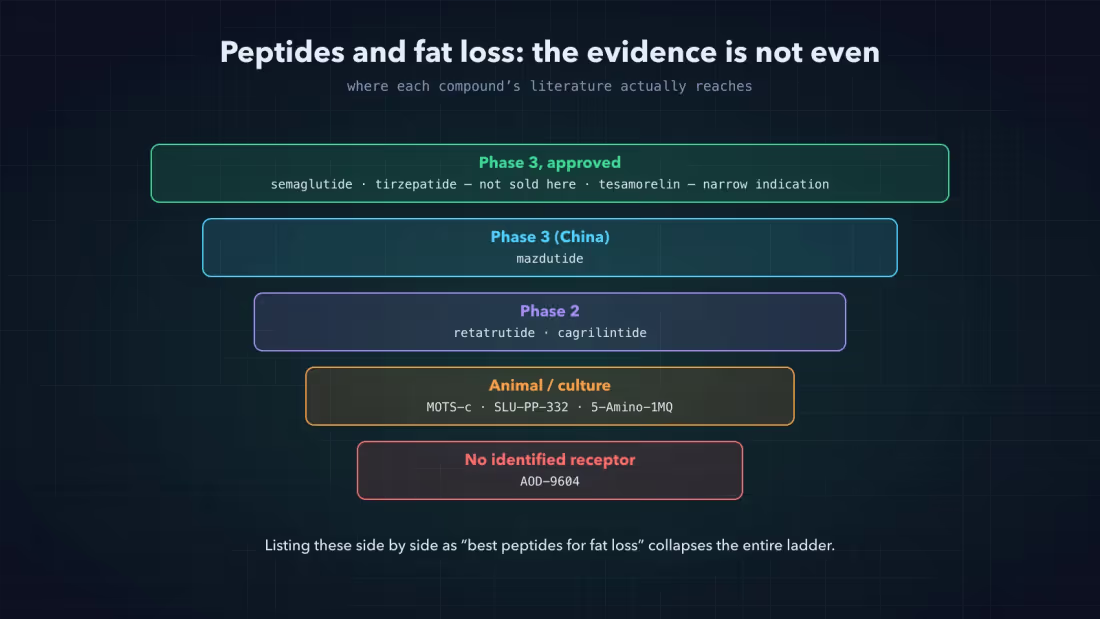
“Best peptide for fat loss” and “best fat burning peptides” are searched heavily, and the pages that answer them almost always rank compounds against each other as though the evidence behind each were comparable. It is not — and the differences are large enough to be the only thing worth writing about.
This article places each compound at the level its literature actually reaches. It contains no information on use, and nothing here ranks anything.
The evidence ladder
Before the compounds, the distinction that organises them:
- Phase 3 trials of an authorised medicine — large, randomised, with regulatory scrutiny behind the endpoint.
- Phase 2 trials — real human data, moderate numbers, a signal rather than a settled result.
- Animal models — closer than culture, with species differences that are rarely trivial.
- Cell culture — a measurement in a dish, at a controlled concentration delivered directly.
- No identified target — a reported effect with no characterised mechanism.
Every compound below sits on exactly one of those rungs, and that is the useful information about it.
The incretin agonists
This is where the strong evidence is, and also where our catalogue deliberately stops short.
Semaglutide and tirzepatide have phase 3 data — STEP 1 reporting about -15% mean weight change at 68 weeks, SURMOUNT-1 about -20.9% at 72 weeks. Both are authorised prescription medicines, dispensed by pharmacies. They are not offered on this site.
Retatrutide is a triple agonist (GLP-1, GIP and glucagon), with phase 2 data reporting about -24.2% mean weight change at 48 weeks at the highest level. It holds no marketing authorisation anywhere. See the clinical literature and the trial doses.
Mazdutide is a GLP-1/glucagon dual agonist with phase 3 data from GLORY-1, conducted in China — about -14.84% at 48 weeks at 6 mg — and authorised in China since June 2025, nowhere else. See the mazdutide dossier.
Cagrilintide is not an incretin agonist at all but a long-acting amylin analogue, studied alone and with semaglutide. See the cagrilintide dossier.
The glucagon receptor is what distinguishes the newer ones: its agonism is associated in the literature with increased energy expenditure, where GLP-1 and GIP act mainly on intake. That is the mechanistic reason the triple agonist is interesting, and our four-way comparison sets out the targets side by side.
AOD-9604: the cautionary case
AOD-9604 is the C-terminal hGH(176-191) fragment with an added tyrosine, and it is the clearest example of why listing compounds together misleads.
It was designed to separate a metabolic activity from growth activity. Structurally it lacks the domains that bind the GH receptor, so it cannot act through the classical GHR/JAK2/STAT5 route — the literature is explicit on this. The in-vitro work uses differentiated 3T3-L1 adipocytes, measuring lipolysis by glycerol release.
And: no specific receptor has ever been identified for it. That is an acknowledged limit of the whole body of work. A compound with no characterised target sitting in the same list as one with phase 3 data is not a comparison — it is a category error. See the AOD-9604 dossier.
Tesamorelin: a narrow authorisation
Tesamorelin is the one GHRH analogue with a completed clinical development. It was authorised in the United States in 2010 for a precise indication: reduction of excess abdominal adipose tissue in patients with HIV-associated lipodystrophy.
The published trials addressed visceral adipose tissue, and more recently liver fat, in that population. That is real phase 3 evidence and it is also tightly bounded — it concerns the authorised medicine in its trial framework, and does not generalise to other populations or to a research material. See the tesamorelin dossier.
The metabolic activators
Three compounds sit at the culture end of the ladder, studied on metabolic signalling rather than fat mass.
- 5-Amino-1MQ is studied as an NNMT inhibitor, with endpoints around adipocyte metabolism in culture.
- SLU-PP-332 is a pan-ERR agonist, studied on oxidative metabolism and exercise-mimetic signalling in cells and animals.
- MOTS-c is a mitochondrial-derived peptide studied as an AMPK activator, with glucose uptake and metabolic adaptation as endpoints.
These are mechanistically interesting and evidentially early. Treating them as interchangeable with an incretin agonist, as the listicles do, inverts the actual strength of evidence.
Where each one sits
| Compound | Highest rung reached | Status |
|---|---|---|
| Semaglutide, tirzepatide | Phase 3, approved | Prescription medicine — not sold here |
| Tesamorelin | Phase 3, approved (narrow indication) | US authorisation; none in EU |
| Mazdutide | Phase 3 (China) | Authorised in China only |
| Retatrutide | Phase 2 | No authorisation anywhere |
| Cagrilintide | Phase 2 | No authorisation |
| MOTS-c, SLU-PP-332, 5-Amino-1MQ | Culture / animal | No authorisation |
| AOD-9604 | Culture, no identified receptor | No authorisation |
The spread from the top row to the bottom is the entire point. A “best peptide for fat loss” ranking collapses it.
Sport and status
The GHRH analogues including tesamorelin fall under WADA section S2.2.4, GH fragments including AOD-9604 under S2.2.3, and MOTS-c under S4.4.1 as an AMPK activator. Tesamorelin’s case is instructive: an authorised medicine is still prohibited if it appears in a section. See the WADA 2026 list.
What is the best peptide for fat loss?
The question assumes a ranking the evidence does not support. The compounds studied in this area sit at very different levels of evidence, from phase 3 trials of approved medicines to culture work with no identified receptor, and no trial compares them directly.
Which has the strongest evidence?
Among compounds offered here, tesamorelin has a completed clinical development but for a narrow authorised indication, and mazdutide has phase 3 data from a Chinese population. Retatrutide’s data are phase 2.
Why is AOD-9604 singled out?
Because no specific receptor has been identified for it, which is an acknowledged limit of its literature. Its reported effects cannot be tied to a defined signalling pathway.
Can semaglutide or tirzepatide be bought here?
No. Both are prescription-only pharmacy medicines and are not offered on this site.
Further reading: Semaglutide, tirzepatide, retatrutide, mazdutide compared · Retatrutide: the clinical literature · Peptides and muscle growth