Topic guide
Peptides and muscle growth: what the literature has actually measured
Which compounds the hypertrophy literature studies, what endpoint each one actually reports, and where the evidence stops.
Translated from the French original, which remains the reference version: lire en français →
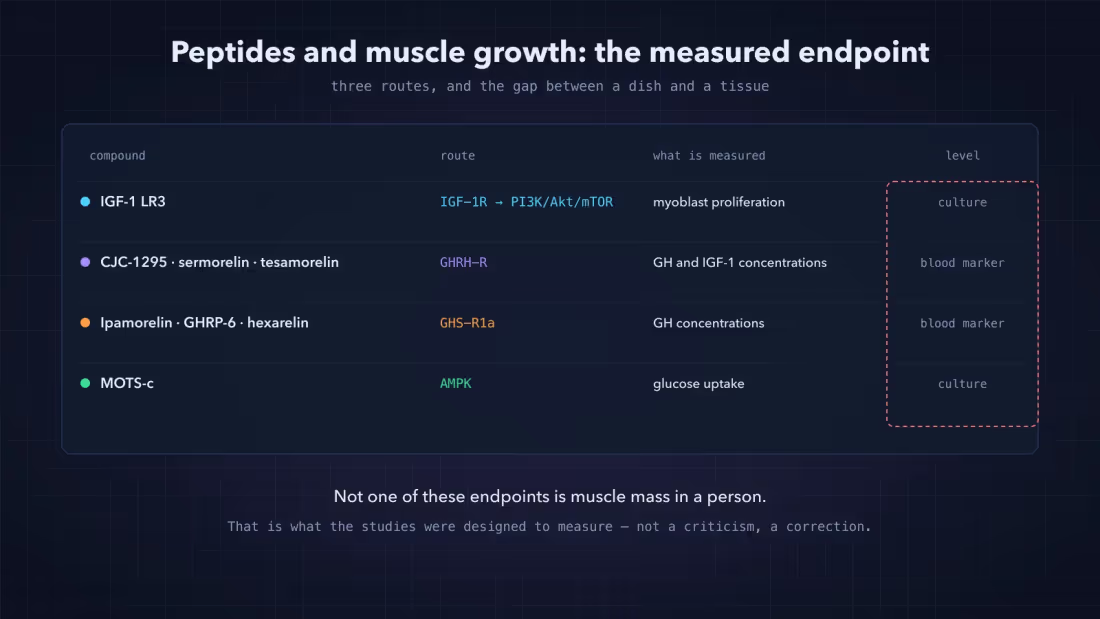
“Peptide for muscle growth” is a high-volume query with almost no careful writing behind it. The pages that rank mostly list compounds and assert outcomes.
This article does something different: it takes the compounds the literature actually studies in muscle contexts, states what endpoint each body of work measures, and marks where the evidence stops. It contains no information on use, and nothing here is an outcome claim.
The endpoint problem, stated first
Almost everything that follows is measured in one of three places: a cell culture, an animal model, or a blood marker in humans. None of those is muscle mass in a person.
- A culture endpoint — myoblast proliferation, protein synthesis rate, nuclear count — measures what cells do in a dish, with the compound delivered directly at a controlled concentration.
- An animal endpoint gets closer, and carries species differences that are rarely trivial.
- A human blood marker, such as IGF-1 concentration, measures a signal in the pathway. It does not measure tissue.
Keeping these apart is most of what reading this literature honestly requires.
IGF-1 and its analogues
IGF-1 LR3 is the compound most directly tied to the hypertrophy literature, because IGF-1 signalling is genuinely central to it.
IGF-1 acts at the IGF-1 receptor, activating the PI3K/Akt/mTOR pathway — the canonical protein-synthesis route in muscle. The LR3 variant carries an N-terminal extension and a substitution that sharply reduce its binding to the IGF-binding proteins (IGFBPs), which in the native system govern how much free IGF-1 exists at any moment.
That is the point of the analogue and also its main interpretive catch: by evading the IGFBPs it changes the very regulation the native system uses, so results with it do not transpose to native IGF-1. The studied endpoints are mostly myoblast proliferation and differentiation in culture, and satellite cell behaviour — which is where the “hyperplasia” framing comes from. See the IGF-1 LR3 dossier.
The growth hormone secretagogues
This is the largest group, and the one where the endpoint gap is widest.
CJC-1295, sermorelin and tesamorelin act at the GHRH receptor; ipamorelin, GHRP-6, GHRP-2 and hexarelin act at GHS-R1a, the ghrelin receptor. Both routes end at the pituitary, which releases GH, which raises IGF-1. Our secretagogue comparison sets out the two classes.
What the literature on these compounds overwhelmingly reports is GH and IGF-1 concentrations. That is a pathway measurement, and it is a real one. It is not a muscle measurement, and the step from “IGF-1 rose” to “muscle changed” is exactly the step the published work on these compounds mostly does not take.
Two further points the secretagogue literature does establish, both relevant:
- Selectivity differs. Ipamorelin was characterised as selective for GH without notable ACTH or cortisol elevation; GHRP-6 and hexarelin are not selective and come with a marked orexigenic effect. See the ipamorelin and GHRP-6 dossiers.
- Desensitisation is documented. Attenuation of the GH response under prolonged exposure is described for hexarelin and others — a parameter any extended design has to account for.
MOTS-c and the metabolic route
MOTS-c is a different proposition: a mitochondrial-derived peptide studied as an AMPK activator, with endpoints around glucose uptake and metabolic adaptation in muscle cells rather than hypertrophy as such. It appears in WADA section S4.4.1 alongside AICAR for that reason. See the MOTS-c dossier.
Grouping it with the GH compounds, as most listicles do, obscures that it is answering a different question.
What each one actually measures
| Compound | Route | Principal measured endpoint |
|---|---|---|
| IGF-1 LR3 | IGF-1R → PI3K/Akt/mTOR | Myoblast proliferation and differentiation, in culture |
| CJC-1295, sermorelin, tesamorelin | GHRH-R | GH and IGF-1 concentrations |
| Ipamorelin, GHRP-6, GHRP-2, hexarelin | GHS-R1a | GH concentrations; selectivity profile |
| MOTS-c | AMPK | Glucose uptake, metabolic markers |
Read down the right-hand column: not one of these rows is muscle mass. That is not a criticism of the research — these are the endpoints the studies were designed to measure. It is a correction to how the list is usually presented.
Prohibited in sport
Every compound named here is on the WADA Prohibited List, and at all times rather than in competition only. The GHRH analogues and GH secretagogues fall under S2.2.4, IGF-1 and its analogues under S2.3, MOTS-c under S4.4.1. Strict liability applies: presence in a sample is the violation, with no need to prove intent. See our article on the WADA 2026 list.
The reference materials
All of the above are supplied here as analytical reference materials for in-vitro research, each strength carrying its Janoshik lot report. They are not medicines, hold no marketing authorisation, and are not intended for administration to humans or animals. The individual references are available separately, which is what a design with per-compound control arms requires — see our note on blends and attribution.
Which peptides are studied for muscle growth?
Mainly IGF-1 analogues such as IGF-1 LR3, the GHRH analogues and GH secretagogues, and metabolic peptides such as MOTS-c. They act by different mechanisms and are studied against different endpoints.
Do GH secretagogues build muscle?
The published work on them measures GH and IGF-1 concentrations, which is a pathway endpoint rather than a tissue one. The step from that measurement to muscle mass is not established by that literature.
What does IGF-1 LR3 do differently from IGF-1?
Its N-terminal extension and substitution sharply reduce binding to the IGF-binding proteins, which changes the regulation the native system relies on. Results with it do not transpose to native IGF-1.
Are these peptides allowed in competitive sport?
No. All of those named here appear on the WADA Prohibited List, prohibited at all times.
Further reading: GHRH and GHRP secretagogues compared · IGF-1 LR3: the dossier · Peptides and the WADA 2026 list