Topic guide
Peptides and sleep: DSIP, orexin, GHRH — what the research has established
Sleep is regulated in part by peptides. One of them, orexin, changed the understanding of narcolepsy; another, DSIP, is still waiting for its receptor.
Translated from the French original, which remains the reference version: lire en français →
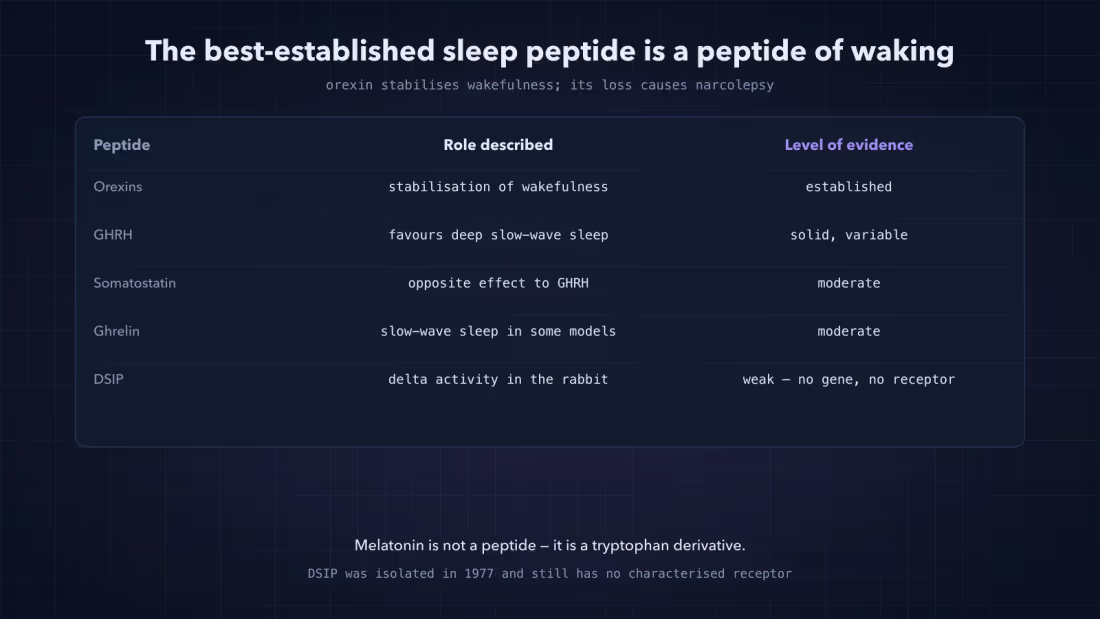
Sleep is not only a matter of melatonin and the classical neurotransmitters. Several neuropeptides take part in regulating the sleep-wake alternation and the architecture of the cycles. This guide sets out those that research has studied, distinguishing what is established from what remains hypothetical.
A reminder: the architecture of sleep
A night alternates four to six cycles of about 90 minutes. Each comprises slow-wave sleep — including deep slow-wave sleep, marked by delta waves on the electroencephalogram — and REM sleep. Deep slow-wave sleep dominates early in the night, REM sleep late in the night.
DSIP: a 1977 discovery left orphaned
DSIP (delta sleep-inducing peptide) was isolated in 1977 by the Swiss group of Schoenenberger and Monnier, from the blood of rabbits whose sleep had been induced by electrical stimulation. Injected into the brain of waking rabbits, it increased delta activity on the electroencephalogram. Its sequence is a nonapeptide: Trp-Ala-Gly-Gly-Asp-Ala-Ser-Gly-Glu.
Nearly fifty years later, its status remains uncertain:
- no gene encoding DSIP has been identified;
- no specific receptor has been characterised;
- studies in humans have given inconsistent results.
DSIP remains an object of study, but its role as a “sleep factor” is not demonstrated. See the DSIP dossier and the DSIP page.
Orexin: the discovery that changed everything
In 1998, two groups independently discovered the same hypothalamic neuropeptides, named orexins by one and hypocretins by the other. There are two, orexin A (33 amino acids) and orexin B (28 amino acids), which act at two receptors, OX1R and OX2R.
Their role emerged as early as 1999-2000: canine narcolepsy is linked to a mutation of the OX2R receptor, and patients with type 1 narcolepsy have lost almost all of their orexin neurons. Orexin is therefore a peptide of wakefulness: it stabilises the waking state and prevents abrupt transitions into sleep.
That discovery led to a class of sleep medicines, the orexin receptor antagonists, such as daridorexant, authorised in the European Union. These are small molecules, not peptides.
GHRH and deep slow-wave sleep
The principal peak of growth hormone secretion occurs in the first phase of deep slow-wave sleep. This is no coincidence: GHRH is described as favouring slow-wave sleep, while somatostatin, which restrains GH, has the opposite effect in several models.
Studies in animals and in humans have reported an increase in deep slow-wave sleep after GHRH administration, with effects varying by age and sex. This work links the somatotropic axis to sleep. It explains research interest in GHRH analogues such as sermorelin. See the sermorelin dossier.
Ghrelin, the ligand of the GHS-R1a receptor, has also been associated with an increase in slow-wave sleep in certain models, which ties the GHRPs to the same question.
The pineal gland: melatonin and peptides
Melatonin, the pineal gland hormone that signals night to the body, is not a peptide: it is a derivative of the amino acid tryptophan.
The Russian bioregulation school has, by contrast, studied short peptides linked to the pineal gland. Epitalon, derived from a pineal extract, is described in its work as modulating melatonin secretion in aged animals. Pinealon, a tripeptide, has been studied in neuronal models. This work comes mainly from a single research group. See the epitalon and pinealon dossiers.
What is established, and what is not
| Peptide | Role described | Level of evidence |
|---|---|---|
| Orexins | Stabilisation of wakefulness; lost in type 1 narcolepsy | Established |
| GHRH | Favours deep slow-wave sleep | Solid, effects variable |
| Somatostatin | Opposite effect to GHRH in several models | Moderate |
| Ghrelin | Association with slow-wave sleep in certain models | Moderate |
| DSIP | Delta activity in the rabbit; neither gene nor receptor identified | Weak |
| Epitalon, pinealon | Pineal modulation described by a single group | Weak, not replicated |
Frequently asked questions
Does DSIP make you sleep?
It increased delta activity in the rabbit in the 1977 study, but no gene or receptor has been identified and the human studies are inconsistent. Its role as a sleep factor is not demonstrated.
What is orexin?
A hypothalamic neuropeptide that stabilises wakefulness. Its loss is the cause of type 1 narcolepsy.
Is melatonin a peptide?
No. It is a tryptophan derivative, a small molecule.
What is the link between growth hormone and sleep?
GHRH favours deep slow-wave sleep, during which the main nocturnal GH peak occurs.
Further reading: DSIP: the dossier · Sermorelin: the dossier · Epitalon: the dossier
References
- Schoenenberger GA, et al. A naturally occurring delta-EEG enhancing nonapeptide in rabbits. X. Final isolation, characterization and activity test. Pflugers Arch. 1977. PubMed
- Kovalzon VM, Strekalova TV. Delta sleep-inducing peptide (DSIP): a still unresolved riddle. J Neurochem. 2006. PubMed
- Sakurai T, et al. Orexins and orexin receptors: a family of hypothalamic neuropeptides and G protein-coupled receptors that regulate feeding behavior. Cell. 1998. PubMed
- de Lecea L, et al. The hypocretins: hypothalamus-specific peptides with neuroexcitatory activity. Proc Natl Acad Sci U S A. 1998. PubMed
- Lin L, et al. The sleep disorder canine narcolepsy is caused by a mutation in the hypocretin (orexin) receptor 2 gene. Cell. 1999. PubMed
- Peyron C, et al. A mutation in a case of early onset narcolepsy and a generalized absence of hypocretin peptides in human narcoleptic brains. Nat Med. 2000. PubMed
- Steiger A, et al. Effects of growth hormone-releasing hormone and somatostatin on sleep EEG and nocturnal hormone secretion in male controls. Neuroendocrinology. 1992. PubMed
- Obál F Jr, Krueger JM. GHRH and sleep. Sleep Med Rev. 2004. PubMed