Comparison
Semax or Selank: comparing two research heptapeptides
The same Pro-Gly-Pro tail, two different heads: an ACTH fragment on one side, tuftsin on the other.
Translated from the French original, which remains the reference version: lire en français →
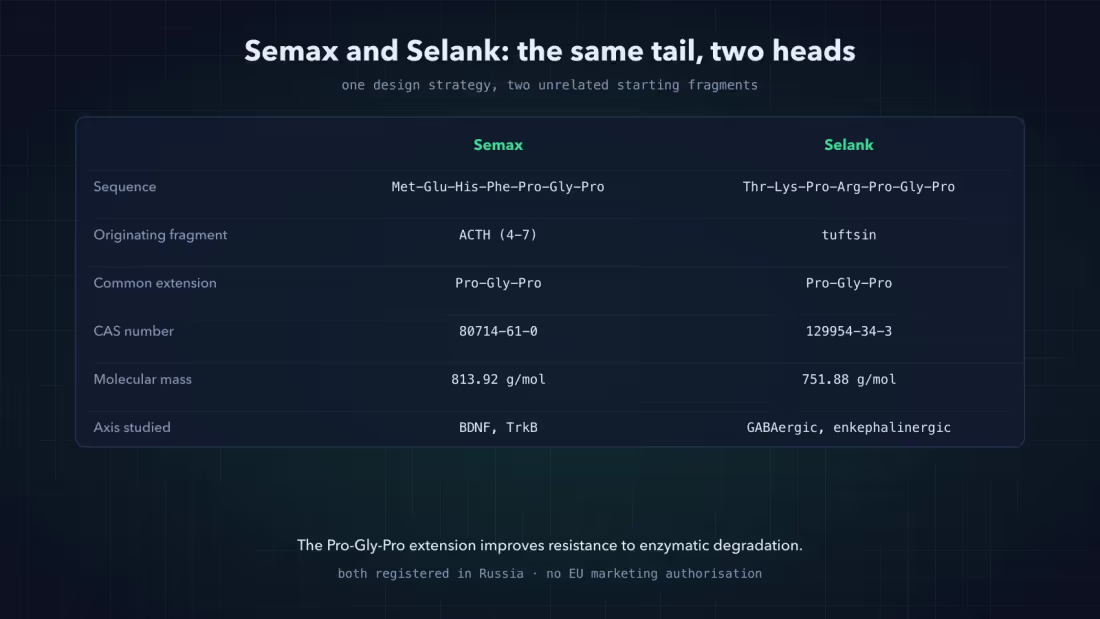
Semax and Selank are often presented together, and for good reason: they were designed in the same Moscow research institute, by the same strategy, and share the same tail. Their active fragment, by contrast, comes from two unrelated molecules.
This comparison describes their structures, the lines of research associated with them and the limits of their literature. It contains no information on use.
In brief
| Critère | Semax | Selank |
|---|---|---|
| Sequence | Met-Glu-His-Phe-Pro-Gly-Pro | Thr-Lys-Pro-Arg-Pro-Gly-Pro |
| Originating fragment | ACTH (4-7) | Tuftsin |
| Common extension | Pro-Gly-Pro | Pro-Gly-Pro |
| CAS number | 80714-61-0 | 129954-34-3 |
| Molecular formula | C₃₇H₅₁N₉O₁₀S | C₃₃H₅₇N₁₁O₉ |
| Molecular mass | 813.92 g/mol | 751.88 g/mol |
| Axes studied | Neurotrophic factors (BDNF) | GABAergic and enkephalinergic systems |
| Status | Registered in Russia; no EU authorisation | Registered in Russia; no EU authorisation |
The CAS, formula and mass values are those of the Semax and Selank pages in our catalogue.
The same tail, two heads
Both peptides have seven amino acids, and their last three are identical: Pro-Gly-Pro. That extension is no accident. Short peptide fragments are rapidly degraded by peptidases; adding a proline-rich sequence improves their enzymatic resistance, and therefore their lifetime in the systems studied.
What differs is the first four amino acids.
- Semax begins with Met-Glu-His-Phe, the 4-7 fragment of adrenocorticotropic hormone (ACTH). That fragment lacks the corticotropic hormonal activity of complete ACTH: it was retained for other properties, studied in the nervous system.
- Selank begins with Thr-Lys-Pro-Arg, tuftsin, a tetrapeptide derived from an immunoglobulin and known for its immunomodulatory properties.
What the literature associates with them
Semax : facteurs neurotrophiques
The published work on Semax deals largely with the expression of BDNF (brain-derived neurotrophic factor) and its TrkB receptor in rodent models, as well as with models of cerebral ischaemia. Our Semax dossier details these data.
Selank: GABAergic and enkephalinergic systems
Research on Selank describes a modulation of the GABAergic system, an inhibition of the enzymes that degrade enkephalins, and effects on cytokine expression. It was carried out mainly in behavioural models in animals. See our Selank dossier.
Regulatory status
Both peptides are registered as medicines in Russia, where they were developed. Neither holds a marketing authorisation in France or in the European Union. The materials in our catalogue are analytical standards intended for in-vitro research; see our article on the legal framework for peptides in France.
Limits of the literature
The great majority of publications on Semax and Selank comes from Russian groups, often linked to the institute that developed them. Independent replications, particularly outside Russia, remain few. Part of the work also rests on animal behavioural models, whose transposition calls for caution.
The Semax + Selank blend
The two compounds share an architecture but target different axes, which explains their pairing in certain research protocols. The Semax + Selank blend answers those protocols. As with any pairing, a rigorous design tests each compound separately before the blend.
All the references on this axis are gathered on the focus & cognition page.
Analytical considerations
The molecular masses of the two heptapeptides are close — 813.92 and 751.88 g/mol — but distinct enough to be separated unambiguously by mass spectrometry. The methionine at the head of Semax makes it sensitive to oxidation: observing the storage conditions described in our guide to storing lyophilised peptides matters particularly for it.
Frequently asked questions
What is the difference between Semax and Selank?
Their originating fragment. Semax derives from an ACTH fragment (Met-Glu-His-Phe), Selank from tuftsin (Thr-Lys-Pro-Arg). Both carry the same Pro-Gly-Pro extension.
Why the Pro-Gly-Pro sequence?
It improves the resistance of the peptides to enzymatic degradation, which lengthens their lifetime in the systems studied.
Are Semax and Selank authorised in France?
No. They are registered in Russia but hold no marketing authorisation in France or in the European Union.
Which is the more studied?
Both have a comparable literature, overwhelmingly Russian. Semax is studied more on neurotrophic factors, Selank on the GABAergic and enkephalinergic systems.