Laboratory guide
Peptide, polypeptide, protein: definitions and differences
Peptide bond, oligopeptide, polypeptide, protein: what these words mean and where the boundaries fall, with real examples from two to fifty-one amino acids.
Translated from the French original, which remains the reference version: lire en français →
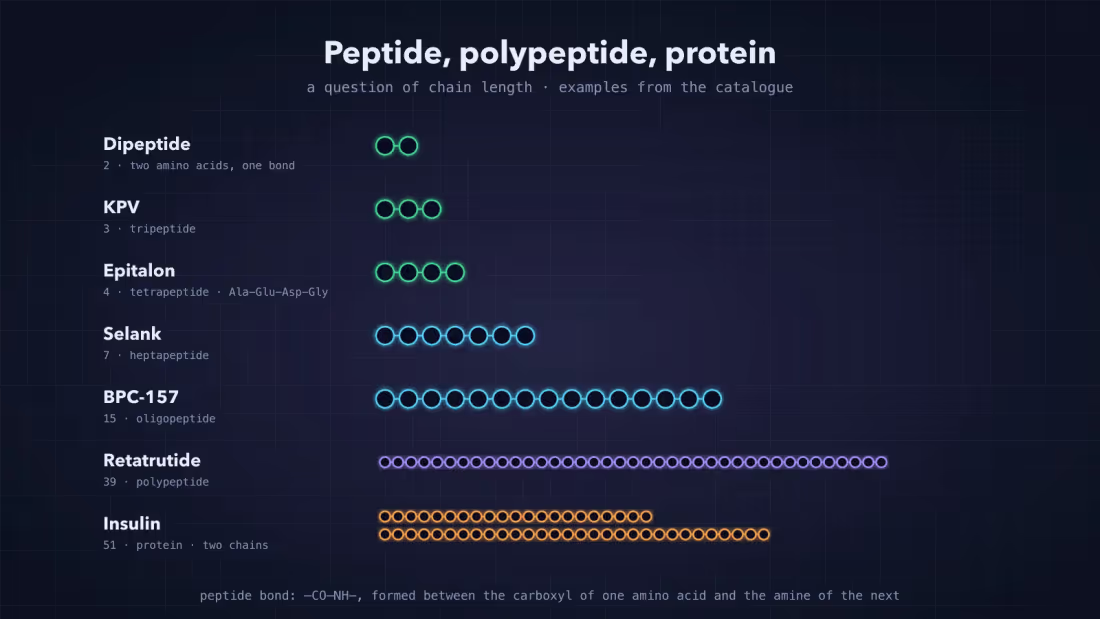
Peptide, polypeptide, protein, peptidic: searches around these words show a genuine confusion of vocabulary. The definitions are simple enough. This guide sets them down once, with real examples.
The peptide bond
A peptide bond joins the carboxyl group (–COOH) of one amino acid to the amine group (–NH₂) of the next. The reaction releases a molecule of water and forms an amide bond, written –CO–NH–. It is that bond, repeated, that makes the chain.
The adjective peptidic describes anything relating to peptides or to that bond: a “peptide bond”, a “peptide chain”, “peptide synthesis”.
Peptide : définition
A peptide is a short chain of amino acids joined by peptide bonds. The shortest are named after their number of residues:
- dipeptide: 2 amino acids;
- tripeptide: 3, like KPV (Lys-Pro-Val) or the GHK of GHK-Cu;
- tetrapeptide: 4, like Epitalon (Ala-Glu-Asp-Gly);
- heptapeptide: 7, like Selank or Semax.
Beyond that, the term oligopeptide covers a chain of a few amino acids up to roughly twenty. BPC-157, with 15 amino acids, is an example.
Polypeptide : définition
A polypeptide is a longer chain, of several tens of amino acids. There is no single official threshold: depending on the author, the boundary with the oligopeptide sits around 20 residues, and the boundary with the protein around 50.
Retatrutide (39 amino acids) and tesamorelin (44) are polypeptides in the ordinary sense, even though usage often calls them simply “peptides”.
Protéine : définition
A protein is a long polypeptide, generally of more than 50 amino acids, often made up of several chains, and folded into a three-dimensional structure on which its function depends. Insulin, with 51 amino acids across two chains (21 and 30) joined by disulfide bridges, sits on the boundary and is classed among the proteins.
Summary table
| Term | Number of amino acids | Example |
|---|---|---|
| Dipeptide | 2 | — |
| Tripeptide | 3 | KPV, GHK |
| Tetrapeptide | 4 | Epitalon |
| Heptapeptide | 7 | Selank, Semax |
| Oligopeptide | up to ~20 | BPC-157 (15) |
| Polypeptide | ~20 to ~50 | Retatrutide (39), tesamorelin (44) |
| Protein | > ~50, folded | Insulin (51, two chains) |
Why length matters in the laboratory
The length of the chain determines the difficulty of the synthesis: each amino acid added is a further coupling cycle, with its own yield and its own possible impurities (see solid-phase synthesis). It also influences stability and sensitivity to the enzymes that cut peptide bonds, proteolysis: see EC50, half-life and bioavailability.
Frequently asked questions
Is a peptide a protein?
No. Both are chains of amino acids, but a peptide is short and generally has no stable folded structure. A protein is long and folded.
Are “peptid” and “pepetide” the same word?
They are misspellings of “peptide”. The analytical glossary gathers the correct terms.
What does “research peptides” mean?
Synthetic peptides sold as reference materials for in-vitro research, ideally accompanied by a per-lot analysis report. See the RUO label.