Comparison
Melanotan II (Melanotan 2) or PT-141: comparing two melanocortins
Two cyclic α-MSH analogues that differ only at their C-terminal end — and whose regulatory statuses have nothing in common.
Translated from the French original, which remains the reference version: lire en français →
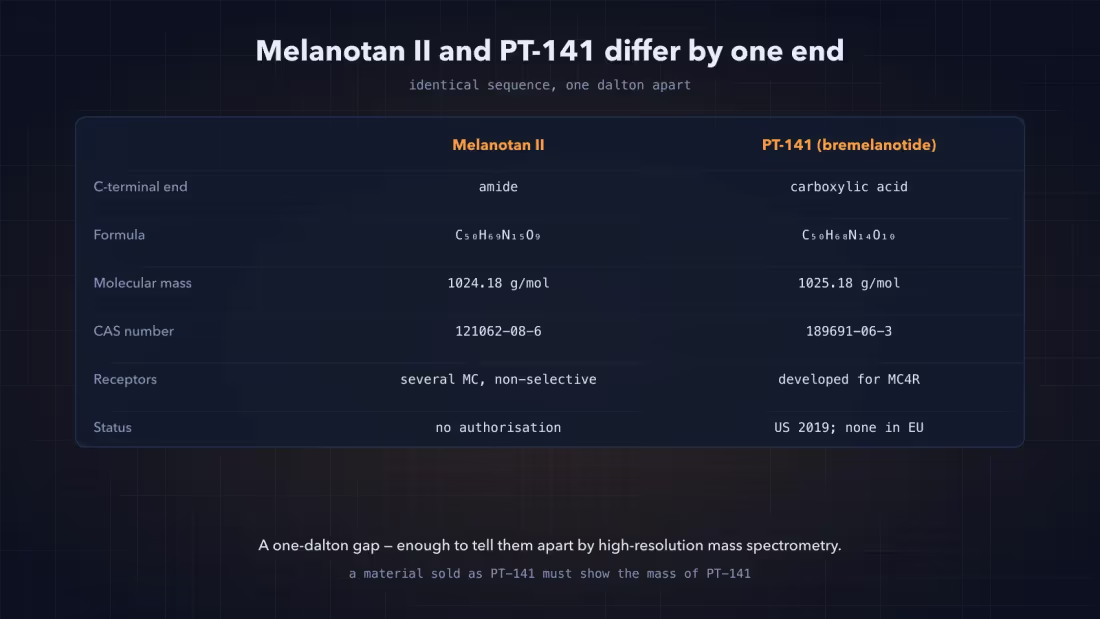
Melanotan II — also written Melanotan 2 or MT2 — and PT-141 are two peptides of the melanocortin family. Their kinship is closer than that of most peptides compared with one another: their sequences are identical, and only their end differs.
This comparison describes that relationship, the receptors concerned, and regulatory statuses that for their part diverge completely. It contains no information on use.
In brief
| Critère | Melanotan II | PT-141 (bremelanotide) |
|---|---|---|
| Other names | Melanotan 2, MT2, MT-II | Bremelanotide |
| Structure | Cyclic heptapeptide, α-MSH analogue | Cyclic heptapeptide, α-MSH analogue |
| C-terminal end | Amide | Carboxylic acid |
| CAS number | 121062-08-6 | 189691-06-3 |
| Molecular formula | C₅₀H₆₉N₁₅O₉ | C₅₀H₆₈N₁₄O₁₀ |
| Molecular mass | 1024.18 g/mol | 1025.18 g/mol |
| Receptors | Several MC receptors, non-selective | Developed for its central action (MC4R) |
| Status | No authorisation | Authorised in the United States (2019); no EU authorisation |
The CAS, formula and mass values are those of the Melanotan II and PT-141 pages in our catalogue.
A difference at one end
Both peptides are cyclic analogues of α-MSH (alpha melanocyte-stimulating hormone). Their ring — a lactam bridge between two amino acids — makes them far more stable than the natural hormone.
Their only difference concerns the C-terminal end: an amide for Melanotan II, a carboxylic acid for PT-141. The molecular formulas show it directly: going from C₅₀H₆₉N₁₅O₉ to C₅₀H₆₈N₁₄O₁₀ amounts to replacing an –NH₂ group with an –OH, hence the one-dalton gap between the two masses (1024.18 and 1025.18 g/mol).
That minimal gap is nevertheless enough to tell them apart by high-resolution mass spectrometry, and it is one of the points to check on an analysis report: a material sold as PT-141 must show the mass of PT-141, not that of Melanotan II.
The melanocortin receptors
Five melanocortin receptors are known, from MC1R to MC5R, each associated with distinct functions:
- MC1R, expressed by melanocytes, is involved in pigmentation;
- MC3R and MC4R, expressed in the central nervous system, are involved in energy homeostasis and in other central functions;
- MC2R is the ACTH receptor; MC5R is expressed notably in the exocrine glands.
Melanotan II is described as a non-selective agonist of several of these receptors. Its first studies, conducted at the University of Arizona, dealt with pigmentation. PT-141 was developed for its central effects, attributed mainly to MC4R; it retains activity at other receptors, including MC1R. See our Melanotan II and PT-141 dossiers.
Two statuses with nothing in common
Bremelanotide was authorised in the United States by the FDA in 2019, under a trade name and for a precise indication. It holds no marketing authorisation in the European Union.
Melanotan II has not been authorised in any country. Several European health authorities, including the ANSM in France, have warned against products marketed as injectable self-tanners.
Two other melanocortins are, for their part, authorised in the European Union: afamelanotide, in implant form, and setmelanotide, an MC4R agonist. Their existence illustrates a general point: it is the authorised product, and not the chemical family, that defines the status. Our article on the legal framework for peptides develops that distinction.
Limits of the literature
The data on Melanotan II remain for the most part old and limited, for want of a completed clinical development. Those on bremelanotide are more structured, but they concern the authorised medicine, within its trial framework — they do not transpose to a research material.
Frequently asked questions
Are Melanotan 2 and Melanotan II the same compound?
Yes. Melanotan II, Melanotan 2, MT2 and MT-II designate the same peptide; only the spellings vary.
What is the difference between Melanotan II and PT-141?
Their C-terminal end: an amide for Melanotan II, a carboxylic acid for PT-141. Their sequence and their ring are identical.
Is PT-141 authorised in France?
No. Bremelanotide has been authorised in the United States since 2019, but holds no marketing authorisation in the European Union.
What is a melanocortin?
A family of peptides derived from a common precursor, pro-opiomelanocortin, which act at five receptors, from MC1R to MC5R. α-MSH is one of them.