Research dossier
LL-37 — dossier on human cathelicidin, an antimicrobial peptide
The only human cathelicidin: a cationic 37-amino-acid helix, both antimicrobial and immunomodulatory.
Translated from the French original, which remains the reference version: lire en français →
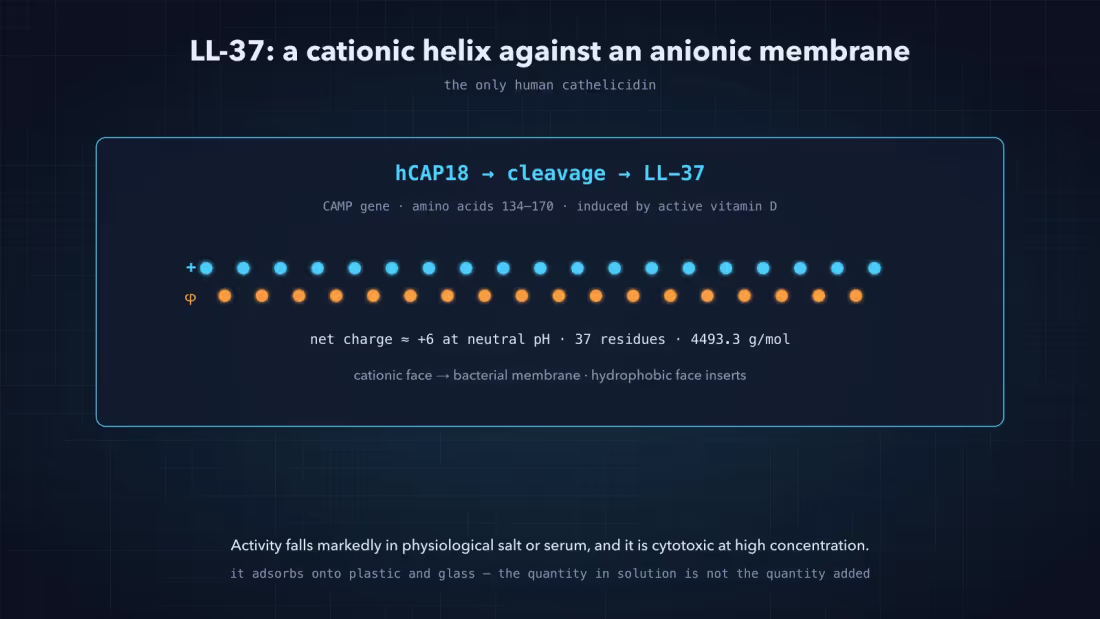
LL-37 is the active form of human cathelicidin, the only member of that family of antimicrobial peptides in humans. It is produced notably by neutrophils and by the epithelial cells of the skin, the airways and the intestine. It is part of innate immunity, the body’s first line of defence.
This dossier describes its identity, its studied mechanisms, the limits of its literature and its analytical parameters. It contains no information on use.
Molecular identity
| Parameter | Value |
|---|---|
| CAS number | 154947-66-7 |
| Molar mass | 4493.3 g/mol |
| Molecular formula | C₂₀₅H₃₄₀N₆₀O₅₃ |
| Sequence / nature | LLGDFFRKSKEKIGKEFKRIVQRIKDFLRNLVPRTES |
| Purity | ≥99% |
| Appearance | White lyophilised powder |
The values above are those of the product page.
Origin: the cleavage of hCAP18
LL-37 is not secreted as such. It is first produced as an inactive precursor, the hCAP18 protein, encoded by the CAMP gene. LL-37 corresponds to its amino acids 134 to 170. It is released by enzymatic cleavage: by proteinase 3 in neutrophils, by kallikreins in the skin.
Expression of the CAMP gene is induced by active vitamin D. That link, described in the mid-2000s, made LL-37 a central subject of study on the relationship between vitamin D and antimicrobial defences.
Structure: a cationic amphipathic helix
In a membrane environment, LL-37 adopts an amphipathic alpha helix: one face carries positively charged residues (lysines and arginines), the other hydrophobic residues. Its net charge is about +6 at neutral pH.
That architecture explains its principal mode of action. The cationic face is attracted to bacterial membranes, which are rich in negatively charged lipids. The hydrophobic face inserts into them and destabilises them.
Mécanismes étudiés
Antimicrobial action. In vitro, LL-37 acts on a broad spectrum of bacteria, Gram positive and Gram negative, as well as on certain fungi and enveloped viruses. Work also describes an action on biofilm formation.
Immunomodulation. LL-37 also acts as a signalling molecule. It has been described as a ligand of the FPR2 receptor, as a modulator of the P2X7 receptor and as a transactivator of EGFR. It attracts certain immune cells and modulates cytokine production.
Wound healing and angiogenesis. Experimental models associate it with a stimulation of epithelial cell migration and of angiogenesis.
A double-edged role
LL-37 is not solely protective. A study published in Nature in 2007 showed that complexes formed between LL-37 and the body’s own DNA could activate certain dendritic cells, a mechanism proposed in psoriasis. Overexpression and abnormal cleavage of LL-37 have also been described in rosacea.
Placing LL-37 among the peptides of immunity
| Critère | LL-37 | Thymosine alpha-1 | KPV |
|---|---|---|---|
| Origine | Cathélicidine humaine | Thymus | Fragment de l’α-MSH |
| Longueur | 37 acides aminés | 28 acides aminés | 3 acides aminés |
| Masse moléculaire | 4493.3 g/mol | 3108.32 g/mol | 342.43 g/mol |
| Axe étudié | Antimicrobien, immunité innée | Immunité adaptative | Anti-inflammatoire |
See the thymosin alpha-1 and KPV pages, together with the KPV dossier.
Regulatory status
LL-37 is not authorised as a medicine in any country. Derivatives have been the subject of clinical trials, notably in venous leg ulcers, with no authorisation to date. See our article on the legal framework for peptides in France.
Methodological limits
A large part of the antimicrobial activity described was measured in culture media of low salt concentration. In the presence of physiological salt or serum, the activity is often markedly reduced. LL-37 is also cytotoxic to mammalian cells at high concentration. Transferring these observations to complex models is therefore uncertain.
Analytical parameters
LL-37 is a long, cationic, amphipathic peptide, which complicates its analytical handling:
- it adsorbs onto certain plastic surfaces and onto glass, which can reduce the quantity actually in solution;
- it tends to aggregate and to oligomerise depending on concentration and medium;
- being rich in lysines and arginines, it is often a trifluoroacetate (TFA) salt after synthesis, whose share weighs in the mass of the vial.
In mass spectrometry, its mass of 4493.3 g/mol appears as multiply charged ions. See our guide to reading an analysis report and the one on storing lyophilised peptides.
Lot verification
The Janoshik certificates of analysis for the catalogue are collected in the lot report register, where each report is tied to the strength and the lot it analyses.
Frequently asked questions
What does the name LL-37 mean?
LL for the two leucines that open its sequence, 37 for its number of amino acids.
Do LL-37 and cathelicidin mean the same thing?
LL-37 is the active form of human cathelicidin. It is released by cleavage of its precursor, the hCAP18 protein.
What is the link between LL-37 and vitamin D?
Active vitamin D induces expression of the CAMP gene, which encodes the precursor of LL-37.
Why is LL-37 difficult to handle in the laboratory?
It adsorbs onto surfaces, aggregates depending on the medium, and its activity is reduced by physiological salt.
Further reading: Thymalin: the dossier · KPV: the dossier
Dossiers in the same category
References
- Dürr UH, Sudheendra US, Ramamoorthy A. LL-37, the only human member of the cathelicidin family of antimicrobial peptides. Biochim Biophys Acta. 2006. PubMed
- Lande R, et al. Plasmacytoid dendritic cells sense self-DNA coupled with antimicrobial peptide. Nature. 2007. PubMed
- Liu PT, et al. Toll-like receptor triggering of a vitamin D-mediated human antimicrobial response. Science. 2006. PubMed