Research dossier
Thymalin — dossier on the thymic polypeptide complex
Not a molecule but a set of peptides extracted from the thymus — and a literature almost entirely from the Russian bioregulation school.
Translated from the French original, which remains the reference version: lire en français →
Thymalin — sometimes transcribed timalin — is a polypeptide complex extracted from calf thymus. It was developed in the Soviet Union at the end of the 1970s by Vladimir Morozov and Vladimir Khavinson, the originators of the Saint Petersburg school of “peptide bioregulators”.
This dossier describes its nature, what its literature reports, its limits and how such a mixture is characterised. It contains no information on use.
Identité
| Parameter | Value |
|---|---|
| CAS number | Polypeptide complex — no single number |
| Molar mass | Not applicable (mixture) |
| Molecular formula | Not applicable (mixture) |
| Sequence / nature | Complex of polypeptides of thymic origin |
| Purity | ≥99% |
| Appearance | White lyophilised powder |
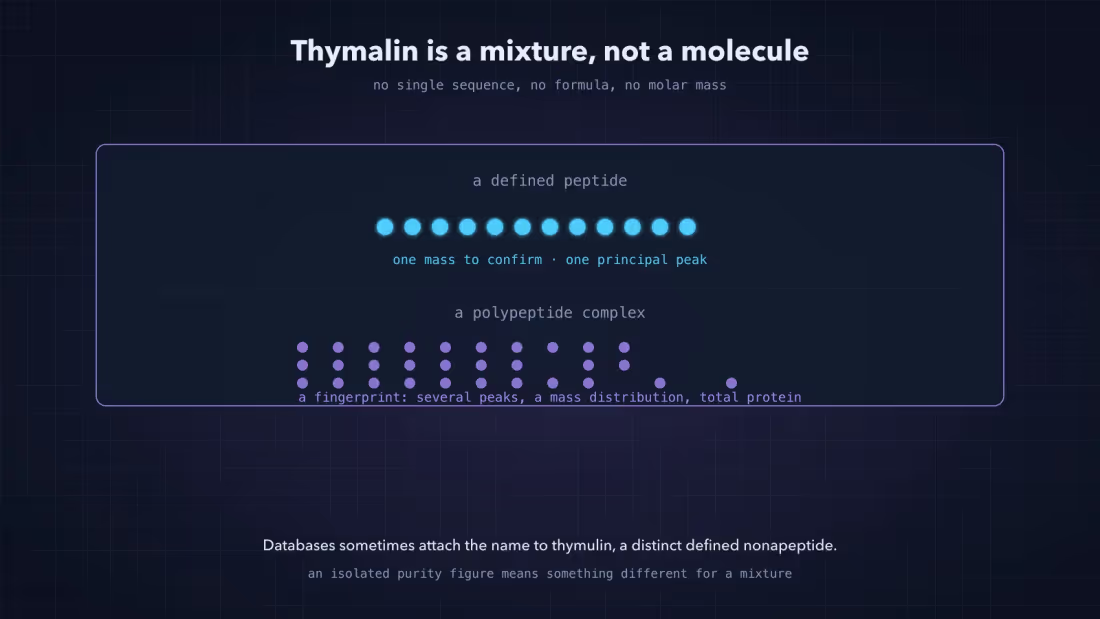
The values above are those of the product page. Chemical databases such as PubChem sometimes associate the name “thymalin” with thymulin, a distinct thymic nonapeptide. The two must not be confused: thymulin is a defined molecule, thymalin a mixture.
A complex, and one identified dipeptide
Thymalin is obtained by acid extraction of the thymus, followed by purification. It contains peptides of varied sizes.
Khavinson’s work describes the identification, within this complex, of a Glu-Trp dipeptide (L-glutamyl-L-tryptophan), subsequently marketed in Russia under the name thymogen. That approach — isolating short peptides from organ extracts — is the same one that led to epitalon, derived from epithalamin, an extract of the pineal gland. See the epitalon dossier.
What the literature describes
Thymalin is registered as a medicine in Russia. Its literature deals mainly with markers of cellular immunity, notably T lymphocyte populations, in animal models and Russian clinical cohorts.
The most cited study is a follow-up of elderly people published in 2003 by Khavinson and Morozov. It reports, among the subjects who received thymalin or epithalamin, a lower mortality than in the control group over several years. These results have not been reproduced by independent groups.
Thymalin and thymosin alpha-1: two approaches to the thymus
| Critère | Thymaline | Thymosine alpha-1 |
|---|---|---|
| Nature | Mélange de peptides extraits | Peptide unique, synthétique |
| Longueur | Variable | 28 acides aminés |
| Masse moléculaire | Non applicable | 3108.32 g/mol |
| CAS number | Aucun numéro unique | 62304-98-7 |
| Littérature | Principalement russe | Internationale |
Thymosin alpha-1 was isolated from another thymic extract, thymosin fraction 5, and then synthesised. It is the active substance of a medicine authorised in several countries outside the European Union.
Regulatory status
Thymalin is not authorised as a medicine in France or in the European Union. See our article on the legal framework for peptides in France.
Methodological limits
The literature on thymalin has three major limits:
- it comes almost entirely from a single research group and is published largely in Russian;
- the trials described are rarely randomised by current standards, and their protocols are difficult to reconstruct;
- the exact composition of the mixture varies with the extraction process, which makes comparison between studies uncertain.
Characterising a mixture
A single peptide is verified by an expected mass and a principal chromatographic peak. A complex like thymalin does not lend itself to that approach. There is no single mass to confirm.
Its characterisation rests instead on a fingerprint: a multi-peak chromatographic profile, a distribution of molecular masses, a total protein content. An isolated purity figure therefore means something different from one for a defined peptide. You need to know what the laboratory measured and against what reference. See our guide to reading an analysis report.
Lot verification
The Janoshik certificates of analysis for the catalogue are collected in the lot report register, where each report is tied to the strength and the lot it analyses.
Frequently asked questions
Do thymalin and timalin designate the same product?
Yes. They are two transcriptions of the same name, the Russian form being Тималин.
Does thymalin have a formula or a CAS number?
No. It is a mixture of peptides, with no molecular formula and no single CAS number.
Are thymalin and thymulin the same thing?
No. Thymulin is a defined thymic nonapeptide. Thymalin is a complex of peptides. Some databases confuse the two names.
What is the difference between thymalin and thymosin alpha-1?
Thymalin is a thymus extract containing many peptides. Thymosin alpha-1 is a single 28-amino-acid peptide, produced by synthesis.
Further reading: LL-37: the dossier · Epitalon: the dossier