Research dossier
CJC-1295 with DAC — dossier on the long-acting GHRH analogue
The same GRF (1-29) fragment as CJC-1295 without DAC, plus a reactive group that hooks it to albumin — and changes its half-life by an order of magnitude.
Translated from the French original, which remains the reference version: lire en français →
CJC-1295 with DAC — often written CJC-1295 DAC or DAC
— is a synthetic analogue of GHRH (growth hormone-releasing hormone) developed in the early 2000s by the Canadian company ConjuChem. It is built on the same fragment as CJC-1295 without DAC, with the addition of a Drug Affinity Complex (DAC) designed to bind to albumin.This dossier describes its identity, its studied mechanism, what distinguishes it from other GHRH analogues, and its analytical parameters. It contains no information on use.
Molecular identity
| Parameter | Value |
|---|---|
| CAS number | 446262-90-4 |
| Molar mass | 3647.2 g/mol |
| Molecular formula | C₁₆₅H₂₆₉N₄₇O₄₆ |
| Sequence / nature | GRF (1-29) tétrasubstitué + Lys(MPA) — complexe d’affinité (DAC) |
| Purity | ≥99% |
| Appearance | White lyophilised powder |
The values above are those of the product page.
The starting fragment: GRF (1-29)
Human GHRH has 44 amino acids, but its biological activity is carried by the first 29. That fragment, GRF (1-29), is the one used in sermorelin. It is degraded within minutes, mainly by dipeptidyl peptidase 4 (DPP-4), which cuts between tyrosine 1 and alanine 2.
CJC-1295 introduces four substitutions intended to protect it: D-Ala at position 2, Gln at 8, Ala at 15 and Leu at 27. It is this tetrasubstituted sequence, also called Modified GRF (1-29), that is found on its own in CJC-1295 without DAC.
The affinity complex: DAC
The “with DAC” version adds, at the C-terminal position, a lysine carrying a maleimidopropionamide (MPA) group. That group is designed to form a covalent bond with the free thiol of cysteine 34 of serum albumin.
Once bound, the peptide circulates with albumin, whose half-life is counted in weeks. It thereby escapes renal filtration and, in large part, enzymatic degradation.
What the literature describes
The reference study is that of Teichman and colleagues, published in 2006 in the Journal of Clinical Endocrinology & Metabolism. It was conducted in healthy adults with single or repeated administrations. It reports:
- a half-life estimated at between 5.8 and 8.1 days;
- an elevation of GH concentrations maintained for 6 days or more;
- an elevation of IGF-1 maintained for 9 to 11 days;
- the preservation of the pulsatile character of GH secretion, observed in a companion study.
These data remain those of early-phase trials in small numbers of participants.
CJC-1295 with or without DAC
| Critère | CJC-1295 with DAC | CJC-1295 without DAC | Tesamorelin |
|---|---|---|---|
| Fragment | Tetrasubstituted GRF (1-29) | Tetrasubstituted GRF (1-29) | Full GHRH (1-44) |
| Protection | Albumin binding | Substitutions alone | N-terminal hexenoyl group |
| Molecular mass | 3647.2 g/mol | 3367.97 g/mol | 5135.86 g/mol |
| Described duration of action | Several days | On the order of 30 minutes | A few tens of minutes |
| Status | No authorisation | No authorisation | Medicine authorised in the United States |
The difference in duration between the two CJC-1295 versions is why the two names must never be confused. A protocol designed for one is unsuited to the other. See the comparison of GHRH and GHRP secretagogues.
Regulatory status
Clinical development of CJC-1295 with DAC was halted in the mid-2000s. The compound is not authorised as a medicine in any country. Like the other GH-releasing factors, it appears in section S2 of the World Anti-Doping Agency prohibited list. See our article on the legal framework for peptides in France.
Methodological limits
The human literature is limited to a few phase 1 and 2 studies. Long-term data are lacking. Albumin binding also complicates pharmacokinetic interpretation: bound peptide and free peptide do not have the same activity.
Analytical parameters
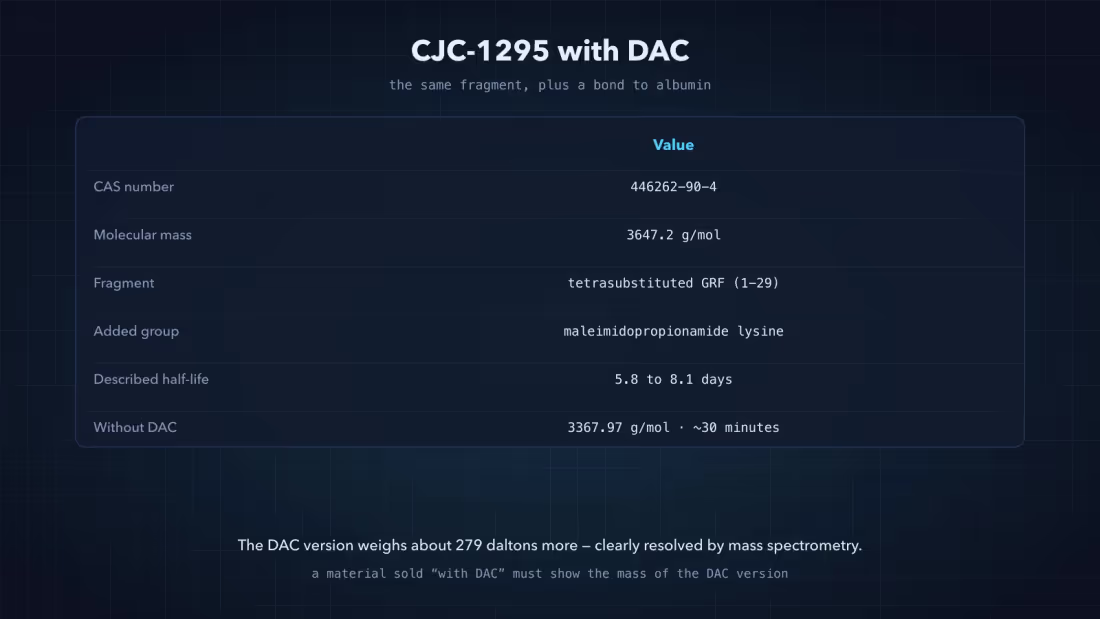
At 3647.2 g/mol, CJC-1295 with DAC weighs about 279 daltons more than the version without DAC (3367.97 g/mol). That gap, which corresponds to the lysine carrying the MPA group, is clearly resolved by mass spectrometry. It is the decisive identity check: a material sold “with DAC” must show the mass of the DAC version.
The maleimide group is reactive. It can hydrolyse or react with thiols present in the medium. Storage in the lyophilised state, at −20 °C and dry, limits this degradation. See our guide to storing lyophilised peptides.
Lot verification
The Janoshik certificates of analysis for the catalogue are collected in the lot report register, where each report is tied to the strength and the lot it analyses.
Frequently asked questions
What does DAC mean in CJC-1295 DAC?
Drug Affinity Complex. It is a reactive group added to the peptide so that it binds to serum albumin and circulates for much longer.
What is the difference between CJC-1295 DAC and CJC-1295 without DAC?
The peptide fragment is the same. The DAC version additionally carries a modified lysine that binds it to albumin. Its described half-life goes from the order of 30 minutes to several days.
Are CJC-1295 without DAC and Mod GRF (1-29) the same compound?
Yes. Modified GRF (1-29) designates the tetrasubstituted sequence sold under the name CJC-1295 without DAC.
Is CJC-1295 with DAC a medicine?
No. Its clinical development was halted and it is not authorised in any country.
Further reading: CJC-1295 without DAC: the dossier · Sermorelin: the dossier · Tesamorelin: the dossier
Dossiers in the same category
- CJC-1295 without DAC — CAS 863288-34-0
- Sermorelin — CAS 86168-78-7
- Tesamorelin — CAS 218949-48-5
References
- Teichman SL, et al. Prolonged stimulation of growth hormone (GH) and insulin-like growth factor I secretion by CJC-1295, a long-acting analog of GH-releasing hormone, in healthy adults. J Clin Endocrinol Metab. 2006. PubMed
- Ionescu M, Frohman LA. Pulsatile secretion of growth hormone (GH) persists during continuous stimulation by CJC-1295, a long-acting GH-releasing hormone analog. J Clin Endocrinol Metab. 2006. PubMed