Research dossier
NAD+ — redox cofactor and sirtuin substrate dossier
A central redox cofactor, and also a substrate consumed by the signalling enzymes.
Translated from the French original, which remains the reference version: lire en français →
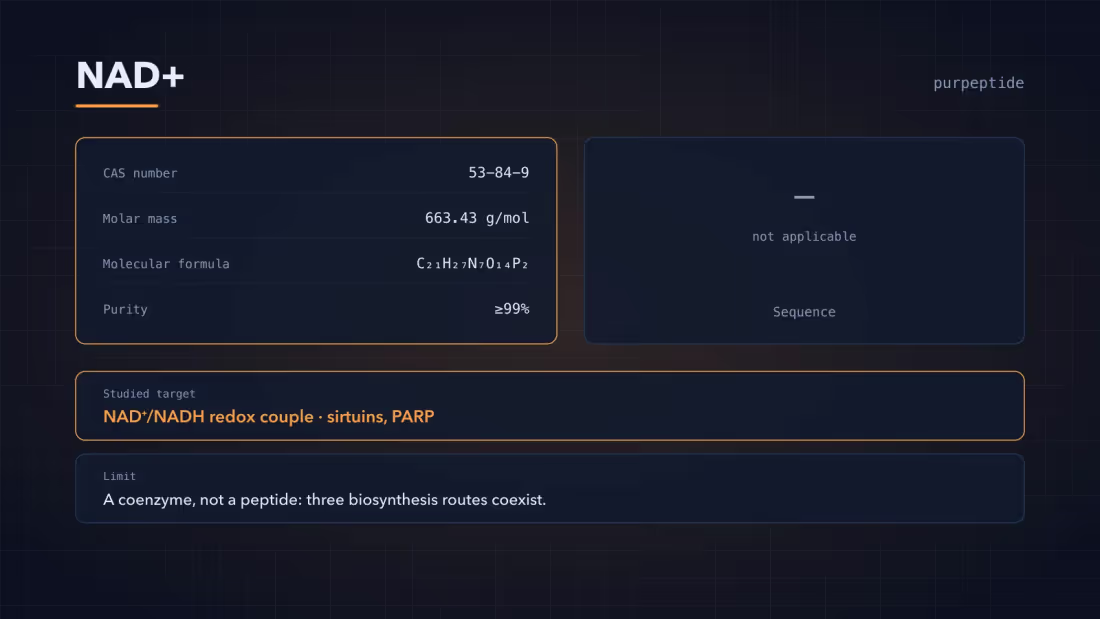
Molecular identity
| Parameter | Value |
|---|---|
| CAS number | 53-84-9 |
| Molar mass | 663.43 g/mol |
| Molecular formula | C₂₁H₂₇N₇O₁₄P₂ |
| Purity | ≥99% |
| Appearance | White lyophilised powder |
The values above correspond to the catalogue lot and are reproduced as they stand from the product page. Any discrepancy between this dossier and the product page should be reported before use.
Research context
NAD+ is a long-standing object of study that has recently become very active, because of the recognition of its role as a consumed substrate and not only as a recycled cofactor. That dual nature makes it a point of convergence between energy metabolism and epigenetic regulation, and explains the current volume of publication.
Mechanism studied
NAD+ (nicotinamide adenine dinucleotide) is not a peptide but a dinucleotide, and it holds a well characterised dual function in cellular metabolism.
The first is catalytic and reversible: the NAD+/NADH redox couple, an electron acceptor in glycolysis, the Krebs cycle and beta-oxidation. In that role the molecule is recycled, not consumed.
The second function consumes it. The sirtuins (NAD+-dependent deacetylases), the PARPs (poly-ADP-ribose polymerases) and the ADP-ribosyl cyclases use NAD+ as a substrate and cleave it, releasing nicotinamide. That consumption links cellular redox status directly to signalling activity, and it is this relationship that the in-vitro literature examines most frequently.
The analytical methods used rest on cyclic enzymatic assays, liquid chromatography coupled to mass spectrometry for nucleotide quantification, and genetically encoded sensors allowing the NAD+/NADH ratio to be followed in living cells.
In-vitro literature
The published work concerns compartmentalised NAD+/NADH ratios — cytosolic, mitochondrial, nuclear — whose separate measurement is a recognised methodological difficulty.
Bibliographic entry points
- PubMed — peer-reviewed literature
- PubChem — chemical profile and assay data
- NCBI — methodology and receptor references
These links are an entry point into the literature, not an edited selection. None of the sources cited relates to a human use of this material, and consulting them directly is recommended for any protocol design.
Distinguishing this compound from its analogues
To be distinguished from its precursors (nicotinamide, nicotinamide riboside, NMN), whose entry routes and kinetics differ appreciably.
The CAS number shown on the product page is the identifier to rely on. Trade names, development codes and customary abbreviations vary from one source to another and are not a reliable identification.
Routes used in the literature
Published work on NAD+ and its precursors uses various routes: oral administration of precursors (nicotinamide riboside, nicotinamide mononucleotide) in model studies, and parenteral administration — by injection or infusion — of the dinucleotide itself in other experimental protocols. Queries such as “NAD+ injection” refer to this second category.
These protocols describe published experimental conditions. The material offered here is an analytical standard intended exclusively for in-vitro research: no route of administration is proposed or described for it.
The cellular pool and its turnover
Understanding NAD+ means separating two registers that everyday vocabulary runs together.
As a redox cofactor, NAD+ is not consumed: it alternates between oxidised (NAD+) and reduced (NADH) forms through successive reactions, and the couple regenerates indefinitely. What matters then is the NAD+/NADH ratio, not the absolute quantity.
As a substrate, by contrast, it is destroyed. Several enzyme families cleave the glycosidic bond and release nicotinamide, consuming the molecule permanently. It is this second function that requires the pool to be renewed continuously.
Three biosynthesis routes coexist:
The salvage pathway recycles the nicotinamide released by the consuming enzymes. NAMPT catalyses the rate-limiting step. It is by far the dominant route in mammals.
The Preiss-Handler pathway starts from nicotinic acid.
The de novo pathway starts from tryptophan, by way of the kynurenine route. It is quantitatively the minor one.
The consuming enzymes
Three families consume NAD+, and their demands compete for the same pool.
| Family | Reaction | Context studied |
|---|---|---|
| Sirtuins (SIRT1-7) | NAD+-dependent deacetylation | Transcriptional regulation, mitochondrial metabolism |
| PARP (PARP1/2) | Poly-ADP-ribosylation | DNA damage response |
| CD38 / CD157 | ADP-ribosyl cyclase | Calcium signalling, immune cells |
This competition is the central conceptual point of the literature. Sustained PARP activation — under genotoxic stress — consumes NAD+ and correspondingly reduces the cofactor’s availability to the sirtuins. CD38 activity, which rises in several models of ageing, is described as a further depleting factor.
In other words, the sirtuins are not simply “activated” or “inhibited”: their activity depends on a pool shared with enzymes whose demand varies. It is regulation by substrate availability, and it is difficult to isolate experimentally.
NAD+ and its precursors
One frequent confusion deserves to be cleared up, because it concerns distinct molecules often treated as interchangeable.
| Compound | Molar mass | Nature |
|---|---|---|
| NAD+ | 663.43 g/mol | The dinucleotide itself |
| NMN (nicotinamide mononucleotide) | 334.22 g/mol | Immediate precursor, a nucleotide |
| NR (nicotinamide riboside) | 255.25 g/mol | Precursor, a nucleoside |
| Nicotinamide | 122.12 g/mol | Vitamin form, product of the consuming enzymes |
These four molecules occupy different positions on the same pathway and have very different molecular masses — which makes them trivially distinguishable by mass spectrometry, and makes it all the less excusable for a lot to be labelled as one and contain another.
Which of them most effectively raises the cellular pool is an active research question, and the results vary with the model, the tissue and the assay method used. No general answer emerges from the literature.
Analytical considerations specific to NAD+
NAD+ poses handling difficulties that peptides do not, and they bear directly on what a lot report means.
It is hygroscopic. The powder takes up ambient moisture. A vial opened cold condenses water on its surface, which distorts any subsequent weighing and starts hydrolysis. Hence the rule of letting the vial return to room temperature before opening it.
It is unstable in solution. Hydrolysis of the glycosidic bond releases nicotinamide. That degradation is accelerated in alkaline media and by temperature, which makes solutions markedly less stable than the lyophilisate.
It is light-sensitive. As are most nicotinamide-based dinucleotides.
The NAD+/NADH ratio is fragile. The reduced form oxidises in air. An assay claiming to measure that ratio must control oxygen exposure; most lot analyses do not measure the ratio but the identity and purity of NAD+ itself.
These properties explain why the lot date and the storage conditions matter more here than for an ordinary lyophilised peptide.
Methodological limits
NAD+ is strongly compartmentalised — cytosol, mitochondrion, nucleus — and assays on whole lysate mask those differences. A variation measured on a complete extract says nothing about which compartment is involved. The molecule is also unstable in aqueous solution, which requires fresh preparation for any reliable quantification.
These limits are not formalities: they determine what a protocol using this material can and cannot establish. Making them explicit in the experimental plan avoids attributing to the compound an observation that belongs to the measurement system.
Analytical parameters
A compound sensitive to hydrolysis in aqueous solution and to light. Storage in lyophilised form and away from light governs the integrity of the material.
| Parameter | Value |
|---|---|
| Storage | Store at −20 °C, protected from light |
| Solubility | Soluble in bacteriostatic water (BAC) |
| Stability | Stable for 24 months at −20 °C; 30 days after reconstitution at 2–8 °C |
| Control methods | RP-HPLC · MS · NMR |
Reconstitution is a matter for the experimental protocol. The volume of solvent determines the final concentration and is not prescribed here: it depends on the design of the experiment and the conditions of the assay.
Resulting concentrations
The table below is arithmetic: it gives the concentration obtained for a given solvent volume, with no recommendation of use.
| Format | 1 ml | 2 ml | 3 ml |
|---|---|---|---|
| 500mg | 500.00 mg/ml | 250.00 mg/ml | 166.67 mg/ml |
| 1000mg | 1000.00 mg/ml | 500.00 mg/ml | 333.33 mg/ml |
These values assume complete dissolution and a peptide content consistent with the lot report. Where the actual quantitative content differs from the nominal mass — a common discrepancy, caused by counter-ions and residual water — the effective concentration is lower than the theoretical value. That is precisely why quantitative content per vial forms part of the verification protocol.
Protocol design
Three points govern the validity of an assay using this material, whatever the question being asked.
The effective concentration is not the nominal concentration. It depends on the actual peptide content of the lot, on complete dissolution and on adsorption to the walls of the container. A concentration check after reconstitution is preferable to assuming a perfect yield.
The actual exposure time may be shorter than the nominal duration where the compound is degraded by the medium. Verify stability under the exact conditions of the assay — medium, serum, temperature, duration — before interpreting an absence of effect.
The control arm must correspond to the vehicle actually used, at the same final concentration. This requirement is unremarkable and remains the most frequent cause of irreproducible results.
Lot verification
The following formats are covered by a Janoshik Analytical report, readable from the product page:
- 500mg — lot report available
- 1000mg — lot report available
| Format | Lot report | Availability |
|---|---|---|
| 500mg | Covered | In stock |
| 1000mg | Covered | In stock |
The verification programme covers exclusively the identity and purity of the material, by reversed-phase chromatography and mass spectrometry. It covers neither sterility, nor endotoxins, nor any microbiological characteristic.
Frequently asked questions
How does this product arrive?
As a lyophilised powder in a sealed vial, shipped in insulated, plain packaging. Return the vial to the storage temperature given in the specifications on receipt.
Which solvent should be used for reconstitution?
Bacteriostatic water is the usual reconstitution solvent for lyophilised peptides in a laboratory setting. The volume is a matter for the experimental protocol and the concentration sought; we provide no dosage recommendation.
How long does the material remain stable?
The stability window appears in the specifications table on this page, before and after reconstitution. Those values correspond to the storage conditions stated; any temperature variation shortens them.
Does the analysis report correspond exactly to my vial?
The report linked on this page corresponds to the format selected. Each report is issued by Janoshik Analytical from an anonymously submitted sample, and covers the identity and purity of the peptide.
Can this product be used on humans or animals?
No. It is an analytical grade reference material intended exclusively for in-vitro laboratory research. Any administration to humans or animals is excluded, and no therapeutic, diagnostic or medical claim is made.
Dossiers in the same category
- Epitalon — CAS 307297-39-8
- MOTS-c — CAS 1627580-64-6
- Pinealon — CAS 175175-23-2
- SS-31 (Elamipretide) — CAS 736992-21-5