Research dossier
Methylene blue — mitochondrial redox cycling dossier
A historic dye whose redox reactivity makes it a mitochondrial research tool.
Translated from the French original, which remains the reference version: lire en français →
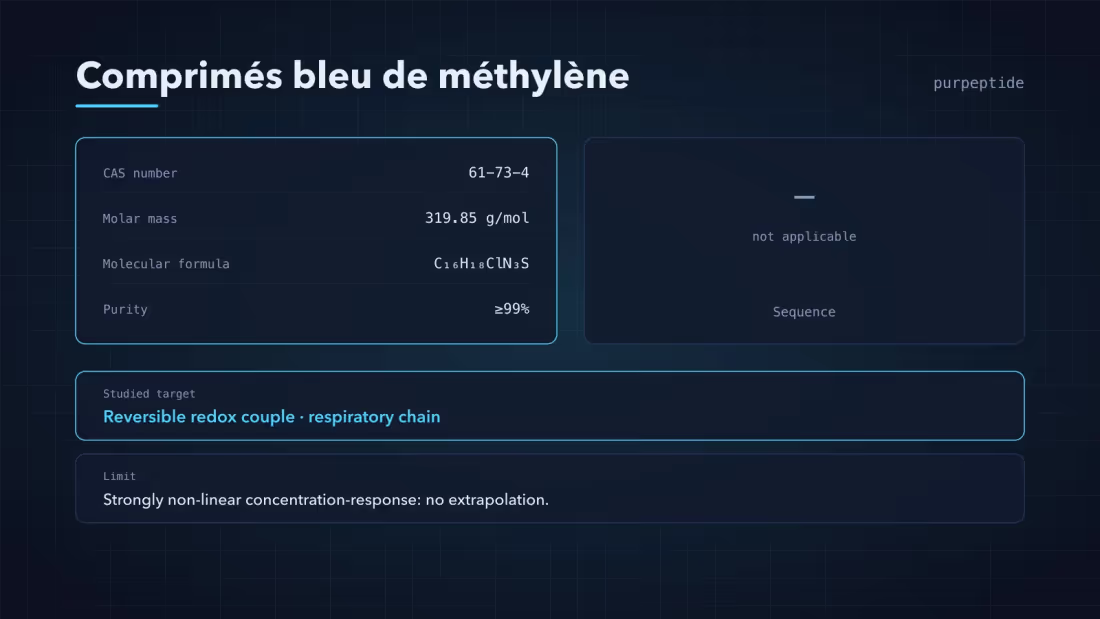
Molecular identity
| Parameter | Value |
|---|---|
| CAS number | 61-73-4 |
| Molar mass | 319.85 g/mol |
| Molecular formula | C₁₆H₁₈ClN₃S |
| Purity | ≥99% |
| Appearance | Blue 20 mg tablet |
The values above correspond to the catalogue lot and are reproduced as they stand from the product page. Any discrepancy between this dossier and the product page should be reported before use.
Research context
A historic dye that became a mitochondrial research tool, this compound illustrates how a simple physico-chemical property — a redox potential sitting in a useful range — can ground a durable experimental use. Its non-linear concentration-response also makes it a textbook case in the hazards of extrapolation.
Mechanism studied
Methylene blue is a dye of the phenothiazine family, not a peptide. Its decisive property is electrochemical: it forms a reversible redox couple whose potential sits in a range that lets it exchange electrons with several components of the mitochondrial respiratory chain.
The literature describes an electron “bypass” behaviour: the oxidised form can accept electrons upstream of the chain and release them downstream, partially short-circuiting certain complexes. This property is studied on isolated mitochondrial preparations by respirometry, and on cells in culture by measuring the oxygen consumption rate.
A second documented aspect is inhibition of monoamine oxidase A, measured by enzyme assays. This activity is methodologically notable because it introduces a confounding variable into any experiment involving monoamine metabolism.
The redox reactivity also calls for analytical vigilance: the effective concentration in solution depends on the oxidation state, which is itself sensitive to light and dissolved oxygen.
In-vitro literature
The reference measurements are respirometric. The dependence of the observed effects on concentration is strongly non-linear in this case, with opposite behaviours reported depending on the range used — a major methodological point.
Bibliographic entry points
- PubMed — peer-reviewed literature
- PubChem — chemical profile and assay data
- NCBI — methodology and receptor references
These links are an entry point into the literature, not an edited selection. None of the sources cited relates to a human use of this material, and consulting them directly is recommended for any protocol design.
Distinguishing this compound from its analogues
Material quality matters particularly for this compound: industrial dye grades contain metallic impurities absent from analytical grades.
The CAS number shown on the product page is the identifier to rely on. Trade names, development codes and customary abbreviations vary from one source to another and are not a reliable identification.
Methodological limits
The concentration-response relationship is strongly non-linear, with opposite behaviours reported depending on the range used: a result obtained at one concentration does not extrapolate. Inhibition of monoamine oxidase A also introduces a confounding variable into any experiment touching monoamine metabolism. Photosensitivity requires constant protection from light.
These limits are not formalities: they determine what a protocol using this material can and cannot establish. Making them explicit in the experimental plan avoids attributing to the compound an observation that belongs to the measurement system.
Analytical parameters
A coloured, photosensitive compound, subject to redox cycling in solution. Store protected from light and prepare working solutions fresh.
| Parameter | Value |
|---|---|
| Storage | Store at −20 °C, protected from light |
| Solubility | Oral format — no reconstitution required |
| Stability | Stable for 24 months at −20 °C; 30 days after reconstitution at 2–8 °C |
| Control methods | RP-HPLC · MS · NMR |
Reconstitution is a matter for the experimental protocol. The volume of solvent determines the final concentration and is not prescribed here: it depends on the design of the experiment and the conditions of the assay.
Resulting concentrations
The table below is arithmetic: it gives the concentration obtained for a given solvent volume, with no recommendation of use.
| Format | 1 ml | 2 ml | 3 ml |
|---|---|---|---|
| 20mg × 100 tabs | 20.00 mg/ml | 10.00 mg/ml | 6.67 mg/ml |
These values assume complete dissolution and a peptide content consistent with the lot report. Where the actual quantitative content differs from the nominal mass — a common discrepancy, caused by counter-ions and residual water — the effective concentration is lower than the theoretical value. That is precisely why quantitative content per vial forms part of the verification protocol.
Protocol design
Three points govern the validity of an assay using this material, whatever the question being asked.
The effective concentration is not the nominal concentration. It depends on the actual peptide content of the lot, on complete dissolution and on adsorption to the walls of the container. A concentration check after reconstitution is preferable to assuming a perfect yield.
The actual exposure time may be shorter than the nominal duration where the compound is degraded by the medium. Verify stability under the exact conditions of the assay — medium, serum, temperature, duration — before interpreting an absence of effect.
The control arm must correspond to the vehicle actually used, at the same final concentration. This requirement is unremarkable and remains the most frequent cause of irreproducible results.
Lot verification
The following formats are covered by a Janoshik Analytical report, readable from the product page:
- 20mg × 100 tabs — lot report available
| Format | Lot report | Availability |
|---|---|---|
| 20mg × 100 tabs | Covered | In stock |
The verification programme covers exclusively the identity and purity of the material, by reversed-phase chromatography and mass spectrometry. It covers neither sterility, nor endotoxins, nor any microbiological characteristic.
Frequently asked questions
Does this format require reconstitution?
No. This format is supplied ready to use for laboratory protocols and requires no solvent.
Comment conserver ce produit ?
Under the conditions given in the specifications table on this page, protected from light and moisture.
Is an analysis report available?
Where a Janoshik report exists for the lot concerned, it is linked directly on this page. In its absence, no analytical characteristic is claimed.
Can this product be ingested?
No. This is an analytical-grade reference material intended exclusively for in-vitro laboratory research. No human or animal administration is permitted, in any dosage form.